


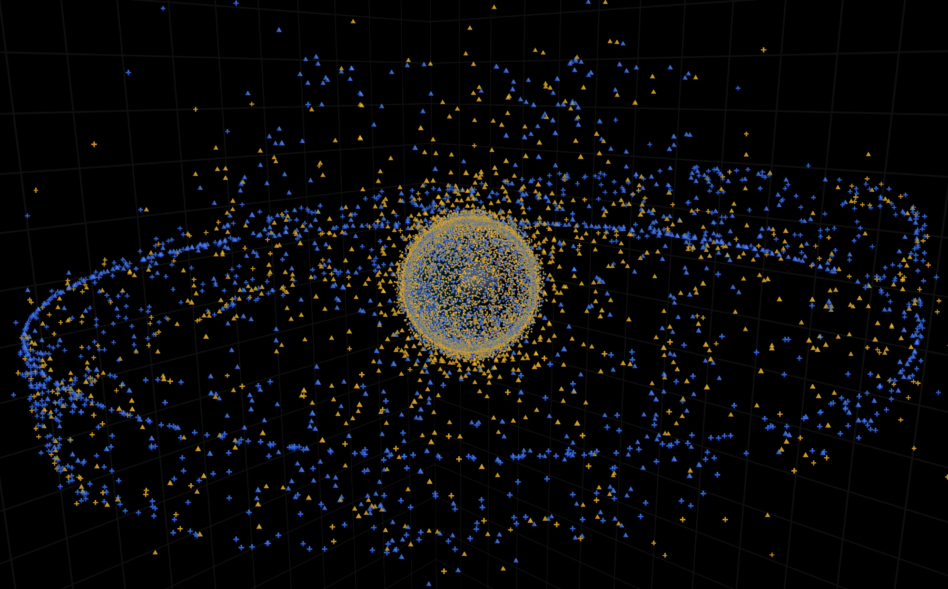
Business and liberal arts majors rejoice! Kayhan Space, a startup behind the Satcat orbital data aggregation tool, just launched a new digital product focused on making it easier for the not-engineering-trained to understand what’s happening on orbit.
Satcat Terminal—a reference to the Bloomberg Terminal for financial data—presents all of the data that Kayhan gathers on 36,000+ orbital objects in a way that’s intended for market movers.
“Satcat started with the mind of connecting different data sources together, and that was very satellite centric,” Kayhan Chief Product Officer Hyun Seo told Payload. “As we aggregated more data together we found out, if we add a little bit more curation and perspective…[we can] extend that to the actual personas of insurance, finance, or anyone that’s not a space operator.”
The rub: While the terminal is built on the same catalogue of information housed in Satcat, its user interface is immediately familiar to the shortcut-minded.
The terminal presents a large language model that can parse through the orbital trajectory data to surface insights and answer questions such as “What are the top 10 companies with satellite losses this year?” or “How many conjunctions do a company’s satellites experience per month?”
Much like a Bloomberg Terminal, the Satcat version can also display out-of-the-box and custom dashboards to keep users abreast of up-to-date information. It can display a wide range of information including:
- Continuously updated orbital trajectory data on 17,000+ payloads, 15,000 high risk debris objects, and 600 unidentified objects;
- Space weather information;
- Real-time data on “close approach” events;
- Information on satellite coverage over various parts of the planet—at any point in time;
- Fleet-wide monitoring for groups of satellites.
Like and subscribe: For analysts, insurers, or journalists covering the space industry, the terminal opens the door to information that has historically been hard to parse for those without a technical background.
“If you give enough expertise to certain analysts, they can do a lot. They can extract a lot of intelligence out of that, and this platform kind of allows that,” Kayhan CTO Araz Feyzi told Payload.
While the use cases are abundant, covering everyone from space enthusiasts to financial analysts, Kayhan envisions a few early adoptors for whom the product was built.
- Financial analysts and traders will be given new insight into the operations of the space companies they’re following, and able to view details about a constellation and risks associated with orbital congestion alongside stock and company information.
- Insurers will be given tools to quickly analyze risks associated with a mission before it launches, and the ability to perform post-mortem analysis on a mission before issuing a claim.
Journalists will be able to do all of the above and more, but maybe stay tuned to see what we come up with.
Exclusive: EraDrive Lands $13M DoD Award For Autonomy Module
EraDrive won a $13M DoD award, under which the Space Force will buy an undisclosed number of the company’s Era-Node vision-based autonomy modules.
WarpWare Closes Pre-Seed to Bring Agentic Tools to Flight Software
CO-based WarpWare closed its $1.2M pre-seed round today to expand what it calls an AI-enabled engineering platform for space missions.

RATLOG Wants to Cut ~90% of a Rocket Engine’s Parts
The heavy-lift rocket startup debuted on Y Combinator as part of the Fall 2026 batch.

Seraphim Space Investment Trust Doubled its Value in 2026
Seraphim’s major holdings—ICEYE, ALL.SPACE, D-Orbit, HawkEye 360, and Xona Space Systems, which together represent more than 75% of the firm’s portfolio—all had a great year, and that success has trickled upwards.

Austria may be best known for its history, as the home of Mozart, Strauss, and the Habsburg dynasty, but the country’s space industry is in the midst of a renaissance of its own.
Like many of its neighbors, Austria has spent recent months signaling its increasing commitment to achieving bold national space ambitions.
Beyond these large institutional announcements, however, Austria has spent recent years fostering its space startup landscape. In 2024, ESA opened a Phi-Lab in Vienna, which is a space hub aiming to commercialize startups. The lab has already churned out some promising leads, including:
Keep reading