


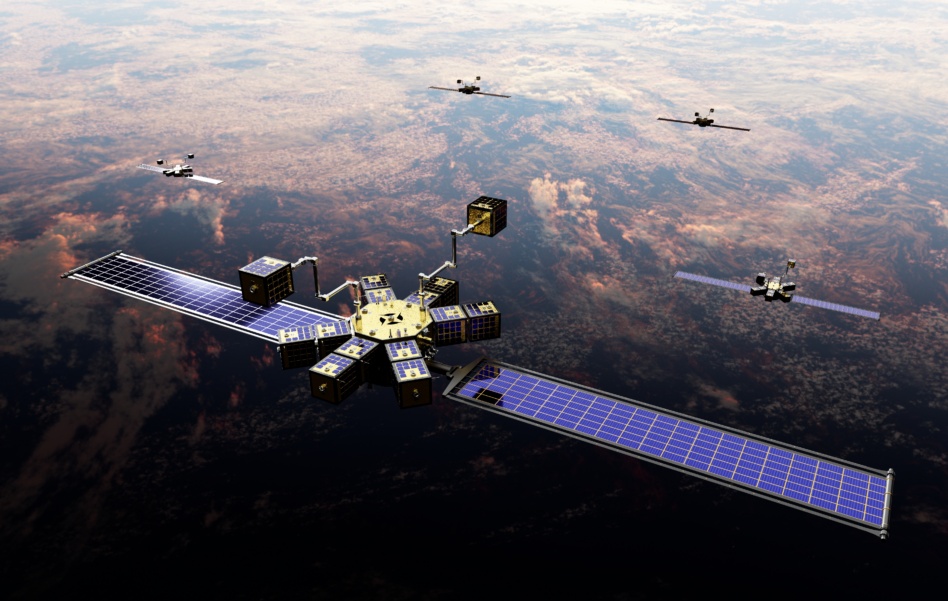
Symphony Space is building a new model for hosting payloads—one where the satellite remains in orbit and the payloads come and go.
The platform—called Adagio—aims to be a lower-cost, higher-capacity hosted payload provider. It’s a big departure from traditional business models, where payloads took a one-way, permanent ride to space aboard their host sats.
“Infrastructure in space…needs to be much more accessible,” CEO Merry Walker told Payload. “We need to have not just more of it. We have to make it more cost-effective, and we have to be able to run the missions at a much higher cadence than what’s being done. We can’t have 18 to 26 month lead times.”
Doing that, however, takes money. Symphony said it’s aiming to raise $6M+ to fund its first ground demonstration next year—though it’s also considering a larger round due to increased interest that would fund itself through its first demo flight in 2028.
How it works: At first, Adagio works like any other hosted payload satellite. The platform launches to space, preloaded with modules housing customer payloads. Throughout its lifetime, however, Adagio is designed to accept new occupants, who reach the sat via orbital transfer vehicles, space tugs, and rideshare launches. Adagio will be equipped with robotic arms that can grapple the new payloads and make them right at home.
The idea is to provide a pay-as-you-go style offering to payload operators, who may be unwilling or unable to pay for a multi-year spot on a traditional hosted payload platform. On Adagio, they can fly their payload in orbit for a few months, to perform a tech demonstration, or to gain flight heritage—then end the mission.
Adagio is targeting around $10,000 per kg, Walker said—a steal compared to traditional hosted payload prices, which can run two to five times higher.
Go big or go home: Adagio’s low price point comes, in part, because of its massive payload capacity. The satellite platform is being designed to host 1,200 kg of payload at a time for missions ranging from national security payloads, in-space science experiments, technical demonstrations, in-orbit compute platforms and manufacturing payloads, according to Walker.
Regardless of application, every hosted payload module will have a view of the Earth to allow for communications and EO payload applications. Future iterations of the platform, Walker said, might even include specific platforms tailored to each type of hosted payload.
“We are looking at creating a network of different platforms in different orbits,” Walker said. “We might see platforms dedicated completely to compute. We might have a platform dedicated like a habitat, completely for biological and biotech experiments. We might do an entire platform for in-orbit manufacturing.”
Walker also said the company envisions flying platforms at varying altitudes, opening the door for hosted payloads as high as cislunar space to help companies test deep-space or lunar tech.
What’s next: Symphony Space was founded in 2025, and is focused on ramping up quickly. The company has multiple milestones in its sights, including:
- Preliminary design review of Adagio this summer;
- Ground demonstrations, beginning in 2027;
- In-orbit demonstration mission to gain flight heritage, in 2028;
- First full-scale launch of Adagio in 2029.
Contrivian Launches New Product Bundling Amazon Leo & Starlink
Customers looking for satellite connectivity are often forced to choose between one provider or another. Those days are over.

Kayhan Space Launches Satcat Terminal
Business and liberal arts majors rejoice!

Inside Austria’s Small But Mighty Space Ecosystem
Austria’s space industry is in the midst of a renaissance, with bigger funding deals and more startup activity.

Advanced Navigation Raises $110M Series C
Not many space companies want to reduce the world’s reliance on satellite infrastructure, but that’s the pitch that landed Australia-based Advanced Navigation a $110M Series C.

There’s another entry in the space-data-center race.
Ramon.Space plans to fly an orbital-data-center prototype next year, developed in collaboration with Ingrasys, a large cloud infrastructure provider.
If all goes to plan, the companies aim to build scalable computing infrastructure for orbital satellite data processing by the end of the decade.
Keep reading