


The orbital data center hype is quickly turning into real orbital hardware.
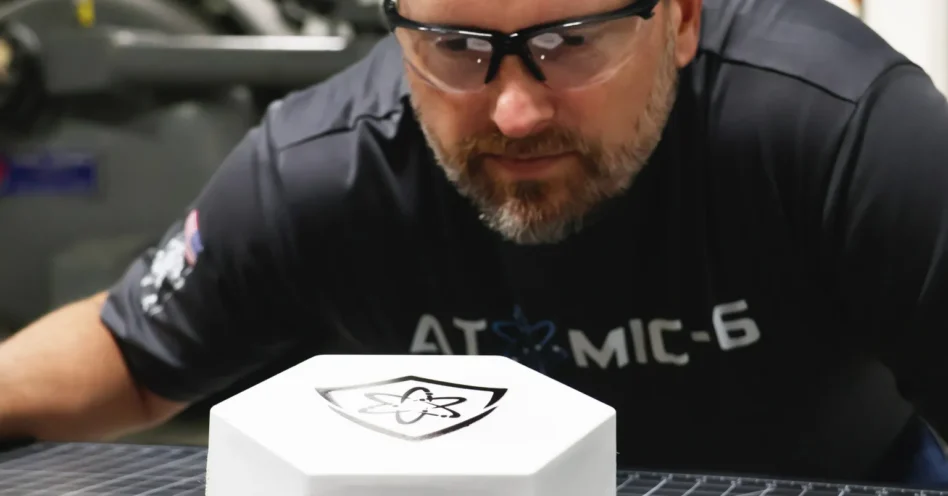
GA-based composite manufacturer Atomic-6 is fueling that acceleration with the launch of a new marketplace today—called ODC.Space—to make securing orbital compute as simple as “add to cart.”
Atomic-6 is positioning itself as a general contractor, bringing together suppliers across the space ecosystem to help customers build and operate data centers in orbit—without the hassle of manufacturing spacecraft of their own.
“This represents a maturation of the ODC market, where users are more interested in contracts than projections,” Atomic-6 CEO Trevor Smith told Payload. “We wanted to speed up the ease of a customer getting compute into space, and also bring the ecosystem together and partner different suppliers.”
What’s included: Atomic-6 isn’t building the spacecraft itself. The plan is to provide a meeting spot for orbital-compute customers—AI developers, software providers, and government agencies—to quickly identify the data-center architecture that fits their needs, and to buy spacecraft from relevant suppliers.
Atomic-6 plans to integrate its hardware into future models, including:
- Atomic-6’s “Light Wing” deployable solar array for power;
- The company’s “Hot Wing” deployable thermal radiators, announced today. These use the same deployable tech as Light Wing, but are designed to help keep orbital compute hardware cool.
Hardware purchased on ODC.Space is expected to be delivered to orbit two to three years after customers sign on, but once the production lines are built up, timelines could shrink to as little as four to six weeks, according to Smith.
Purchase options range from 1U shared data centers, to sovereign 42U models. Smith estimated that a 42U, 100 kW sovereign rack could cost ~$3.5M per month.
Location, location, location: Atomic-6 is betting on the idea that demand for orbital data centers will increase considerably over the coming decade.
Smith argued that price point and deployment timelines for orbital data centers are already competitive with terrestrial alternatives. As the production line ramps up—and launch becomes more accessible with decreasing costs—the economic viability of orbital compute will only grow, according to Smith.
“I think we’re going to get really surprised about where the first customers come from,” Smith said. “The [terrestrial] demand is far outweighing the capacity…Instead of waiting five years to turn on a terrestrial data center for a new chip, which has already lost money—opportunity costs, by the way, it’s $10B per gigawatt per year [in] lost revenue—you can get up in six weeks.”
Correction: A previous version of this article incorrectly stated the cost of a sovereign rack. It is $3.5M per month.

Kuva Space Spots Illegal Poppy Farms from Orbit
Kuva Space released data today from a pilot program that demonstrated its ability to monitor illegal crop farming from space.

Sophia Space, SLI Set Terms for $300M Satellite Leasing Deal
Orbital compute startup Sophia Space and space asset leasing company SLI have set terms for a $300M asset-financing deal.

International Space Summit Highlights the Strength of Europe’s Space Ecosystem
Efforts by the US government to rain on Europe’s parade this week backfired.
Tomorrow.io Unveils Next-Gen Weather Forecasting Instruments
Tomorrow.io announced the five instruments that will fly aboard DeepSky—its next-gen constellation built for real-time global atmospheric monitoring.

Hawkeye 360 has filed paperwork to go public on the NYSE, operating under the ticker symbol “HAWK.”
The space-based RF data and analytics firm is the latest in a string of defense-focused space companies seeking to go public, opening access to more capital as the industry grows. Firefly Aerospace began trading on Nasdaq in August, and York Space Systems went public with the NYSE in January. The kingpin is the expected IPO of SpaceX this summer.
TBD: The VA-based company did not release the number of shares that would be offered, or the price range for the shares.
Keep reading