


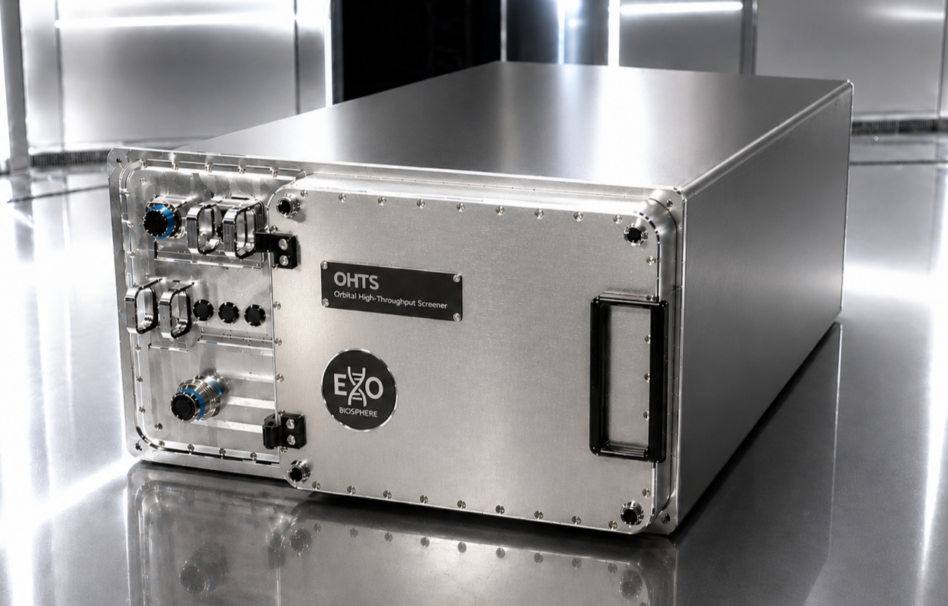
Exobiosphere signed a contract with Voyager Technologies to fly its automated, miniaturized lab to the ISS.
Under the partnership, announced today, Voyager Technologies Europe will be the mission integrator for the Luxembourg-based space biotech firm to conduct research aboard the orbiting habitat.
How it works: Exobiosphere has designed an Orbital High-Throughput Screening Device—an automated mini lab that fits into standard mid-deck lockers, aboard crewed or uncrewed space stations.
- The devices can autonomously keep organ cells alive, and deliver therapeutics.
- By taking astronauts out of the loop, the tech is intended to allow more experiments to head to orbit—and speed up how quickly results are delivered back to Earth.
“Six months in space is equivalent to a decade on Earth in disease progression,” Exobiosphere CEO Kyle Acierno told Payload. “That means space could be the best place to study how diseases progress, and if you’re studying a variety of therapeutics, you can find the results much faster.”
Early customers include hospitals and academic institutions, according to Acierno, but the company plans to expand to fly biotech firms “who want to accelerate or differentiate their research.”
“Ideally, we would be able to attract Big Pharma, and they have experimented already…but I still think there’s more work to show them the value,” he said.
Blast off: In addition to the deal with Voyager, Exobiosphere is integrated into Vast’s Haven-1 space station, which is set to fly next year.
Last week, Exobiosphere signed a contract with ESA to operate biotech experiments aboard Haven-1. Under that contract, the company will provide ESA an end-to-end mission, including selecting science experiments, preparing for the mission, overseeing the experiments in orbit, and returning data to Earth.
Far out: Exobiosphere also has ambitions beyond LEO, Acierno said, including studying what NASA’s plans for a permanent lunar base could mean for astronaut health.
“We’re developing a system to study disease progression on the Moon, because the longest a human has spent on the lunar surface is 72 hours,” he said. “This system would be able to help us understand how humans can survive in orbit, on the Moon, and eventually on Mars.”

Viasat and Space42 Commit Up to $1B to Equatys Joint Venture
Space42 and Viasat agreed to formally establish Equatys, a shared satellite-and-ground-infrastructure company for D2D connectivity and advanced mobile satellite services.

Kuva Space Spots Illegal Poppy Farms from Orbit
Kuva Space released data today from a pilot program that demonstrated its ability to monitor illegal crop farming from space.

Sophia Space, SLI Set Terms for $300M Satellite Leasing Deal
Orbital compute startup Sophia Space and space asset leasing company SLI have set terms for a $300M asset-financing deal.

International Space Summit Highlights the Strength of Europe’s Space Ecosystem
Efforts by the US government to rain on Europe’s parade this week backfired.

NASA’s new launch director pick—a former space agency chief of staff—quickly turned into the latest political divide plaguing the nation’s space program.
Return of the chief: Brian Hughes, who will serve as NASA’s first senior launch operations director, was the space agency’s chief of staff from May to December, departing the agency once Administrator Jared Isaacman took over.
More details: In his new role, Hughes will oversee launch operations in Florida and Virginia, at KSC and Wallops Flight Facility. His top job will be working with industry officials and local government leaders to support the increased launch cadence at the two spaceports, according to a NASA release.
Keep reading