


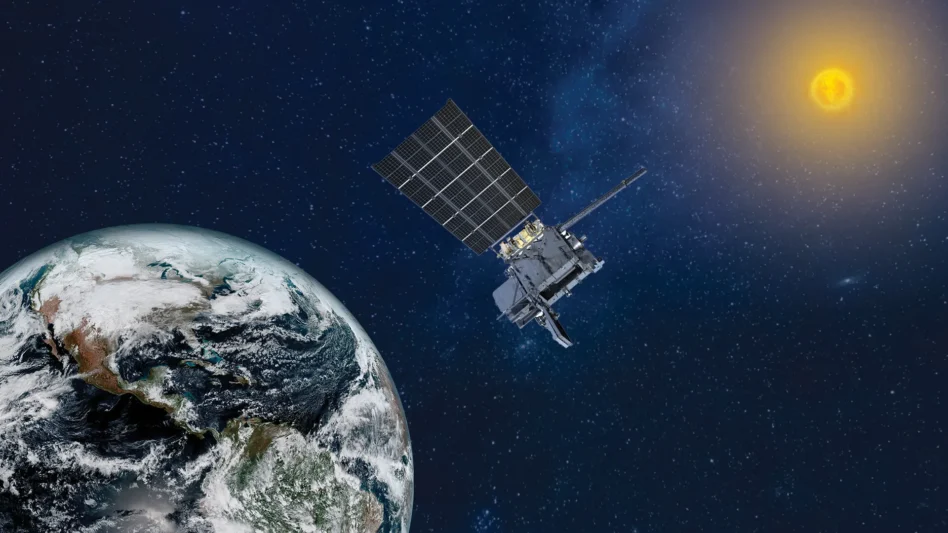
Next month, United States weather forecasting capabilities are set to hit a troubling milestone—the formal end of the DoD’s Defense Meteorological Satellite Program’s lifespan.
Those satellites have orbited hundreds of miles above the Earth for decades, collecting data on cloud patterns and other atmospheric parameters. When those sensors go silent this fall, the country will lose as much as half of the key scans used by weather forecasters.
So much of our lives and public safety depend on weather. Losing the ability to predict it could have profound effects on national defense, our economy, and hurricane preparation.
Blind spot: Weather has always been a determining factor in military operations, from the D-Day invasion to the raid that killed Osama bin Laden. Weather decides which aircraft can fly, which equipment a unit carries, and when an operation goes.
When we lose our visibility, we lose our edge. The military needs more, higher-quality weather data, not less.
It’s not just the Pentagon—other agencies are losing satellites that are critical to predicting weather.
- As we head into potentially the most severe El Niño on record, NOAA’s polar-orbiting instruments are aging out faster than they are being replaced.
- The agency has fewer weather satellites on-orbit this summer than it did just a few years ago.
Microwave sounding data—the core sensing modality feeding NOAA’s forecasting models—is what lets forecasters tell a coastal community whether to evacuate tonight or tomorrow. Degrade that data and you degrade every warning, every evacuation order, and every emergency-management and insurance decision that follows.
Cloudy outlook: As American weather forecasting capacity erodes, others are investing in it. China is aggressively deploying weather satellites in both GEO and LEO. Its Fengyun constellation continues to outpace US weather satellite deployments and is becoming the largest government weather satellite constellation in the world. Europe also continues to out-forecast us—the European Centre for Medium-Range Weather Forecasts remaining the global benchmark.
So how do we get the US back on track? The government cannot fix this alone, and certainly not in time. A government-owned, government-operated weather satellite takes the better part of a decade and billions of dollars to design, build, and launch. Neither storms nor global conflicts will wait.
Forecast fix: The answer must include the ingenuity and innovation of American companies. We’ve seen that nimble industries have stepped up where slow and cumbersome government processes are strained. The Trump administration’s December 2025 executive order explicitly mandates improving high-value Earth weather data, and doing so by integrating commercial capabilities.
Fortunately, the US commercial weather industry is investing hundreds of millions of dollars deploying constellations of weather satellites that are operational right now.
Washington says it understands this.
- NOAA, which historically hesitated to rely on commercial weather observations , has now publicly committed to a “hybrid” architecture that blends commercial data with its own systems.
- The Space Force, for the first time, has requested funding for environmental monitoring data as a service.
- Members of Congress on both sides of the aisle say they want to expand commercial data buys to improve forecasts.
The words are right, but the money is not yet there to back them. Commercial line items remain a rounding error next to legacy satellite budgets, and promising ideas that appear in one budget cycle vanish in the next. Lawmakers are rightly concerned about the role of government in these crucial functions. This is about strengthening US government agencies by providing them with far better and more adaptive future capabilities.
The government must retain its core mission of protecting American lives and property. Commercial providers are partners, not substitutes or replacements. The point is to let the public sector keep doing what only it can do, while tapping the innovation, scale, and speed that only private industry can now deliver, and to do it for less than the taxpayer is paying today for slower, aging systems.
Next steps: Time is literally running out. In this budget cycle, Congress must fund commercial weather data and services at a level that matches the hybrid strategy everyone claims to support, by fully funding NOAA’s commercial data purchase program and the Space Force’s environmental monitoring data-as-a-service line.
The weather capability gap opens this September. The commercial answer is already on-orbit. The only missing piece is the appropriation. Fund it now, before the next storm or military conflict makes the case for us.
Rei Goffer is a co-founder and the chief strategy officer of Tomorrow.io.
Kevin M. O’Connell is the founder and CEO of Space Economy Rising and the former director of the Office of Space Commerce (2018-2021).

Op-ed: Up to a Trillion Dollars is About to Chase Space. What Kind of Economy Will Be Built?
The largest IPO in history is here, and capital is expected to flow into the space industry at record volume. Whether that capital builds an economy that fully operates—or one that just accumulates hardware—is a choice we are about to make.

Opinion: Commercial Space Is Generating Signals Decision-Makers Cannot Hear
Launch cadences, debris accumulation rates, reusing hardware, conjunction events—the commercial sector is generating more operational signals than any previous era of space activity. However, the mechanism that decides whether a signal reaches a decision-maker or disappears into the background noise is broken.

Op-ed: Commercial Demand in LEO is Lacking. The Government Can Help.
LEO’s most promising market opportunity—in-space manufacturing—doesn’t yet have the commercial demand to sustain itself. Government support is what will get us there.

Op-ed: Mars Sample Return May Be Canceled, But the Legal Questions It Leaves Behind Continue
With Mars Sample Return canceled, the question is no longer how to bring samples home—but how far existing space law can stretch before its gaps become consequential.


Europe’s capital drought may be coming to an end.
Scaleup Europe, a new €5B fund created by the European Commission, announced this week that it completed its first investment—co-leading ICEYE’s €450M Series F, announced in June, which reached €1B+ in total investment after secondary placements.
The investment signifies a new era for Europe, one in which the region is better equipped with the capital necessary to fund its own growth-stage ventures.
Keep reading