

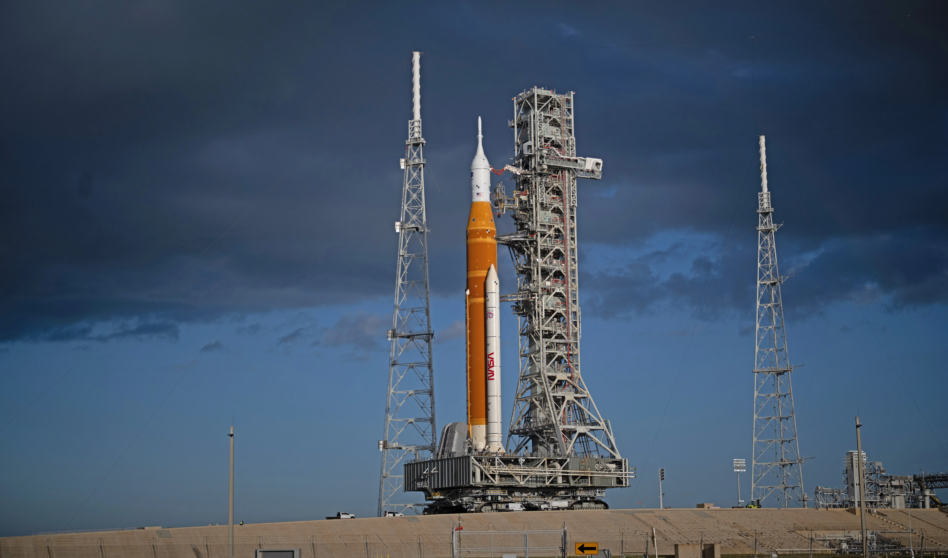
When Artemis II lifts off, the world will see a rocket. What it won’t see is the digital architecture that makes the mission possible.
“It [Artemis] may look similar up there on the pad, but it’s completely different from Apollo,” said Karen Fields, vice president and NASA account lead at Booz Allen.
“The vehicle is more capable. The communications architecture has been modernized. The ground systems are fundamentally different. Artemis represents a “massive leap forward in capability, and Booz Allen provides the solutions to bring these together with the flight system to make the missions work.”
From One-Off Missions to Scalable Systems
Apollo was designed to achieve a singular objective: land astronauts on the Moon and return them safely to Earth. It was episodic by design.
Artemis is something else entirely.
Beyond the rocket and spacecraft, Artemis missions rely on a global web of ground stations, communications networks, mission control systems, training environments, and engineering platforms.
“Thousands of people contribute to every Artemis mission launch, Fields said, including trajectory analysts, cybersecurity engineers, and systems engineers working in the Mission Engineering Room (MER). Booz Allen collaborates with NASA to develop and execute these missions every step of the way.”
And the complexity only increases with each mission. Artemis I validated the uncrewed vehicle. Artemis II adds humans. Artemis III plans to test new systems in low Earth Orbit, and Artemis IV plans to land humans on the Moon. Beyond that, it also gets more complicated with planned gateways, rovers, habitats, infrastructure, and longer-duration missions. Each addition introduces new data flows, new operational dependencies, and new integration challenges. “We’re moving from one-off missions to scalable infrastructure designed for repeated, sustained presence.” To enable these complex missions, Booz Allen brings the latest in digital engineering, cloud, and high-performance computing capabilities.
“You can have the largest rocket of all time or the most powerful lunar habitat ever imagined,” Fields said. “But key to the missions’ successes will be how we use this technology efficiently and securely with edge infrastructure.”
Designing for Disconnection
One of the most consequential architectural shifts in Artemis-era missions isn’t visible to the public at all. It’s autonomy.
In Low Earth Orbit (LEO), astronauts can rely heavily on Mission Control. As missions push beyond the Moon — and eventually toward Mars — that reliance begins to break down. Latency increases. Bandwidth becomes constrained. The ability to “phone home” for every contingency fades.
The further from Earth a spacecraft travels, the more disconnected it becomes. In that disconnected environment, spacecraft and crews must operate with greater onboard capability. That’s where edge computing comes in.
Rather than transmitting massive volumes of raw data back to Earth for processing, edge architectures enable processing at the point of capture — on board the spacecraft or within lunar systems themselves. The constraints are severe: limited power, limited cooling, limited mass.
This year Booz Allen showcased a human performance technology demonstration with Axiom Space and Oura. A private astronaut wore a biometric ring pre-, during, and post-mission to test data collection and distribution in orbit — a proof point for processing and managing data without constant ground dependence.
From this exercise, the requirements are clear. Missions must filter signal from noise locally, extract insights in real time, and enable decision-making without waiting for Earth.
Operational AI in Space
In 2024, Booz Allen partnered with Meta and HPE to deploy a generative AI model aboard the International Space Station National Lab — a demonstration known as Space Llama. The model enabled astronauts to query technical manuals and procedures without relying on continuous communication with Mission Control.
It was a practical test of something larger: how large language models and AI systems might function in orbit.
Future applications could extend far beyond document retrieval. Intelligent systems could assist with anomaly detection, mission replanning, and dynamic decision support.
Fields offers a hypothetical example: today, if an anomaly occurs mid-mission, a large Earth-based team would need to analyze the situation and replan. In a more autonomous architecture, AI-enabled systems could help replan in minutes, rather than hours — potentially avoiding an abort scenario.
That capability becomes mission-critical the farther from Earth crews travel.
Designing for Degradation
Booz Allen holds the largest cybersecurity contract at NASA and is among the largest providers of cybersecurity services to the federal government.
For space missions, that experience translates into an end-to-end security posture for the flight systems, the ground systems, and the space communications networks – what Fields describes as cybersecurity “woven cradle to grave” throughout the lifecycle of a mission, from build to launch to operations. This includes Booz Allen partnering with HPE to demonstrate defensive cybersecurity solutions on-orbit through the ISS National Labs.
Resilience, in this context, doesn’t mean preventing every compromise. It means designing systems that can continue operating even in degraded conditions using a zero-trust architecture.
“If a network is compromised, you can’t just shut it down if your mission depends on that network,” Fields said.
In other words: cybersecurity engineering is not just about defense, but also resilience through redundancy.
The Artemis Era
During the Apollo missions, Booz Allen provided mission trajectory analysis. Today, it contributes integrated trajectories for Artemis missions — a throughline connecting the earliest lunar efforts to today’s ambitions.
In the mainstream, Artemis II will validate modern spacecraft and crews. Less visibly to the public, it will validate something larger: a cyber-secure, AI-enabled, edge-capable architecture designed for sustained presence beyond Earth.
The rocket will capture our attention.
The resilient and secure digital architecture will determine how far we go.
Viasat’s HaloNet: The Innovation of Reprogrammable Space Crypto
Spacecraft today operate in an environment defined by two accelerating forces: the explosive growth of satellites in orbit, and the rapid evolution of cyber threats targeting them. As missions become more autonomous, networked, and interdependent, the need for strong, adaptable security has moved from a supporting feature to an operational requirement.
Demonstrators Are No Longer Optional — They’re How Programs Stay on Track
For decades, aerospace and defense programs followed a familiar pattern: define requirements, finalize designs, then validate at the end of the process. That model assumed time was available to manage surprises.
Viasat’s HaloNet: Building the Bridge to a More Connected Orbit
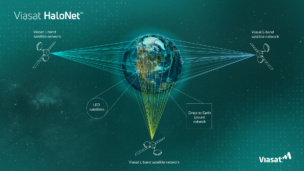
In today’s rapidly proliferating orbital environment, spacecraft are only as capable as their ability to stay connected. Traditional communications architectures—built around scheduled ground passes and line-of-sight links—can’t keep pace with the speed and complexity of modern missions.Viasat’s HaloNet hybrid terminal aims to change that by unifying multiple communications pathways into one adaptive system, designed to keep satellites in constant contact—from launch, through orbit.
Viasat’s HaloNet: Eliminating Launch Telemetry Blackouts
For decades, space launch providers have faced the same persistent challenge: intermittent loss of telemetry data when rockets travel out of range of ground stations. These “blackouts” can last for minutes—leaving long and critical periods when vehicle health, performance, and safety information go dark. Viasat’s HaloNet Launch Telemetry Data Relay Service (DRS)aims to change that, by providing continuous, global coverage from ascent through early orbit.

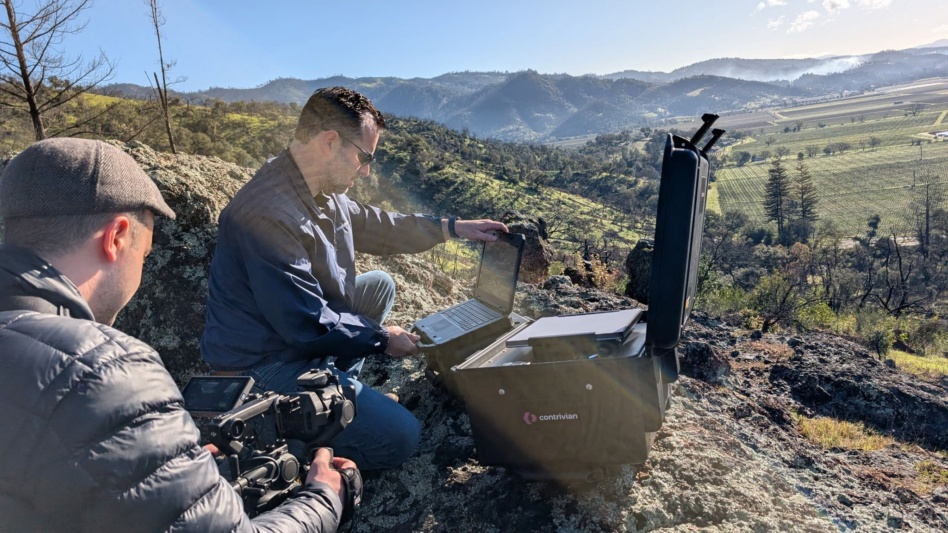
Customers looking for satellite connectivity are often forced to choose between one provider or another. Those days are over.
CA-based managed connectivity provider Contrivian announced a new product today—Contrivian Constellation—which combines Amazon Leo and Starlink connectivity into one solution, offering customers both services under a single data plan, contract, and IP address.
How it works: While most multi-network systems operate on a primary/secondary structure, which can sometimes take seconds to switch connectivity providers when there’s an outage, Contrivian Constellation’s approach is designed to ensure outages are avoided altogether.
Keep reading