

Orbital traffic is increasing at a rapid clip, and many sats aren’t even looking where they’re going.
EraDrive wants to give sight to the next generation of satellites. Today, the CA-based startup announced a $5.3M seed round to scale the production of its self-driving modules that allow satellites to maneuver autonomously using observational data.
Haystack Ventures led the round, with additional participation from Point Nine, Harpoon Ventures, Brave Capital, 2100 VC, and Entropy Industrial Capital.
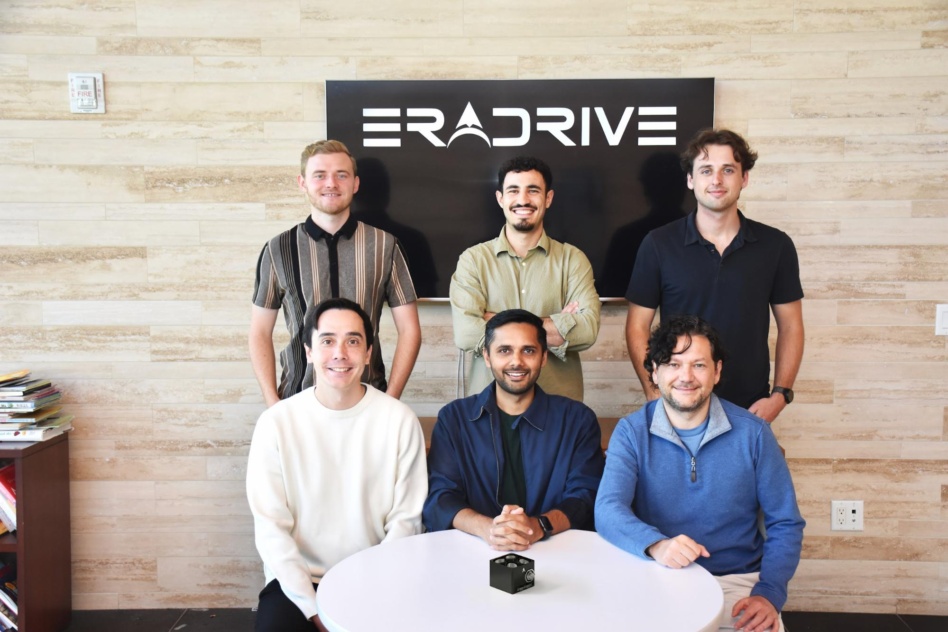
Meet the Eras: EraDrive was founded this year by three vets of Stanford University’s Space Rendezvous Laboratory (SLAB), and took off faster than a green light. This summer, the company won a $1M single source contract from NASA to develop software to help the agency’s Starling spacecraft detect and track other satellites and debris in orbit using onboard star trackers.
EraDrive is now developing a 1U payload—armed with optical sensors, AI and machine learning tech, and comms capabilities—that promises to give satellites the power to keep an eye on their surroundings and conduct maneuvers for collision avoidance or RPO with little-to-no input from operators on the ground.
“What we plan to achieve with EraDrive is to deploy hundreds to thousands of these autonomy modules onto as many satellites as possible, and these satellites can then do decision making at the edge,” EraDrive CEO Sumant Sharma told Payload.
While much of the technology EraDrive is using has already been flight proven through past work at SLAB and NASA’s Starling mission, the company will use the new funds to expand its capabilities and shift the tech from relying on flight proven COTS parts to in-house designed alternatives.
The company plans to more than double its headcount in the next two years—from six employees to as many as 15—and is looking to hire hardware and software engineers to ensure they can get the best possible images of objects on orbit, and perform autonomous operations in any orbital trajectory.
The end game: EraDrive’s long-term vision is much grander than simply selling payloads to satellite operators. The real value of the tech, according to Sharma, lies in the big data applications once enough modules have been launched.
“We look at what Waymo and Google Maps is doing for driving on the streets,” Sharma said. “[They’re] feeding a network of sensors, which is then utilized to provide intelligence information to everybody else who might be driving around.”
The idea for EraDrive is the same: if enough satellites on orbit have their eyes open, can communicate with one another, and maneuver autonomously, then the risk of collisions decreases considerably.
Phantom Space Acquires Thermal Management Technologies
Thermal Management Technologies builds advanced satellite thermal components for in-space applications.
Exclusive: In-Orbit Manufacturing Startup Dispatch Emerges from Stealth
Dispatch emerged from stealth this week with $500,000 in funding to build an uncrewed space station that will host manufacturing infrastructure on orbit
Antaris Raises $28M Series A
WestWave Capital led the round, which also included participation from Lockheed Martin Ventures and other new investors.
Voyager and Icarus Team Up on ISS Robotics Demo
The pages of the ISS manifest are starting to look a lot like those of a sci-fi novel.


In 2025, Golden Dome captured the attention of the space industry. It drove hundreds of millions in venture funding, sparked the creation of new hardware (or at least new marketing specifically targeting the program), and secured $25B from Congress.
A year ago, it didn’t exist.
How we got here: Golden Dome entered our collective consciousness on Jan. 27, when President Donald Trump signed an executive order calling for “the Iron Dome for America.” While the program was later renamed, the broad outline has remained the same, including:
Keep reading