


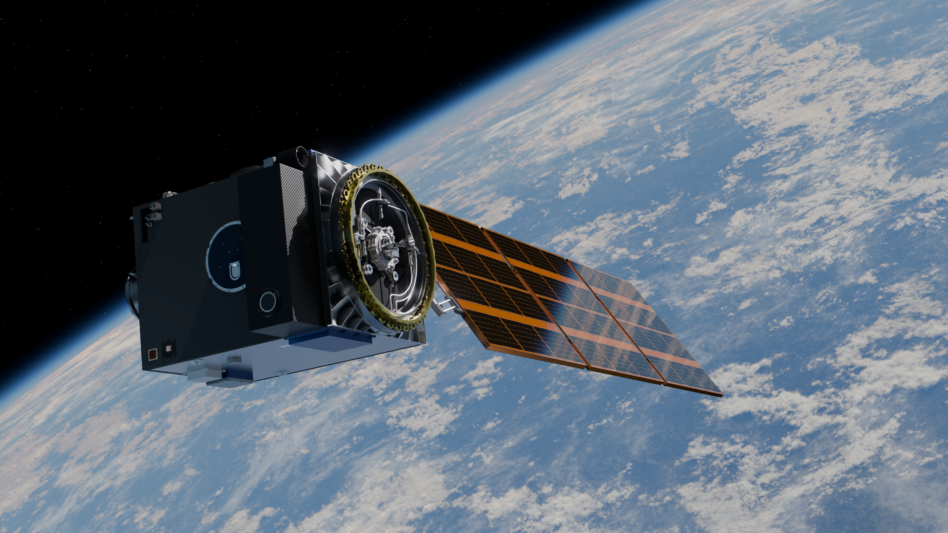
Portal Space Systems has a new craft hitting the market, and it’s set to fly for the first time next year.
The Bothell, WA-based space maneuverability startup has unveiled Starburst, an ESPA-class vehicle that can maneuver payloads in orbit.
- Starburst was initially designed as a way to de-risk thruster and rendezvous and proximity operations (RPO) tech that would be used on Supernova, the company’s larger planned inter-orbit shuttle.
- However, Portal found that customers were interested in the smaller Starburst architecture for its ability to maneuver precisely within a given orbit, and spun the de-risking vehicle out into its own product for hire.
“It was obvious that there was interest in the customer community beyond just us using it as our own risk reduction vehicle,” Jeff Thornburg, CEO of Portal Space Systems and architect of SpaceX’s Raptor engine, told Payload. “There is a strong hunger for smaller, ESPA-sized, 300-kilogram-ish vehicles that can maneuver well and perform everything from Golden Dome type missions to other things out there for the Defense Department that need more mobility.”
The company has manifested its first Starburst on a Transporter mission for Q4 2026. On that mission, it will be flying three customer payloads:
- TRL11 will fly a camera to capture video and conduct edge processing
- Zenno will fly a superconducting magnetic actuator for precision maneuvering
- A third customer TBA
Moving for defense: Portal’s expertise lies within on-orbit maneuverability. It’s developing thrusters for precise navigation within orbits, as well as the more powerful solar thermal propulsion system that Supernova will use to navigate between orbits. The company has self-funded the R&D for those systems, per Thornburg.
“We wanted to have skin in the game with all of our customers, but especially defense customers, because I think too many space startups specifically just want to rely on government dollars only and try to get them to fund the experiment,” Thornburg said. “I think we’ve got a nice mix of venture capital and government contract support to get Supernova and Starburst where they need to be for our defense customers.”
The road ahead: Since raising its seed round this year, Thornburg said that Portal has just about doubled its headcount—including about 25 direct employees and another 25 on contract. Thornburg said he expects to add another 20 people by next summer, and then scale up as needed after the company moves into its larger manufacturing facility in mid-2026.
As the company works toward Starburst deployment next year, things are still moving full steam ahead with Supernova, which will leverage the systems tested and de-risked on the first Starburst flight.
“It’s definitely not a pivot away from Supernova,” Thornburg said. “It’s basically something that we can do for our customer needs right now, while Supernova is still going through its development program, that’s completely synergistic with our tech supply chain and subsystems for Supernova.”
Portal has several key milestones planned for its vehicles over the next two years:
- A flight test of the flight computer and several subsystems and sensors aboard a Vigoride mission in February
- The first flight of Starburst around October 2026
- The first customer missions for Starburst in 2027
- The first flight of Supernova, also in 2027, which is also the first flight of Portal’s solar thermal propulsion system
ICEYE Smashes Its Own Revenue Projections
ICEYE’s results reveal a massively successful year for a business in the right place at the right time.
Anduril To Acquire ExoAnalytic
Anduril Industries announced this morning that it will acquire ExoAnalytic Solutions—a move that will double the neo prime’s space headcount.
Astrobotic Wins Lunar Wheel Contract For Italian Habitat
The Pittsburgh, PA-based space firm won a contract of undisclosed value from Thales Alenia Space to contribute the wheels for Italy’s Multi-Purpose Habitation.
Infinite Orbits Expands into the UK with Lúnasa Acquisition
French in-orbit servicing startup Infinite Orbits is on a buying streak.

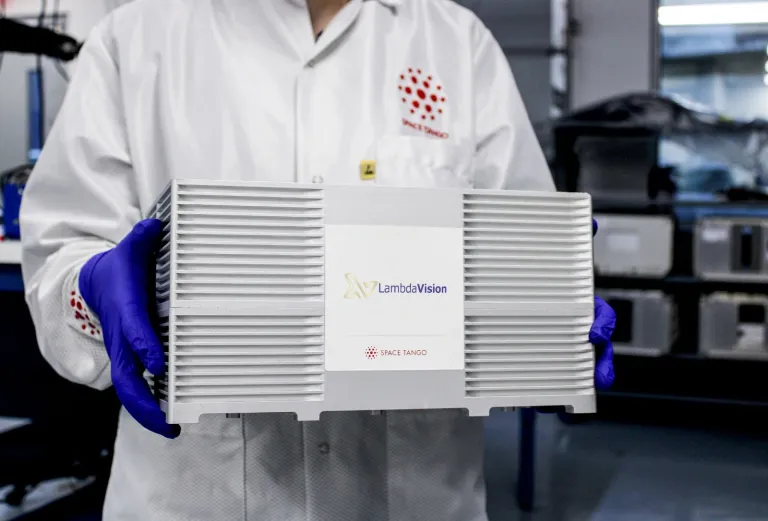
A biotech company hoping that space can help some people on Earth regain their vision closed a $7M seed round on Wednesday.
LambdaVision said the funding will allow it to continue operations through 2027, including scaling up manufacturing in LEO for artificial retinas. Seven Seven Six and Aurelia Foundry Fund led the round, which also included participation by Seraphim Space.
“This seed round funding will help bring us closer to clinical trials, and continue to pioneer scalable production of our artificial retina, including manufacturing techniques implemented in low-Earth orbit,” LambdaVision CEO Nicole Wagner said.
Keep reading