


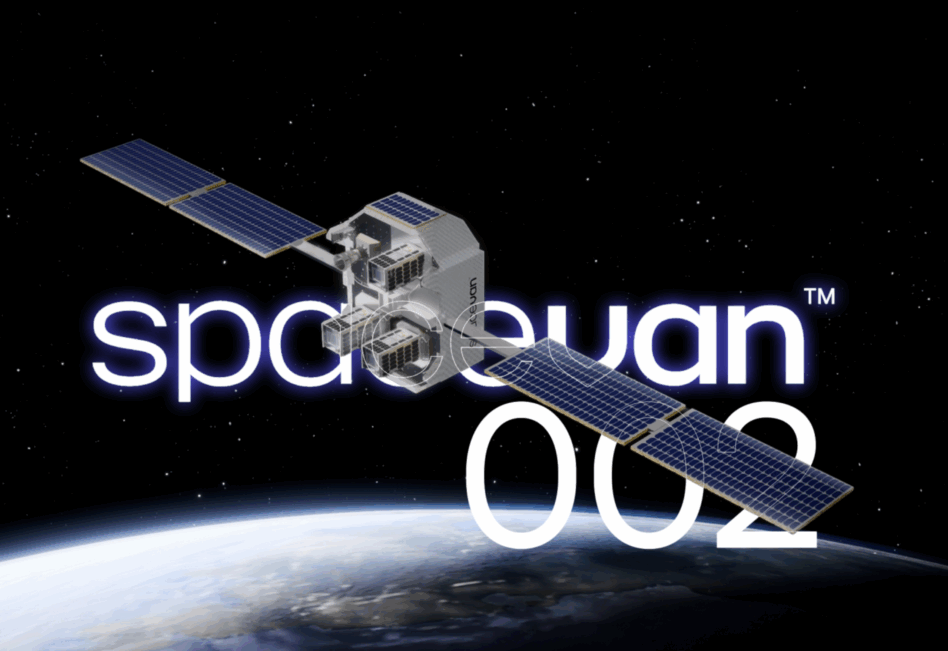
PARIS—Exotrail, the French propulsion and in-space mobility company, unveiled the customer manifest flying on the second mission of its spacevan orbital transfer vehicle, which will launch on SpaceX’s Transporter-16 rideshare in early 2026.
The mission, dubbed Wings of Light, will carry hosted payloads as well as satellites the OTV will deploy on orbit. Passengers include:
- Cailabs, the French optical communications startup, flying its Astrolight ATLAS-1 terminal as a hosted payload to test optical comms links in space.
- QuantX Labs, the Australian quantum technology company, sending a component of its TEMPO atomic clock to demonstrate improvements in GNSS-based systems.
- DcubeD, the German space tech manufacturer, testing a deployable solar panel using spacevan’s onboard power and control systems.
- Xtenti, the US space logistics company, supporting the mission with its satellite deployment systems.
- Lunar Outpost, the US spacetech firm, deploying a 6U cubesat to test advanced robotics in space.
- The University of Colorado’s Atmosphere Effects of Precipitation through Energetic X-rays (AEPEX) mission, funded by NASA, flying a 6U cubesat to study electron precipitation and advance climate models.
Same same, but different: Exotrail’s second OTV mission will come more than two years after its first spacevan flight, which launched in 2023.
Following that mission, Exotrail took the time to vertically integrate many of the subsystems aboard the spacevan to improve the economics and capabilities of future OTV missions. The new spacevan was developed and assembled entirely in-house, and relies on an in-house designed satellite bus and propulsion system.
With the new model, Exotrail is ramping up its mission cadence. The company has two missions in LEO planned for 2026, and two missions in GEO beginning in 2027, one of which is being supported by CNES.
The aim is to provide as many services for future customers as possible, and eventually, to take on in-space servicing missions that require RPO capabilities and multi-orbit trajectories.
“We are learning how to industrialize the product, how to produce at scale,” Exotrail CEO Jean-Luc Maria told Payload. “Once you master proximity maneuvers…it will change everything.”
Pickup and dropoff: Hosting payloads gives customers the ability to test their technologies, gain flight heritage, and move up the TRL scale, but deploying satellites puts the company in direct competition with small launchers, according to Maria.
The idea is to offer satellite operators the ability to share the cost of launch on cheaper rideshare missions, and then use the OTV to deliver customer satellites to their desired orbital trajectory.
“When we are really analyzing the situation, there is only one [small rocket], which is Rocket Lab. And…the capacity of the vehicle today is very low…and you have to wait,” Maria said.

Isaacman Doubles Down on New NASA Model for International Partnerships
Isaacman is less than a year on the job, but he’s already upended the way the agency interacts with the rest of the world.

Hubble Network Raises $200M Series C at $1.6B Valuation
The round follows a $70M Series B in September 2025, and brings Hubble’s total financing to $300M to date.
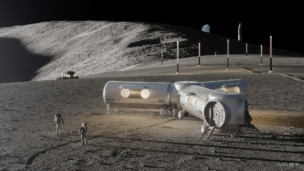
Vast Announces New Lunar Programs Division
Vast announced a Lunar Programs division, building on its commercial space station and satellite development work to support NASA’s Moon Base ambitions.
Exclusive: Exolaunch Books its first Starfall Mission
Exolaunch signed an agreement to support customer payloads on a SpaceX Starfall reentry mission scheduled to launch on a Starship NET 2029.


Maxar Intelligence is joining forces with Ecopia AI, an AI-powered mapping company, to build more accurate vector maps that are already being used by government customers around the world.
The problem: Vector maps rely on geospatial data to precisely locate things like buildings, road center lines, and trees. Today, these maps rely on people to update them—a time consuming process.
These maps also face the problem of a “drift” as new imagery updates, making the product less useful over time and potentially falsely flagging anomalies.
Keep reading