


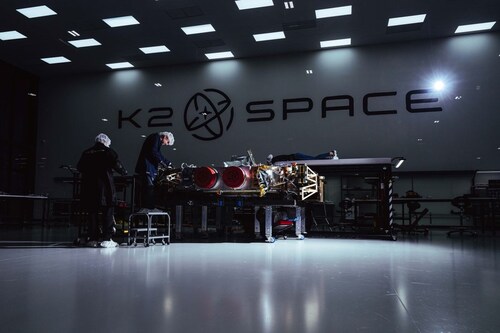
A $3B valuation before ever launching a satellite? Stranger things have happened.
K2 Space announced yesterday that it secured a $250M Series C ahead of its first satellite launch early next year.
- Redpoint Ventures led the round.
- T. Rowe Price, Altimeter Capital, Hedosophia, Lightspeed Venture Partners, and Alpine Space Ventures also participated in the round.
- K2 has secured more than $500M in contracts across government and commercial customers—a major selling point for the new funding round.
- The announcement followed a $110M Series B that closed in February.
“It’s time to build bigger, and we intend to be on the vanguard of doing just that,” Karan Kunjur, CEO of K2, said in a video release about the raise.
Bigger and better: K2’s MO, from its founding, has been to develop ultra-powerful, large-scale spacecraft by leveraging additional capacity expected from super-heavy launch vehicles like SpaceX’s Starship. This bucks the industry trend of constructing smaller, more lightweight satellites. .
While the company waits for Starship to open up commercial flights (and payload capacity for craft like K2’s planned Giga buses), it’s keeping busy. Starting next year, K2 plans to launch a smaller, but still powerful, satellite class called Mega, with the first flight expected in March.
- On that flight, K2 will test its 20 kW Hall-effect thrusters, which company officials say would be the most powerful flown to date.
- K2 will also test its high-voltage power system for the first time, as well as two, 10 kW solar arrays.
K2’s priority is high-power satellites aiming to enable more capabilities than your average smallsat from near Earth orbits to cislunar to throughout our solar system.
“Their approach isn’t incremental,” T. Rowe Price Investment Analyst Jason Leblang said in a release. “They’re rethinking satellite design from the ground up, and the result is a platform that can support entirely new classes of missions.”
Full speed ahead: With this round of funding, K2 has some growing to do. The team is planning to scale up manufacturing capability at its 180,000 sq. ft. facility in Torrance, CA.
The company hasn’t yet launched a satellite (though it did fly hardware this year, and tested its flight computer and avionics), but that’s coming up soon. After the first Mega flight in March, several more missions are planned during the next two years. K2 says it will start deploying constellations for customers in 2028.
From there, the company plans to launch its Giga line of sats, which require a super-heavy rocket like Starship, or Blue Origin’s New Glenn.
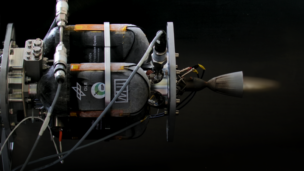
ISPTech Raises €5.5M to Scale Green Propulsion Tech
Green energy is all the rage in Europe, and the trend is beginning to reach beyond the stratosphere.

Canada’s NordSpace Opens VC Arm for Sovereign Space Investments
The company today launched NordSpace Ventures, which will make investments in “Canadian space, defense, and dual-use technologies”—starting with Wyvern, an EO company based in Edmonton, AB.
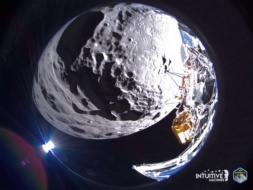
Intuitive Machines, Seraphim Announce Fundraising Wins
The space industry is well into its nine-figure funding era.
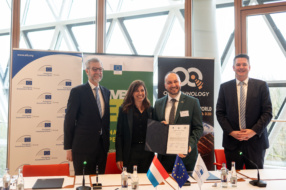
OQ Technology Lands €25M in EIB Venture Debt Financing
Europe is driving hard on direct-to-device (D2D).


European officials have spent much of 2025 promoting sovereign defensive capabilities in space. A new partnership between Kongsberg Defence & Aerospace and Helsing, a German defense tech company, isn’t wasting any time turning talk into action.
The two companies announced plans this week to build a sovereign ISR and communications constellation with the goal of deploying by 2029.
All hands on deck: The partnership is the result of years of ever-deepening ties between Norway and Germany, who have collaborated on defense projects from submarine acquisition, to maritime security, to support for Ukraine.
Keep reading