

Leonardo is positioning itself to become a mass distributor of space-enabled missile defense shields.
The Italian A&D prime announced last week it would begin testing its Michelangelo Dome missile-defense system in Ukraine before the end of the year. But that’s just the beginning.
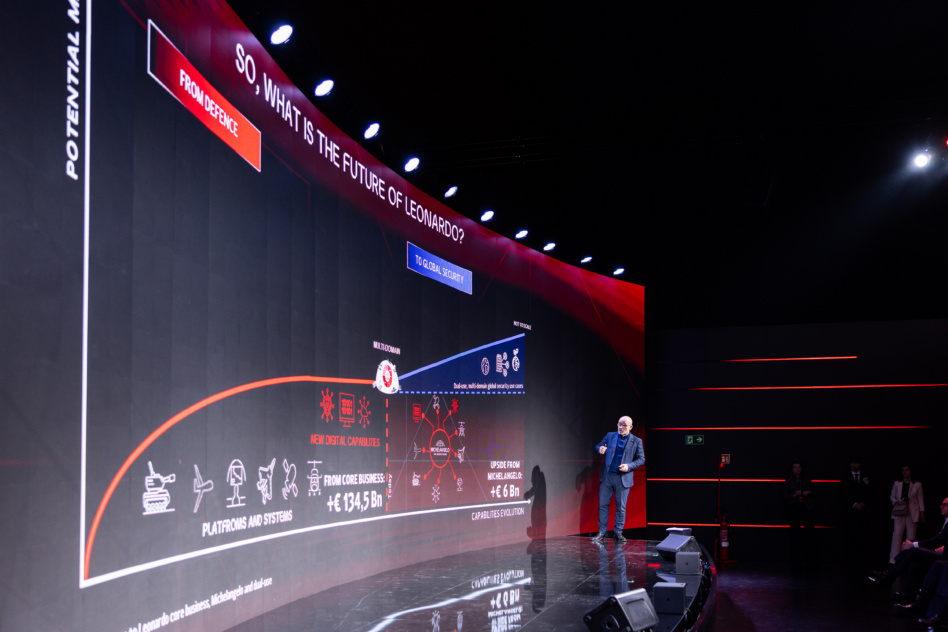
In the company’s longer-term plan also released last week, Leonardo laid out a larger vision to turn the company into a global security power player by 2030.
Shoot for the stars: Leonardo’s plan for the next five years hinges on two expansive projects—Michelanglo Dome and Space Guardian—going right. The company expects the global annual defense spending pie
to increase to $1T+ by 2030. The results of the “high reward” side of the equation for Leonardo are projected to include:
- €30B ($34.4B) in yearly revenue;
- +20% growth in Space Division revenue;
- +14.5% growth in Cyber Division revenue;
- +20% in headcount.
Michelangelo Dome: Fittingly named after another Renaissance artist, Leonardo’s Michaelangelo Dome, a multi-domain defense shield, aims to be a masterpiece of modern protection. The dome’s objective is to create a “dead zone” between 10 km and 15 km—expandable if needed—to detect, track, and terminate threats across a full span of modern attack modes: drone swarms, ballistic and hypersonic missiles, saturating attacks, surface/subsurface naval threats, and hostile ground forces.
Michaelangelo will come with automated threat responses to select the most appropriate effectors per target, and rely on an MC5 module (the “brain” of the operation) to coordinate information across domains, including third-party systems.
Beyond the company’s trial in Ukraine, Leonardo has plans for NATO trials in 2027, which will pit the system against ballistic missiles. Leonardo is also in talks with ~20 countries that have expressed interest in using Michaelangelo for themselves, according to CEO Roberto Cingolani.
Leonardo expects Michaelangelo Dome to open up €21B ($24B) in new business opportunities over the next decade—€6B ($6.9B) by 2030, and €15B ($17.2B) more by 2035.
Space Guardian: Leonardo’s planned EO constellation, unveiled in March 2025, will provide the eyes of the Michaelangelo Dome. Space Guardian will consist of 20 sats launched in batches beginning NET than 2027, with capabilities including SAR, very high-resolution optical payloads, high-powered compute, and advanced-optical-comms links.
The idea is for the system to be interoperable with other national and European-wide systems—Copernicus, IRIDE, COSMO-SkyMed, etc.—but Leonardo has invested in infrastructure to ensure that the system can interact in near-real-time to competently defend from a range of threats.
Leonardo tapped Telespazio to build two ground stations to improve data downlink times—and both are expected to be operational by next year.
With Artemis Changes, Europe is Left Holding the Bag
ESA and European space primes were developing many of the key components of the planned lunar orbiting station.
Arkadia Space Secures €14.5M to Develop New Biprop Engine
Spanish propulsion startup Arkadia Space just secured a stamp of approval from the European Investment Council.
PAVE Space Raises $40M for In-Space Propulsion Tech
PAVE’s propulsion systems rely on a storable rocket bipropellant, which aims to make launch operations simpler and more cost-effective, compared with cryogenic fuels.
One-On-One With SDA’s GP Sandhoo
It’s been about six months since the SDA launched its first operational tranche of satellites—but troops still aren’t benefiting from the better comms tech because of a series of small issues that forced the agency to take a “strategic pause,” SDA Acting Director Gurpartap “GP” Sandhoo told Payload.

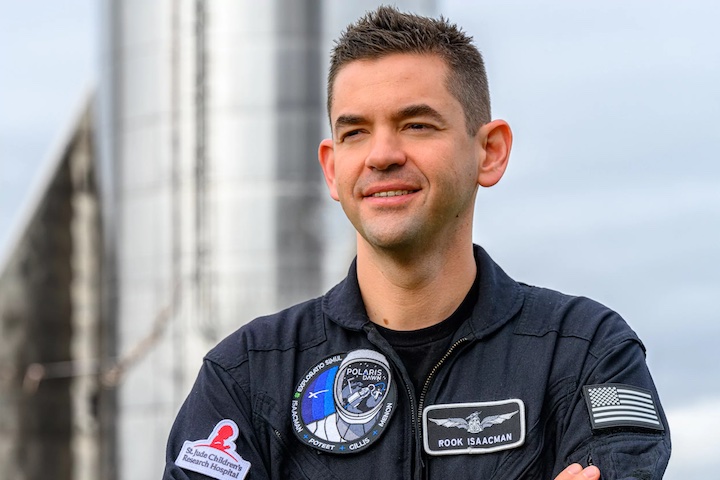
NASA Administrator Jared Isaacman is going all in on building a Moon base, with initial plans kicking off next year.
Isaacman is calling for monthly lunar lander missions to the South Pole starting in 2027, saying the only way to build a Moon base is with regular, frequent missions. Those missions will largely rely on the CLPS program framework, he said.
“We are going to plus up for Moon base construction in a huge way,” said during an interview with Spaceflight Now that was released late Friday night.
Keep reading