


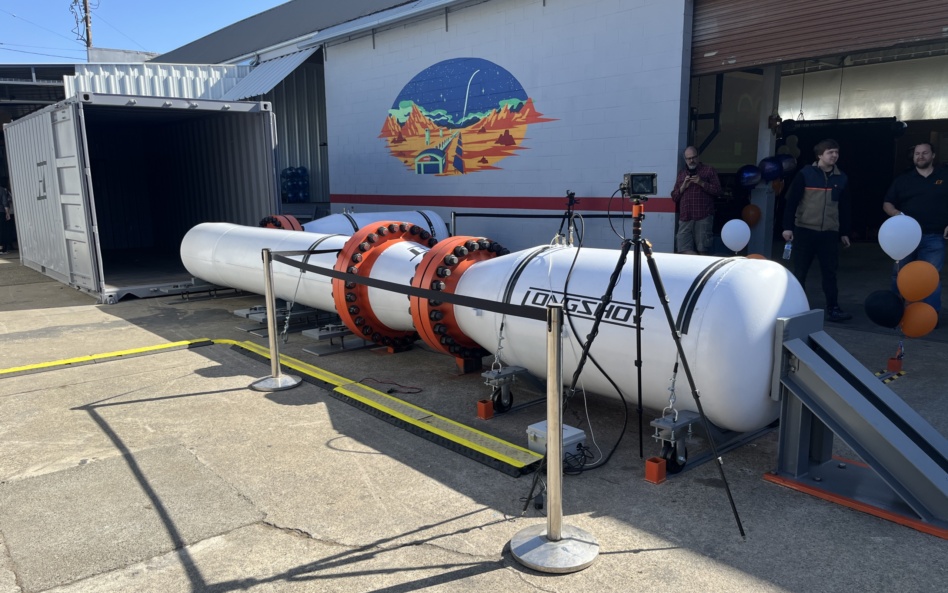
Physics gives us many ways to make something go very fast, but thus far chemical propulsion has won out for space transportation. Oakland, CA-based Longshot Space Technologies thinks the time is finally right to change that—with an enormous gun.
Marginal revolution: Rockets have awful marginal costs, making them less than ideal for regular space transportation. Today’s space rockets grew out of Nazi Germany’s V-2, as well as US and Soviet investment in missile tech. Another World War II superweapon, however, inspired Longshot’s space travel solution.
Mass accelerator: The V-3 was a massive gun Germany built to bombard London across the English Channel, using the technique of “multi-injection,” or adding timed explosive charges along the length of the gun’s barrel to accelerate a projectile. Longshot is using that same technique with compressed gas, not combustion.
CEO Mike Grace and CTO Nato Saichek—who met at the Rainbow Mansion, a Mountain View living space that once housed the founders of Planet Labs and Astra—started their company in 2021. It has won $2.8M in USAF SBIR funding and raised a $4M seed round from Starship Ventures, Draper Associates, and angel investors, including billionaire OpenAI CEO Sam Altman.

Progress report: At an investor day last week, the team showed off a 70-ft long prototype that accelerates payloads to just past Mach 4. Now, they are building a 180-ft version that will pave the way for an 1800-ft gun suited for testing military hypersonics at speeds above Mach 5. Weapons researchers today might pay $6M to $8M to put materials or components in that environment, according to Grace, who said his company could do it for $150,000.
If that works, the big leap is a 12-mile gun to send 100-kg payloads into orbit at costs around $150 per kg.
Secret sauce: Grace and Saichek say the trickiest challenge was timing the injections of compressed gas into the barrel to precisely accelerate their payload—as valves don’t open quickly enough, they designed custom, electrically actuated burst discs.

Hub and spoke: The long-term vision for the company is a launch site, perhaps in northern Australia, with a single tank farm and integration center servicing multiple guns arrayed around it—like spokes in a wheel.
The economics of repeat launches with such a system are attractive, but the business will depend on whether satellite makers need to significantly alter their designs to suit the system— and if 100-kg is enough mass to attract customers in an age of ever-larger spacecraft.
Immovable object: Longshot isn’t the only start-up eying kinetic solutions, with SpinLaunch, Auriga Space, and Green Launch all working on this tech. Another major challenge of getting to space this way is the stress placed on payloads by sudden acceleration; Grace argues that the bigger his guns get, the gentler launch will be.
Next up: Grace is working to raise a new $6M funding round, and Longshot has a lease on a Nevada airport where it plans to build its next gun—but the first challenge will be environmental permitting.

Reflect Orbital Buys Two Skyroot Aerospace Launches
Reflect Orbital announced the purchase of two launches today from Indian launcher Skyroot Aerospace.

DOT Proposes Changes to Part 450 Licensing Rules
On Tuesday, Transportation Secretary Sean Duffy announced five proposed FAA rules aiming to streamline and modernize commercial space launch and reentry regulations.
Skyrora Shifts Orbital Launch Timeline to 2030
First-mover advantage isn’t all it’s cracked up to be—at least, that’s the thought process for UK launcher Skyrora.
Transporter-18 Tests the Building Blocks of Orbital Data Centers
Few rideshares come with a theme, but SpaceX’s Transporter-18 had one: getting power to compute in orbit.


Grab a bucket. It’s raining cash in Europe.
A report from the European Space Policy Institute, released today, found that European space ventures secured a record €1.5B in funding last year—a 56% increase over 2023.
The growth was driven by a perfect storm of political will, increased appetite for public and private investment into defense, and the overall maturing of Europe’s space ecosystem.
Keep reading