


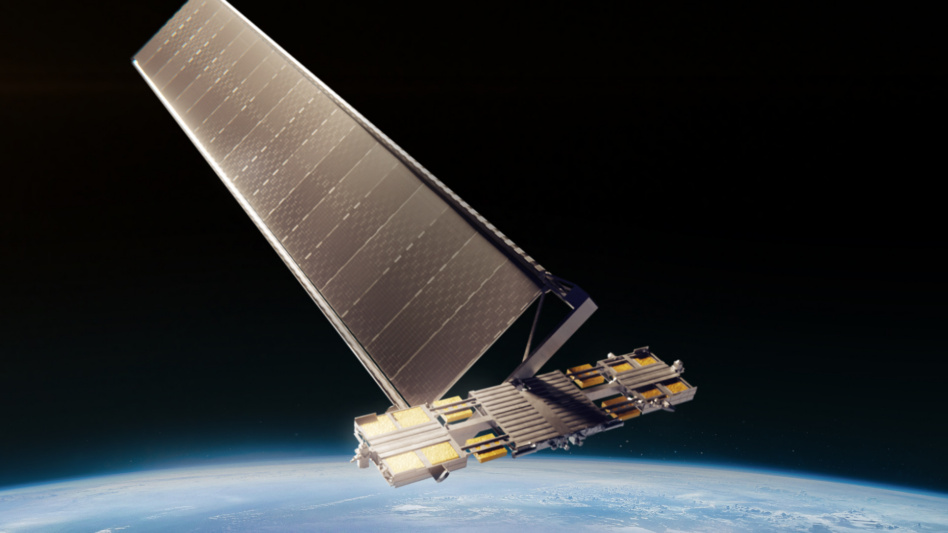
The space industry is demanding more than ever from its satellites—more power, more capable comms, more compute capacity, and more space to host complex payloads.
To meet this increased demand, satellite bus manufacturer Muon Space unveiled a new spacecraft platform today—called Condor-Ultra—which is three times larger than its Condor-XL satellite bus, and geared toward the nascent orbital-data-center market.
“As orbit becomes infrastructure, there’s a new class of applications,” Muon Space President Gregory Smirin told Payload. “Earth’s infrastructure is extending to LEO, and this is part of building that.”
Ultra ready: Condor-Ultra is designed to meet the need of in-orbit data center concepts. Here’s what we know:
- Initial versions will be capable of delivering 20 kW of power, with the option to increase power output to 100 kW on future variants.
- It has space to host at least 18 m2 of payload, with a total payload capacity of roughly 400 kg, according to Smirin.
- It’s designed to integrate with NVIDIA’s Space-1 Vera Rubin module to enable large-scale AI workloads in orbit.
- The spacecraft is equipped with SpaceX Starlink’s laser-comms terminals, and capable of 100 Gbps intersatellite link networking, and always-on 25 Gbps connectivity.
Bumming a ride: Muon is aiming to deliver its first Condor-Ultra pathfinder spacecraft to customers in 2028. Because of that, Muon engineers will need to design a bus to meet the needs of a market that can change a lot in the next two years.
Condor-Ultra will be capable of deploying from SpaceX’s Starship PEZ dispenser, as well as from medium-lift launchers such as SpaceX’s Falcon 9 and Rocket Lab’s Neutron.
“This platform architecture lets us scale that to where the launch market is, which, as we know, is evolving pretty quickly,” Smirin said. “We want [customers] to get up into operation as quickly as possible, so you’ve got to have a framework that can deal with the different launch paths.”
ArbaLabs Launches AI Verification Demo On South Korea’s Nuri Rocket
“In short, tons of companies are looking at the latest and greatest physical AI deployments,” ArbaLabs CEO Ashley Reeves told Payload. “Nobody is really thinking about putting some checks and balances on what these AI models are doing.”
HawkEye 360 Turns its RF-Sensors to Orbital Targets
The DoD wants to better understand what’s going on in orbit. HawkEye 360 ($HAWK) has the inside scoop.

Nebex Partners with Thrusters Unlimited to Unlock $700M for Mexico’s Space Ecosystem
The capital will fund EO, telecoms and other strategic capabilities, according to Nebex.
Transporter-18 Tests the Building Blocks of Orbital Data Centers
Few rideshares come with a theme, but SpaceX’s Transporter-18 had one: getting power to compute in orbit.

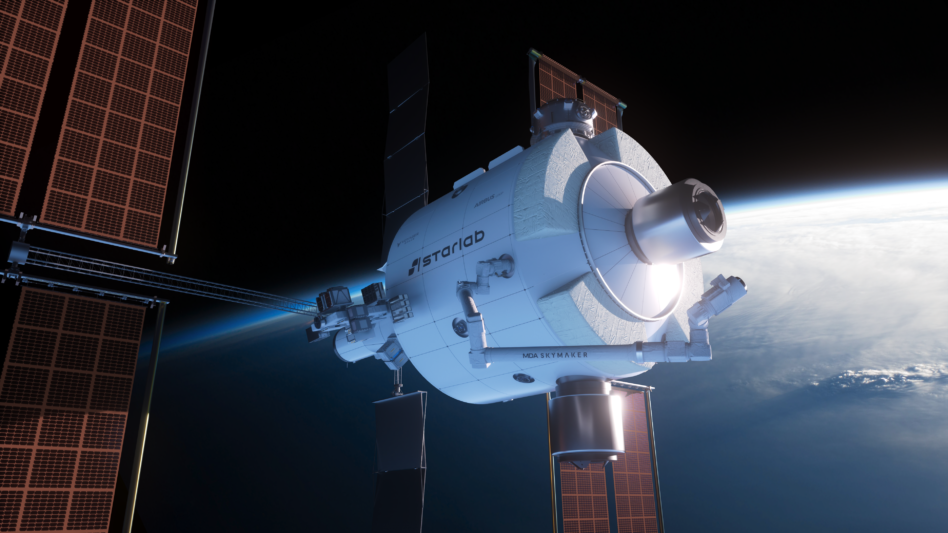
NASA will support free-flying commercial successors to the ISS, abandoning agency proposed changes to the acquisition plan, a spokesperson announced on Monday.
“Industry has provided extensive feedback, making the case for a sustainable commercial market in which NASA is one customer among many, along with assurances regarding available transportation capabilities,” Bethany Stevens wrote on X. “The industry position will now shape the path forward as NASA proceeds with the original commercial strategy.”
How we got here: At NASA’s Ignition event in March, agency officials said they didn’t believe there was a robust enough market in LEO to support free flying commercial space stations. As a result, the agency said it was considering scrapping its Commercial LEO Destination (CLD) plan to support at least one commercial station, pivoting to instead procure a “core module” to be joined to the ISS, where commercial modules could also attach.
Keep reading