


German engineering just entered the quantum realm.
A consortium of German companies announced yesterday that it successfully tested two-way quantum key distribution (QKD) transmission using commercially available hardware for the first time.
The test was performed as part of Germany’s QuNET initiative, which is a seven-year, €125M project funded by the German Federal Ministry of Research, Technology, and Space, to create secure communication networks using quantum comms.
The players: The companies that participated in the mission are:
- Mynaric
- Quantum comms startup MO Space
- The Fraunhofer Heinrich Hertz Institute (HHI)
The demo sets the stage for QKD technology to be operational in orbit before the end of the decade, according to Mynaric officials.
“We would need to get to space qualification,” Mynaric CTO Joachim Horwath told Payload. “[But] when there is a project, we can turn it around quickly.”
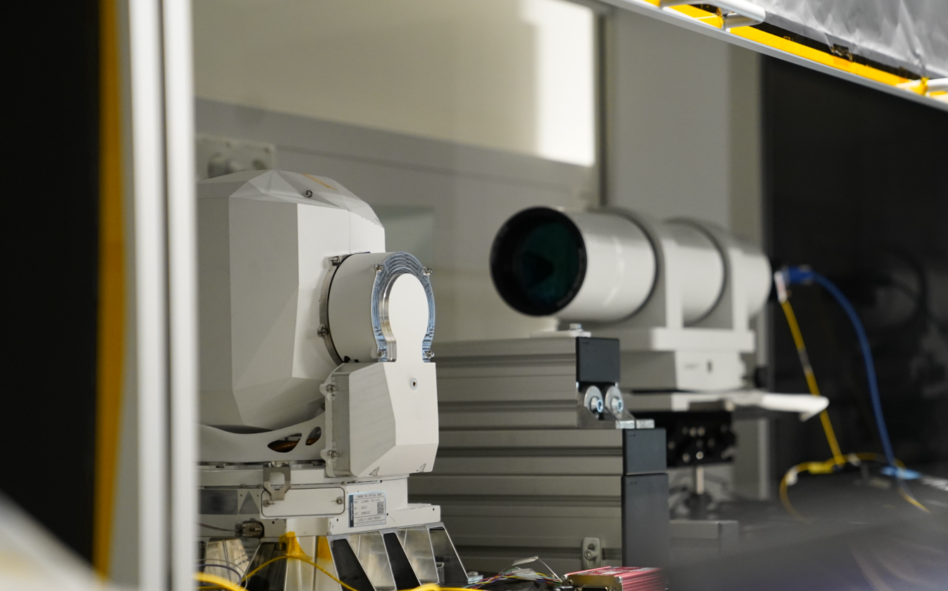
Passing the test: While the demo surpassed expectations—the consortium didn’t originally expect to demonstrate both sending and receiving quantum keys—the real success was proving Mynaric’s CONDOR Mk3 optical terminal—commercially available hardware—can support QKD comms.
It means that QKD tech will soon be accessible to the broader market, and instead of needing high-cost, bespoke scientific equipment, off-the shelf alternatives could be used to support the new secure comms method.
There are still more tests on the horizon to prove that QKD is ready to go mainstream, including a test in October aiming to demonstrate QKD connections across the country.
What to expect: Mynaric has three other QuNET projects in the works.
- A QKD enabled ground station;
- Demonstration of optical connections to high-altitude platforms, including, potentially, to stratospheric aircraft;
- Compact QKD-related sensor technologies for fixed and mobile connectivity.
The company is betting that its low-cost and highly accessible optical terminals will be the accelerating factor to operational QKD comms.
Mynaric is exploring options to fly its hardware as a hosted payload to gain flight heritage, and is positioning itself to be a supplier when quantum comms comes into high demand. This could potentially include future iterations of Europe’s IRIS2 secure-connectivity architecture, according to Horwath.

Inside Austria’s Small But Mighty Space Ecosystem
Austria’s space industry is in the midst of a renaissance, with bigger funding deals and more startup activity.

HyImpulse Signs Launch Agreement with SaxaVord
The second suborbital flight of HyImpulse’s SR75 is expected to lift off from SaxaVord no earlier than Q3 2026.

Advanced Navigation Raises $110M Series C
Not many space companies want to reduce the world’s reliance on satellite infrastructure, but that’s the pitch that landed Australia-based Advanced Navigation a $110M Series C.

NanoAvionics Lands Korean National Security Deal
For NanoAvionics, the deal represents the latest win in a strategy of global expansion— which has found an eager and willing partner in the South Korean space industry.

Space companies buying up AI firms is almost a trend.
CesiumAstro announced Thursday that it had acquired Vidrovr, a company that focuses on prioritizing tasks and automating repetitive processes with the help of AI. CesiumAstro is the second company this month to rely on M&A to boost AI tech, after SpaceX acquired xAI (both owned by Elon Musk).
“By embedding AI directly into our telecommunications payloads, we enable adaptive RF optimization, autonomous tasking, and real-time decision-making at the edge,” Chief Revenue Officer Trey Pappas said in a statement. “This reduces latency, improves spectrum efficiency, and allows our customers to operate resilient, self-optimizing space networks at scale.”
Keep reading