


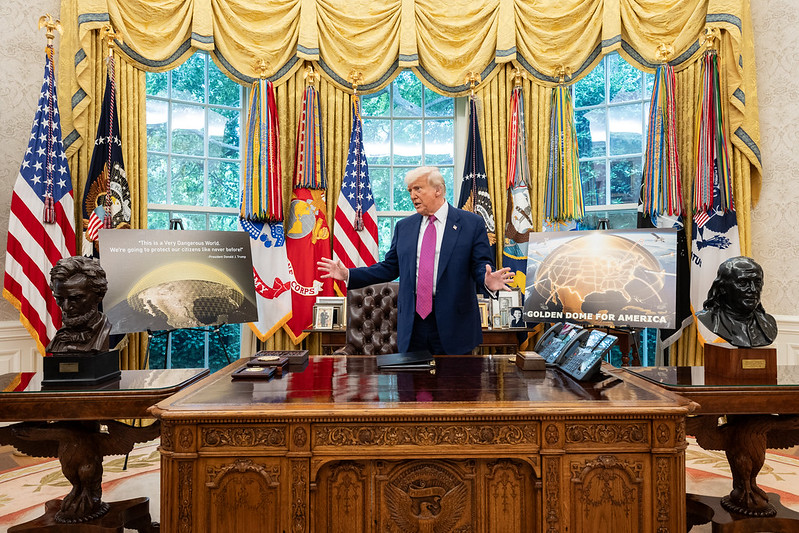
House and Senate negotiators unveiled the compromise fiscal 2026 National Defense Authorization Bill on Monday, which would codify President Donald Trump’s Golden Dome missile defense program into law.
The bill, which still needs to pass both chambers, amends the national missile defense policy with a requirement to maintain “a next-generation missile defense shield.” That solidifies Golden Dome, which was established by a Trump administration executive order in January—and will require action from Congress, rather than another executive order, if a future president wants to scrap the program.
Golden Dome homework: The NDAA requires an annual report to Congress that includes air and missile threats to the US, cost and schedule updates, a test schedule for the following year, and a request for any new legal authorities needed to operate the system. That’s in addition to a quarterly briefing to Congress. Both of these will continue until Golden Dome reaches full operational capability.
Context: This bill is the result of months of negotiations. Top lawmakers serving on national-security committees ironed out differences between the House and Senate versions of the legislation, which authorizes DoD’s activities for the next fiscal year.
If you’re looking for a little light reading, the bill is 3,000+ pages. Consider the below our SparkNotes highlighting space priorities in the bill, other than Golden Dome.
Acquisition: Broadly, the bill attempts to simplify and speed up the Pentagon’s bureaucratic acquisition process. A few space-specific acquisition provisions include:
- Establishing an acquisition career path for Space Force officers;
- Directing the defense secretary to “acquire and operate space systems to be used primarily for space warfighting and control,” including by using commercial space systems.
Launch: The bill also would require evaluation of DoD launch, including:
- Studying the noise created by rocket launches at Space Force bases—and potential tech to keep them quieter;
- Direction to use existing DoD test sites and ranges for rocket cargo program demos, unless requesting a waiver;
- Studying the launch capacity and infrastructure at DoD launch sites, and an evaluation of whether they are prepared to meet the military’s growing launch cadence—including heavy and super-heavy launches.
Best of the rest: Here are a few other space tidbits in the bill:
- The Space Force got three more general officers. It’s now up to 24.
- SDA will continue to use the middle tier acquisition program for Tranches 4, 5, and 6 of the Proliferated Warfighter Space Architecture.
- The Pentagon will keep the Defense Meteorological Satellite Program running until the sats kick the bucket.

Heritage Foundation Rates Space Force ‘Marginal’
“The Space Force is woefully short of the resources required to hold adversary space systems at risk, and is not ready to operate in a contested environment even though conflict with a major adversary will likely begin in space,” the report says. “While most of its current capabilities are highly effective in an uncontested environment, the Space Force lacks the capacity and capability to be ready for conflict in space.”

Senate Tees Up NASA Reauthorization, Deputy Hearings
The Senate Commerce, Science, and Transportation Committee is gearing up for a busy week.

Space Was ‘First Mover’ In Iran Conflict, Top General Says
Military space capabilities played a critical role in the early stages of Operation Epic Fury, according to the Pentagon’s top general.
Austria Commissions its First Military Sat
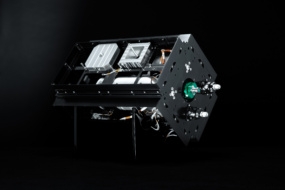
Austria is prepping to launch its first military-commissioned satellite to fight a growing, invisible threat—interference with satellite navigation.

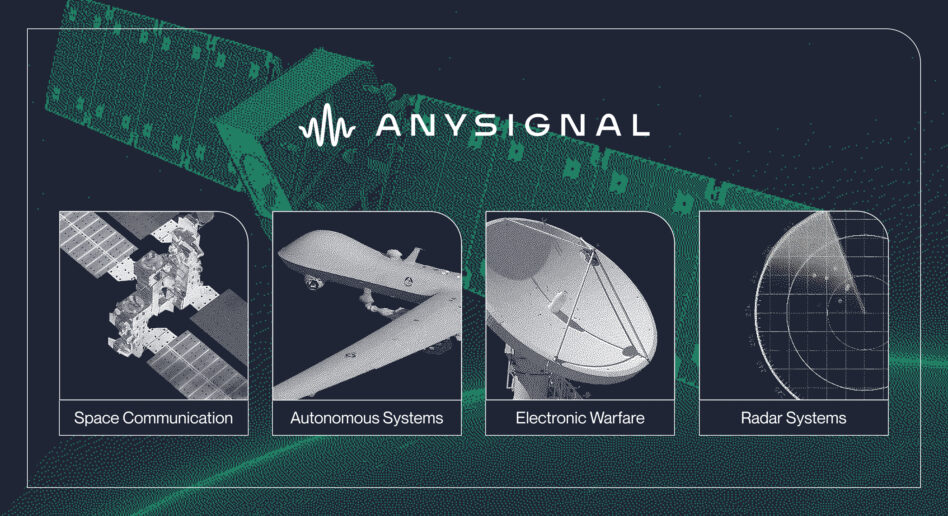
A California startup building new radio tech for space raised more funding to scale production space and people in response to demand.
AnySignal announced this morning that it closed a $24M Series A, and is moving into a larger manufacturing facility to jumpstart production of its radio products for space and defense clients.
AnySignal has four operational missions in orbit—a number that’s expected to grow dramatically in 2026 with the planned launches of a dozen missions, split between LEO, GEO and the Moon.
Keep reading