



European officials have spent much of 2025 promoting sovereign defensive capabilities in space. A new partnership between Kongsberg Defence & Aerospace and Helsing, a German defense tech company, isn’t wasting any time turning talk into action.
The two companies announced plans this week to build a sovereign ISR and communications constellation with the goal of deploying by 2029.
All hands on deck: The partnership is the result of years of ever-deepening ties between Norway and Germany, who have collaborated on defense projects from submarine acquisition, to maritime security, to support for Ukraine.
For the new ISR and comms constellation, Kongsberg and Helsing aim to bring together the best the two countries have to offer.
- Kongsberg will contribute its satellites to form the basis of the constellation, while its KSAT ground network will maintain communication lines to operators on the ground.
- Helsing will integrate its AI software to fuse the satellites’ sensors and comms capabilities.
- HENSOLDT, a German sensor manufacturer, will supply its SAR, electro-optical infrared, and electronic warfare sensors.
- German launcher Isar Aerospace will be the preferred launcher to bring satellites to orbit from Norway’s Andøya Spaceport.
The full constellation, which could include hundreds of satellites when complete, will necessitate a more open approach, Kongsberg’s VP of Smallsat Trond Hegrestad told Payload. The constellation will have interoperability with other European defense sats, and could include participation from other suppliers and launch services as the project progresses.
Walk the walk: In September, Germany proposed a €35B investment in military space capabilities. Just a few months later, A&D primes are getting to work—though it’s unclear if this project is funded by that German investment.
“To reach this goal of having capabilities up in ‘29 or ‘30, there is a clear need for making decisions faster,” Hegrestad told Payload. “This partnership we signed in Germany—we believe that this is a starting point. I think we can go quite fast now.”
Stronger together: This announcement also shows Germany is increasingly open to working on defense projects with partners outside of its borders. That’s great news for Kongsberg, and any other company that can offer the German Bundeswehr unique capabilities.
“There’s a trend in Norway to focus more on space in cooperation with the European Union and ESA, bilaterally,” Hegrestad said. “There’s more and more activity in Norway, but I believe that a lot of these [projects] will also be realized in a bilateral way.”
With Artemis Changes, Europe is Left Holding the Bag
ESA and European space primes were developing many of the key components of the planned lunar orbiting station.
Arkadia Space Secures €14.5M to Develop New Biprop Engine
Spanish propulsion startup Arkadia Space just secured a stamp of approval from the European Investment Council.
PAVE Space Raises $40M for In-Space Propulsion Tech
PAVE’s propulsion systems rely on a storable rocket bipropellant, which aims to make launch operations simpler and more cost-effective, compared with cryogenic fuels.
One-On-One With SDA’s GP Sandhoo
It’s been about six months since the SDA launched its first operational tranche of satellites—but troops still aren’t benefiting from the better comms tech because of a series of small issues that forced the agency to take a “strategic pause,” SDA Acting Director Gurpartap “GP” Sandhoo told Payload.

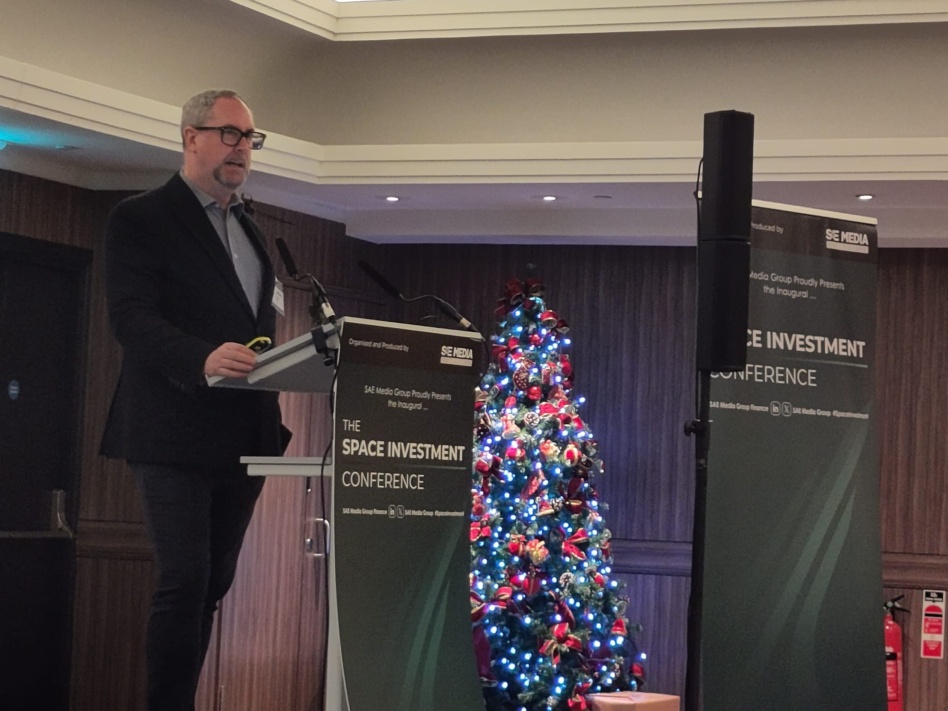
The inaugural Space Investment Conference kicked off in London this week, bringing together founders and investors to discuss the financial future of the space industry—which now has more money than ever.
“This market is growing very rapidly, with a thriving ecosystem of thousands of companies around the world,” Mark Boggett, CEO of Seraphim Space, said at the conference. “With defense budgets of €1T in Europe…we’re seeing a lot of new investors. $39B (€33.2B) has entered this market in the last five years, which we forecast to accelerate given the global tailwinds of defense—which are now speeding into a hurricane.”
Put to work: Compatibility with European public investment in space was a mainstay of the conference. Investors discussed how to align their portfolios with decisions made by entities like the European Investment Bank and the European Fund for Strategic Investments.
Keep reading