


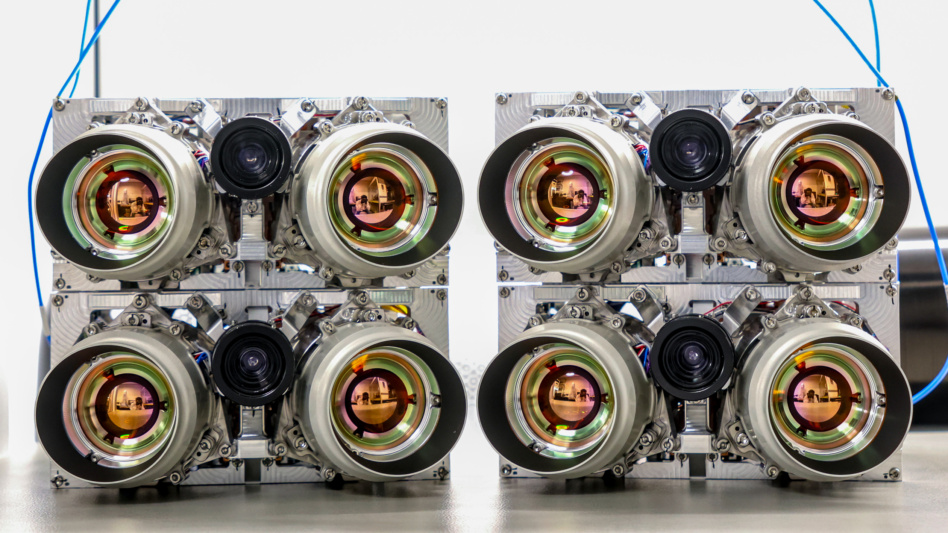
While OroraTech grew its constellation from two sats to over ten in 2025—doubling the areas of Earth it can monitor—a new executive wants to kick things into a higher gear.
Ignacio Zuleta—who has spent over a decade working for, or advising, EO firms including Planet Labs, Satellogic, and Hydrosat—was appointed as OroraTech’s chief technology and product officer.
Zuleta told Payload that his strategy for the company is a fundamental departure from the past because he wants OroraTech to deploy its payloads “at the highest velocity possible.”
“The strategy I found when I joined… was a strategy of sequential deployment,” Zuleta said. “You secure a sequence, essentially, of sovereign contracts, and you try to start slowly populating your constellation.”
Call the paparazzo: With Zuleta as a catalyst, OroraTech aims to grow to a few hundred sats in the coming years, with the aim of providing worldwide coverage, 15-minute revisit rates, and resolution as low as 50 m. (That would be four times better than the company’s current offering, which shows targets down to 200 m.)
The new focus on rapid deployment means OroraTech won’t need to wait for its own supply chain to catch up, as it aims to ramp up its partner satellite agreements to meet the demand.
While OroraTech owns and operates its own satellites, it has also flown its thermal sensing hardware as hosted payloads aboard partner sats (such as on Kepler’s optical comms constellation earlier this year).
Zuleta said to expect more of these agreements—adding that as many as two-thirds of the company’s sensors might operate on partner satellites.
- Flying as a hosted payload means OroraTech can deploy its constellation with speed, as integration timelines for payloads are much shorter than building an entire sat.
- Partner satellites can offer greater power and data downlink capabilities, according to Zuleta, especially with Kepler’s optical comms stack. This means customers can access data with less latency.
Time to market: OroraTech’s new strategy requires the company to think differently about what it’s selling.
“Immediacy and availability: That is the product,” Zuleta said. “The pixels are important, but they’re almost second to what you want… what you’re going to get is the surveillance half of ‘surveillance and reconnaissance’.”
If OroraTech achieves its 15-minute revisit goal, it would position the company to play in the “tip and cue” methodology of many customers—spotting a change on the ground with OroraTech’s sats, then tasking a high-res imager for a closer look.
With Artemis Changes, Europe is Left Holding the Bag
ESA and European space primes were developing many of the key components of the planned lunar orbiting station.
Arkadia Space Secures €14.5M to Develop New Biprop Engine
Spanish propulsion startup Arkadia Space just secured a stamp of approval from the European Investment Council.
PAVE Space Raises $40M for In-Space Propulsion Tech
PAVE’s propulsion systems rely on a storable rocket bipropellant, which aims to make launch operations simpler and more cost-effective, compared with cryogenic fuels.

Airbase Emerges From Stealth With $5M to Automate Spectrum Allocation
As demand for spectrum grows alongside the rising number of missions in orbit, a new startup is looking to ease management of this precious, finite resource.

Axiom Space announced a $350M capital raise yesterday to advance the development of its commercial space station and new NASA space suits.
The company also confirmed that both pieces of hardware are on track to be ready in time to hit critical NASA deadlines—before the demise of the ISS, and ahead of NASA’s Artemis III mission to the Moon, respectively.
Type One Ventures and Qatar Investment Authority co-led the round, which included participation from 1789 Capital, 4iG (the Hungarian telecom), LuminArx Capital Management, and others. Axiom Space’s cofounder and chairman, Kam Ghaffarian, also participated in the round with an undisclosed investment.
Keep reading