


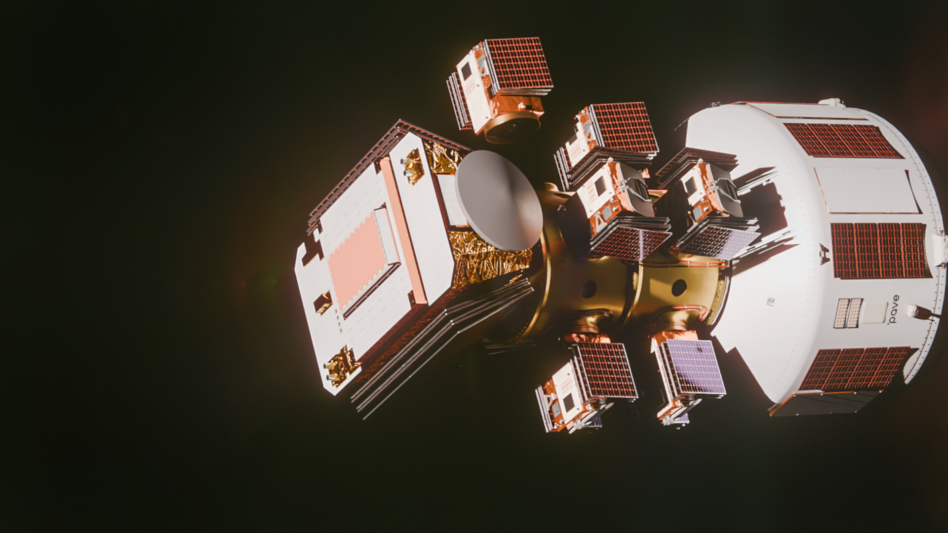
Swiss startup PAVE Space raised $40M in seed funding to bring a new line of propulsion systems and in-space capabilities to orbit.
Visionaries Club and Creandum led the round, with additional participation from Lombard Odier Investment Managers, Atlantic, SISTAFUND, b2venture, ACE Investment Partners, Ilavska Vuillermoz Capital, Pareto Ventures, and Motier Ventures.
It’s a big step up for the young company, which had only raised ~$2M ahead of the seed, according to CEO Julie Böhning.
Meet PAVE: PAVE was founded in 2024 by Böhning and Jérémy Marciacq. The childhood friends previously co-founded the Gruyére Space Program, which is a Swiss reusable rocket initiative.
PAVE’s propulsion systems rely on a storable rocket bipropellant, which aims to make launch operations simpler and more cost-effective, compared with cryogenic fuels. With this propellant, the company is building two families of products:
- LYOBA: A 45 kN kick-stage engine capable of bringing spacecraft from LEO to MEO, GEO, or cislunar trajectories in under 24 hours.
- IBEX: A ~200 kg, payload-agnostic platform targeting highly dynamic operations on orbit for dual-use purposes. For defense customers, the platform can serve as a “police car” in orbit—allowing operators to maneuver quickly to observe other sats, or to get out of Dodge quickly.
PAVE’s vision is to use their propulsion tech to make space more accessible—and more dynamic. Its kick-stage engine architecture can reduce the cost of getting to higher orbits by 40%, according to Böhning, by allowing GEO operators to launch on lower-cost LEO flights and have PAVE power the last mile.
Say cheese: PAVE will use the new funds to fuel a busy test-and-demo schedule in the year ahead, including:
- A hotfire test of the company’s engine, before the end of the year;
- An in-space demonstration of PAVE’s avionics system, scheduled to fly on SpaceX’s Transporter-18 rideshare NET October;
- Completion of the qualification of PAVE’s in-space mobility platform, and progress towards a first launch next year.
PAVE also plans to open a new office inside the EU, and hire additional propulsion and avionics engineers, mission designers, and commercial team members.

Airbase Emerges From Stealth With $5M to Automate Spectrum Allocation
As demand for spectrum grows alongside the rising number of missions in orbit, a new startup is looking to ease management of this precious, finite resource.

Symphony Space Unveils Adagio Hosted Payload Platform
Symphony Space is building a new model for hosting payloads—one where the satellite remains in orbit and the payloads come and go.

Kayhan Space Launches Satcat Terminal
Business and liberal arts majors rejoice!

Inside Austria’s Small But Mighty Space Ecosystem
Austria’s space industry is in the midst of a renaissance, with bigger funding deals and more startup activity.


As demand for spectrum grows alongside the rising number of missions in orbit, a new startup is looking to ease management of this precious, finite resource.
Airbase emerged from stealth today with a $5M round led by Andreessen Horowitz. The round also included participation from Squadra Ventures, and Founders You Should Know.
The problem: RF spectrum is required for everything from GPS, to comms, to studying space weather. Organizations are allocated specific bands of spectrum for operations, to prevent interference between missions.
Keep reading