


Kepler Communications has proven that optical technology works across multiple domains, including space-to-space, space-to-ground, and now, space-to-air. The new era of space communications is imminent.
With Tranche 1 of its optical data relay network set to launch in January 2026 aboard a SpaceX Falcon 9 rocket, Kepler is transitioning from technology demonstrations to commercial operations. This ten-satellite tranche will mark the start of the world’s first operational optical network in low Earth orbit, delivering real-time connectivity and advanced onboard compute.
“Now this is where it gets exciting,” said Beau Jarvis, Kepler’s new Chief Revenue Officer. “We’ve done the demonstrations, and we’re about to bring the full network online in an operational capacity. This is the foundation for real-time space infrastructure.”
Kepler will commission Tranche 1 in early 2026, and expects operational service to begin in the second half of the year—or sooner.
Field-Proven Firsts: Optical in Orbit, Air, and Ground
In September 2025, Kepler partnered with the Space Development Agency (SDA) and General Atomics Electromagnetic Systems to establish the first-ever commercial bi-directional optical link between a satellite and a General Atomics MQ-9B SkyGuardian aircraft in flight. In contested or denied environments where radio frequency (RF) links are vulnerable or jammed, the demonstration confirmed that optical links offer a secure, low-latency alternative.
Kepler’s path to an operational optical satellite network includes a series of key milestones:
- November 2023 – Launched two Pathfinder satellites to validate in-orbit optical networking
- June 2024 – Achieved space-to-space optical link between the Pathfinder satellites;
- May 2025 – Demonstrated SDA-compatible space-to-ground optical link with Cailabs;
- September 2025 – Completed the first commercial space-to-air optical demo with General Atomics Electromagnetic Systems and SDA;
- January 2026 – Launch of Tranche 1, with ten networked satellites;
- Mid-2026 – Begin operational service with onboard compute and hosted payload capabilities.
“We’ve done all the homework and passed all the tests to date,” Jarvis said. “It wasn’t a lab simulation. These were real, bidirectional links in operational conditions. And the industry has taken notice.”
Jarvis added that Kepler’s proven readiness has earned trust across defense, Earth observation (EO), and scientific communities. “At recent conferences around the world, industry leaders are coming up to us, unprompted, to talk about our successful campaign of on-orbit demonstrations.”
Faster and Smarter: Real-Time Data, Real-Time Compute
With Tranche 1, Kepler introduces something new to orbit: not just a fast network, but a smart one. Each satellite carries:
- Multiple GPUs and terabytes of onboard storage;
- Software-defined networking and edge processing;
- Built-in support for AI/ML models and custom analytics.
“Think about maritime monitoring,” Jarvis said. “A customer can send us their sensor data, then we can run object detection in orbit, and send only the insights—not the raw data—to the ground in real time.”
This on-orbit intelligence enables rapid decision-making, while reducing the time and bandwidth required to act—especially valuable for defense, disaster response, space situational awareness, and autonomous operations.
Plug Into Progress: Hosted Payloads and Open Interoperability
To support customers that need faster access to space, Kepler offers hosted payload slots aboard its 300-kg-class satellites. These spacecraft provide room, power, and direct access to Kepler’s global optical network for third-party sensors or instruments.
“Most companies ask us the same thing first: ‘How do I get an optical terminal, and how fast can I connect?’” Jarvis said. “The hosted payload model accelerates that adoption.”
Kepler also designed its network around interoperability. Any terminal that adheres to SDA standards can connect—giving customers freedom to source hardware from vendors around the world. Kepler’s future satellites will also be compatible with ESA’s ESTOL standard for optical links.
Designed for the Mission-Critical Edge
Kepler’s edge-compute capability provides the platform needed for automated detection, tip-and-cue coordination, data fusion, and even space traffic management.
“We’re not just solving the latency problem for Earth observation,” Jarvis explained. “We’re building the infrastructure needed to support the rapid proliferation of LEO. Real-time decisions, automated alerts, onboard tasking—our network is the backbone for that future.”
In urgent scenarios—like unexpected conjunctions or national security alerts—waiting for a ground pass could cost critical time. Kepler’s system ensures those moments aren’t missed.
The Backbone for a Real-Time Space Economy
As Kepler nears launch and prepares for full-scale commercial activation in 2026, more mission operators are paying attention.
EO companies will cut latency from hours to seconds. Government agencies will gain access to secure, interference-resistant links. Scientists will run models in orbit. And—for the first time—customers will act on satellite data while it’s still being collected.
“We call it the internet for space, but it’s more than that,” Jarvis said. “It’s the infrastructure that makes the next wave of space applications possible.”
Optical is coming. Kepler has it handled.
Viasat’s HaloNet: The Innovation of Reprogrammable Space Crypto
Spacecraft today operate in an environment defined by two accelerating forces: the explosive growth of satellites in orbit, and the rapid evolution of cyber threats targeting them. As missions become more autonomous, networked, and interdependent, the need for strong, adaptable security has moved from a supporting feature to an operational requirement.
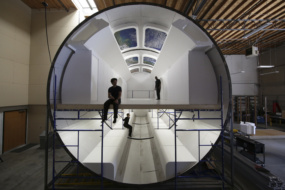
Demonstrators Are No Longer Optional — They’re How Programs Stay on Track
For decades, aerospace and defense programs followed a familiar pattern: define requirements, finalize designs, then validate at the end of the process. That model assumed time was available to manage surprises.
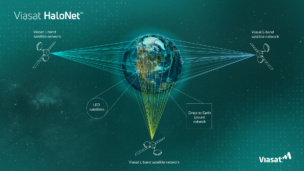
Viasat’s HaloNet: Building the Bridge to a More Connected Orbit
In today’s rapidly proliferating orbital environment, spacecraft are only as capable as their ability to stay connected. Traditional communications architectures—built around scheduled ground passes and line-of-sight links—can’t keep pace with the speed and complexity of modern missions.Viasat’s HaloNet hybrid terminal aims to change that by unifying multiple communications pathways into one adaptive system, designed to keep satellites in constant contact—from launch, through orbit.

Viasat’s HaloNet: Eliminating Launch Telemetry Blackouts
For decades, space launch providers have faced the same persistent challenge: intermittent loss of telemetry data when rockets travel out of range of ground stations. These “blackouts” can last for minutes—leaving long and critical periods when vehicle health, performance, and safety information go dark. Viasat’s HaloNet Launch Telemetry Data Relay Service (DRS)aims to change that, by providing continuous, global coverage from ascent through early orbit.


As the university that sends the most graduates to the foreign service, it’s no surprise that Georgetown University is helping students learn about how international affairs plays a critical role in space policy and business. The only surprise is that it took so long.
The DC-based university recently announced that it had established a space studies concentration under the science, technology, and international affairs (STIA) major last month—a move that follows nearly six years of students lobbying for the school to be a pioneer in educating the next generation of space leaders.
Future vision: Georgetown’s space studies concentration won’t stop at the undergraduate level. Anna Kelly, the president of the Georgetown University Space Initiative (GUSI), told Payload that the program is just the first small step towards a wider program that is open to a bigger population at the university.
Keep reading