



Orbital data centers are closer to reality than you might think.
Sophia Space closed a $10M seed round to accelerate the development and testing of its in-orbit computing technology, laying the groundwork for operational orbital data centers by the 2030s.
The round was led by Alpha Funds, KDDI Green Partners Fund, and Unlock Venture Partners, and brings the company’s total funding to $13.5M.
Meet Sophia: Sophia Space, based in Pasadena, CA, was born out of Mandala Space Ventures, a startup accelerator focused on solving terrestrial problems with space-based tech. The team has been able to leverage and repurpose IP originally developed through a $100M grant intended to study the possibility of solar-power-beaming capabilities.
“The math said it would work, but the economics didn’t quite work out. And then [Sophia founder Leon Alkalai] raised his hand and said, ‘Well, what if we put a server on this thing,’” Sophia CEO Rob DeMillo told Payload. “Because of that lineage that comes out of Mandala, JPL, and Caltech, we were the recipients of a lot of the IP.”
The result is an orbital computing platform that solves many of the roadblocks to viable in-orbit data centers—namely, how to keep the tech from overheating, and requiring repairs in the far out vacuum of space.
Tile game: Founded in 2023, Sophia has built a team of former JPL engineers and cloud computing gurus, and designed its first product: TILE.
- TILE is 1 m2 and just 1cm thick, hosting a solar array on one side, and Nvidia tech inside;
- Each TILE is capable of sending enough juice to power four Nvidia Jetson Orins, and can be configured to support different storage options;
- TILES are non-parasitic, meaning they don’t draw energy from, or send power to, the host satellite.
The tech isn’t just a terrestrial data center repurposed for space, and Sophia has put the cooling system at the forefront of its design and operation.
Each TILE uses a proprietary passive cooling method that expels excess heat into the cold of space using a “heat spreader that’s pushed up against an aluminum alloy radiator,” according to DeMillo. The upshot is a more efficient energy system where each TILE can use 92% of the energy it generates for computing purposes. For comparison, systems using active heat pumps use somewhere between 66-72%, according to DeMillo.
To overcome the impossibility of manually servicing these in-space assets, Sophia has built an AI-assisted operating system—the Sophia Orbital Operating System, or SOOS—that optimizes the distribution of processing power and heat to save certain components from burning out. SOOS also handles firmware upgrades, security patches, “basically everything that an IT person would do,” according to DeMillo.
Center mass: Sophia’s long-term vision is to deploy thousands of these tiles to build modular arrays that can act as in-orbit data centers, handling edge computing for satellites collectively capturing terabytes of data per day in the short term, and acting as an “augment” to terrestrial data capacities in the long term. Their foldable design means even one of the largest designs—a ~2,500 TILE, 1 MW array—should be able to fit in a Falcon 9 fairing, according to DeMillo.
In the meantime, customers are going to be able to buy TILEs to use for their specific in-orbit computing applications—either as add-on systems connected to satellites via an armature, or as free-flying companion-sats with optical comms links.
Sophia plans to use the seed funding to build its first two TILES and begin ground testing this year. After a software demo mission in space, also set for this year, the first in-orbit demonstration of the complete TILE build is expected to fly in late 2027 or early 2028.

DPhi’s Second Demo Brings Compute Space to Orbit
Swiss startup DPhi Space hosted Liquid AI’s large language model to analyze an EO image—without first transmitting the image to the ground. That was the first public result of DPhi’s second mission, Clustergate-2, which rode to orbit on a Momentus Vigoride 7 sat in March. The transmission, which was announced today, signifies a new age…
True Anomaly Closes $650M Series D
True Anomaly has raised a $650M Series D, announced on the heels of its Golden Dome award for space-based interceptor tech—a new product for the four-year-old company.

Meta Secures Overview Energy Space Solar Power Capacity
Meta announced an agreement today to secure up to 1 GW of power capacity through Overview Energy’s planned solar power-beaming satellite system.
UNIVITY Raises €27M Series A
Blast Club and Expansion Venture Capital contributed to the round, which also included support from the Deep Tech fund managed by Bpifrance.

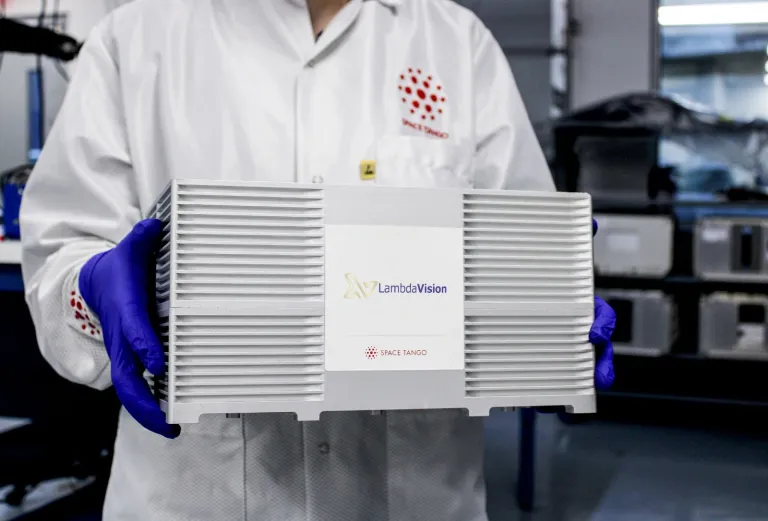
LambdaVision is preparing for its post-ISS future.
The company, which manufactures artificial retinas in LEO, announced on Tuesday that it had pre-booked manufacturing time and space onboard Starlab Space’s yet-to-be-launched commercial space station.
“Their reservation with Starlab enables the transition from demonstration to scalable, sustainable manufacturing, unlocking exponential growth while delivering meaningful benefits to patients on Earth,” Starlab Chief Scientist Luis Zea said in a statement.
Keep reading