

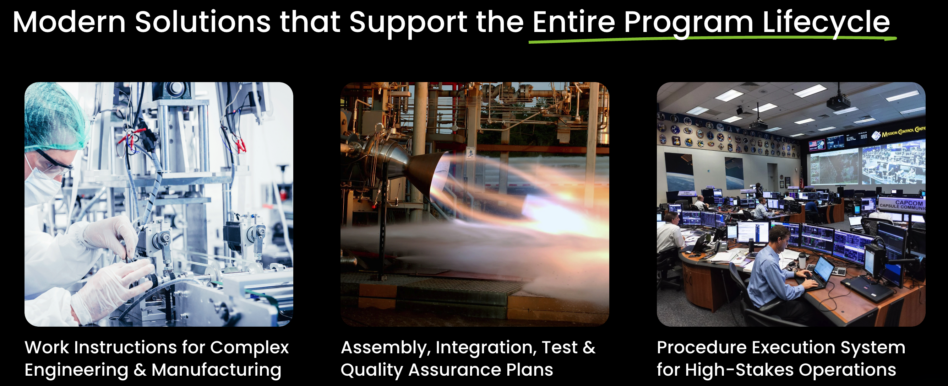
As space missions evolve beyond single-satellite deployments to multi-vehicle constellations, in-space servicing, and lunar exploration, the operational burden placed on engineering teams has grown exponentially. With that shift comes a new imperative: Mission operations software must be as advanced and agile as the hardware it supports.
Laura Crabtree, cofounder and CEO of Epsilon3, had a front-row seat to these shifts. As a former SpaceX mission operations lead, Crabtree now uses that experience to helm a team helping space and defense companies.
That team at Epsilon3 modernizes and scales their customer operations using secure, cloud-based tools. In a recent interview, she discussed what drives complexity in today’s missions—and how the right software can help teams stay compliant, safe, and synchronized.
Why Space Missions Are More Complex Than Ever
“The complexity is coming from all sides,” Crabtree said. “Spacecraft are supporting more missions, more payloads, and more customers—at a faster pace than ever before.”
Shorter development cycles, more frequent launch windows, and faster relaunch timelines are all accelerating expectations. “If you’re not learning and iterating within six months, you’re falling behind,” she said.
Generational shifts also play a role. Engineers today are less inclined to spend decades working on a single mission. “The era of working on one spacecraft for 20 years is over,” Crabtree noted. “Today’s workforce wants to move quickly, and make an impact early. That pressure changes how companies approach development, onboarding, and scaling.”
Modern space teams often struggle not with ambition, but with execution. “One of the biggest pain points is transitioning away from legacy tools,” Crabtree said. “We still see teams using spreadsheets, clipboards, email threads, and static PDFs for procedures.”
These older tools create bottlenecks in communication, particularly as teams grow. “When you scale from 10 to 100 or 300 people, the way you coordinate and communicate has to evolve. You can’t rely on tribal knowledge anymore,” she said. Without a system to manage handoffs between teams in building, integration, and testing, cracks begin to show.
The Pitfalls of Building Ops Tools In-House
Crabtree cautioned against assuming internal tools can keep pace. “Building in-house sounds great—until those five engineers get reassigned, or they leave, and their institutional knowledge walks out the door,” she said.
She shared a rule of thumb: “If a tool already exists off the shelf, like an ERP or operations platform, buy it. Focus your custom software efforts on things unique to your mission.”
Epsilon3’s software was designed to replace fragmented toolchains with a unified platform for building, testing, and executing complex technical operations. It now supports more than 100 space companies, from startups to primes.
“We built the software I wish I’d had during my time at SpaceX,” Crabtree said. “It allows multiple engineering groups to collaborate on a shared system, featuring version history, review workflows, and full traceability.”
A core concept behind Epsilon3’s work is what Crabtree calls software-defined operations: “It’s about systematizing how work is done—so that every person who runs a test does it the same way, every time.”
That consistency supports safety, auditability, and faster iteration. “From version control to execution records, we ensure you can look back at any procedure and see exactly what happened, when, and why.”
Customers are seeing tangible results: faster onboarding, better anomaly detection, and reduced test time. “When your test procedure lives in a dynamic system rather than a Word doc, you’re moving faster and more accurately,” she said.
Automation, AI, and the Road Ahead
Epsilon3 has long supported automation through real-time telemetry and commanding. But when it comes to artificial intelligence, Crabtree said the company is moving strategically.
“Our customers are cautious, and rightfully so,” she said. “There’s a fear that AI means your data is being scraped or shared. We don’t do that. Any AI tools we build will respect data privacy and security first.”
For now, the focus is on practical applications: reducing manual errors, assisting with procedure creation, and improving search-and-query capabilities within vast operations datasets.
Looking ahead, Crabtree sees a need for tools that support autonomous missions, rendezvous and proximity operations (RPO), lunar exploration, and space-to-ground coordination. “We’re prepping customers for a world where people live and work in space, and where spacecraft must operate more independently,” she said.
Epsilon3 is also building features to support regulatory compliance. “Whether it’s proving your tests were safe, or showing you didn’t misuse spectrum, we want customers to generate those reports without growing their compliance teams,” she said.
Don’t Wait to Modernize
Crabtree’s final advice? Don’t wait. “Start modernizing your operations earlier than you think you need to. The pain of starting at 100 people is much worse than starting at 10.”
Ops platforms like Epsilon3’s also help to capture institutional knowledge, and to make that knowledge accessible. “When you’re preparing for your first engine test, you can review the last 10 tests in the system and walk in fully prepared,” she said.
That continuity matters when teams grow and change. “If your institutional knowledge lives in people instead of systems, you’re vulnerable. And in an industry defined by speed and risk, you can’t afford to lose what you’ve already learned.”
As the space industry pushes toward more autonomous, resilient, and scalable infrastructure, the ops systems that support human decision-making and collaboration on the ground will remain critical.
“Our mission is for faster, safer, and more reliable operations, and we are going to evolve with the industry,” Crabtree said. “I want the ground to be completely out of the mix—unless you have to step in. We’re planning for that eventuality, and positioning ourselves to support customers when they get there.”
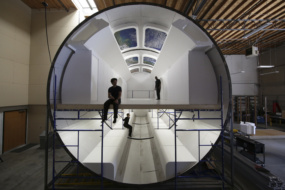
Demonstrators Are No Longer Optional — They’re How Programs Stay on Track
For decades, aerospace and defense programs followed a familiar pattern: define requirements, finalize designs, then validate at the end of the process. That model assumed time was available to manage surprises.
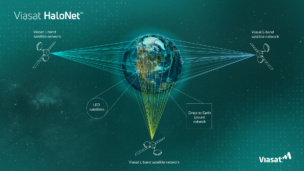
Viasat’s HaloNet: Building the Bridge to a More Connected Orbit
In today’s rapidly proliferating orbital environment, spacecraft are only as capable as their ability to stay connected. Traditional communications architectures—built around scheduled ground passes and line-of-sight links—can’t keep pace with the speed and complexity of modern missions.Viasat’s HaloNet hybrid terminal aims to change that by unifying multiple communications pathways into one adaptive system, designed to keep satellites in constant contact—from launch, through orbit.
Viasat’s HaloNet: Eliminating Launch Telemetry Blackouts
For decades, space launch providers have faced the same persistent challenge: intermittent loss of telemetry data when rockets travel out of range of ground stations. These “blackouts” can last for minutes—leaving long and critical periods when vehicle health, performance, and safety information go dark. Viasat’s HaloNet Launch Telemetry Data Relay Service (DRS)aims to change that, by providing continuous, global coverage from ascent through early orbit.

Common Sense: Avoiding Single-Source Dependency in Government Contracts
Today, as the U.S. Department of War increasingly relies on critical space assets—from satellite communications to reconnaissance platforms—officials should heed Paine’s timeless advice: apply common sense. Entrusting national security capabilities to a single commercial provider contradicts that wisdom, creating vulnerabilities where strategic stability depends on private agendas or individual personalities. Avoiding single-source dependency is not just a strategic choice—it’s a national security imperative.

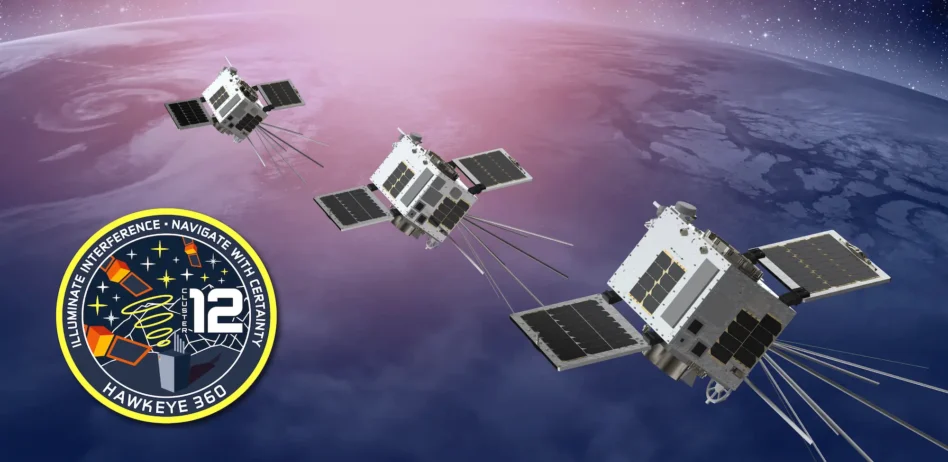
HawkEye 360 has been using its eyes in space for years to provide valuable insights on radio frequency (RF) sensing data for the defense sector. Now, as demand signals from the military are on an upswing, the company is taking growth even more seriously.
Yesterday, the space-based RF data and analytics firm announced that it secured a $150M Series E round.
“We anticipate that the defense sector will grow significantly over the next decade,” Ian Winer, founder of Center15, told Payload via email. “We also think that commercial companies which operate in new domains will gain a larger share of the overall pie.”
Keep reading