


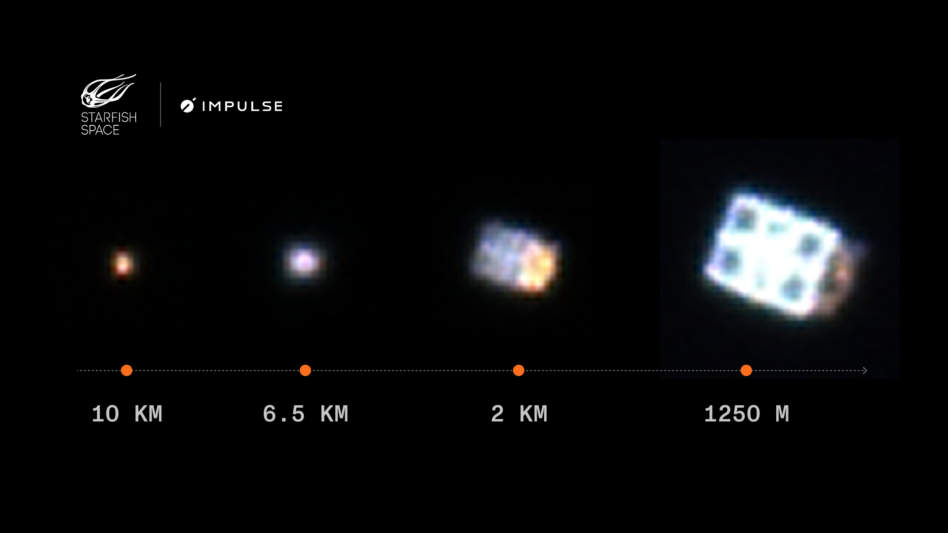
Starfish Space and Impulse Space teamed up quietly this year to conduct an RPO demo in orbit, bringing spacecraft to within 1,250 meters of each other autonomously.
The mission, called Remora, proves RPO missions do not require expensive hardware or custom-built spacecraft, as has historically been the case. Starfish added one camera and its software stack to an already-designed Mira spacecraft, offering a cheaper and faster route to RPO.
“I would like to think it is absolutely a game-changer,” Starfish CEO Trevor Bennett told Payload. “This now becomes a tool for everyone to use.”
More details: Impulse’s Mira spacecraft launched Jan. 14 aboard SpaceX’s Transporter-12 mission, with Starfish’s software and camera onboard. Those payloads bided their time while Mira conducted all of its to-dos for Impulse’s customers. After Mira completed its primary missions this fall—just in case something went wrong—it was go time.
The Mira spacecraft, equipped with Starfish’s tech, autonomously approached a previously-flown Mira still in orbit, and took photos within a close range.
In addition to demonstrating how quickly and easily Starfish’s software could be integrated on a new spacecraft, the mission also proved Mira’s propulsion was precise enough for the delicate approach.
“It was really a desire to demonstrate that Mira could perform those functions,” Eric Romo, Impulse’s president and COO, told Payload. “I’ve heard from people in the market [questioning], can you even do a mission like this with high thrust chem propulsion.”
Spacecraft, take the wheel: The spacecraft conducted the mission—to approach, take photos, and back away—entirely autonomously (though a human was in the loop to call an emergency stop if something went wrong, Bennett said.)
“We were sending zero commands to the spacecraft. It was making all of the choices,” he said. “And it made all the choices correctly.”
What’s next: In addition to pushing the bounds of what an RPO mission requires, Remora tested two Starfish software packages—CETACEAN and CEPHALOPOD—that will aim to enable fully autonomous rendezvous and docking on future missions, including one for the Space Force set for next year.
Fun fact: Starfish is well-known for naming its missions and spacecraft after aquatic creatures. A remora is a fish with a suction-cup-esque appendage on its head, which allows it to rendezvous attach to bigger animals—such as whales and sharks—and hitch a ride.

ORBX ETF Launches Amid Wave of Space Tech IPOs
The goal is to track companies that earn more than half of their revenue from space tech—everything from transportation, to space software, to satellite-enabled data services.
Slingshot Introduces AI-Powered Portal Platform
Slingshot Aerospace introduced a new platform today that will allow operators to spot anomalies—and make decisions—in an AI-powered, one-stop-shop.
ICON Prime Launches, Led By Former TX Rep
Robotic construction company ICON today announced the establishment of ICON Prime, a new business unit that will work with the Pentagon and NASA.
Atomic-6 Launches Orbital Data Center Marketplace
GA-based composite manufacturer Atomic-6 is fueling that acceleration with the launch of a new marketplace today—called ODC.Space—to make securing orbital compute as simple as “add to cart.”

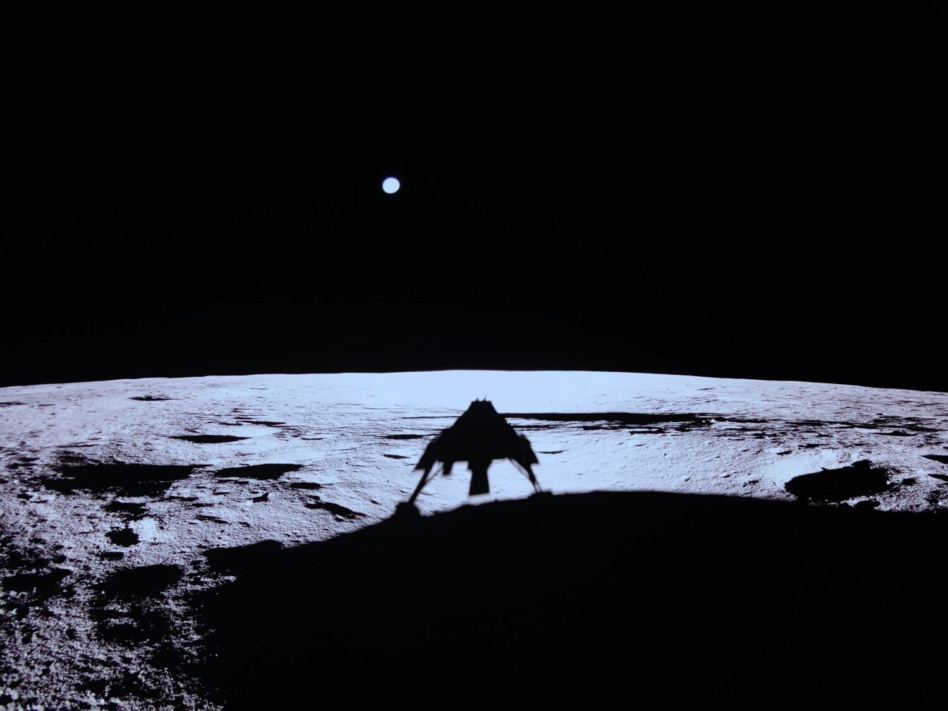
The Moon had a hell of a year.
In the long push to get people back to the Moon—and this time, to bring with them long-term, sustainable infrastructure to support an ongoing lunar presence—2025 has been pivotal.
The first fully successful commercial lunar landing in March, with Firefly’s first Blue Ghost mission, sent shockwaves through the lunar industry. It stoked interest—not only from governments, but also from commercial entities gearing up for the development of a cislunar economy. Getting to the Moon to stay (and to set up shop) has never been a closer, or more exciting, possibility.
Keep reading