


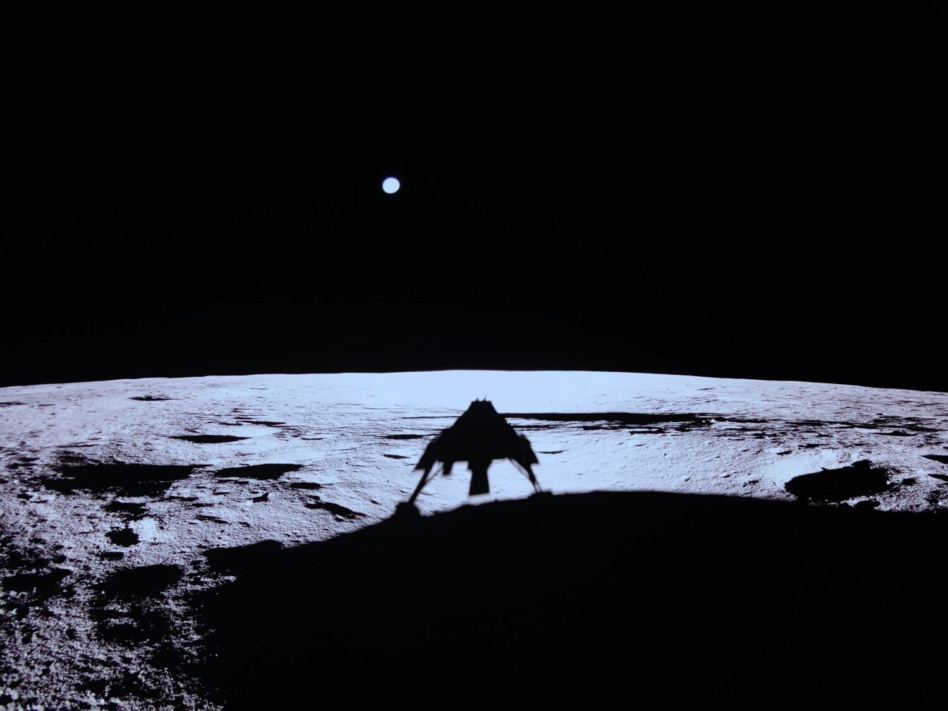
The Moon had a hell of a year.
In the long push to get people back to the Moon—and this time, to bring with them long-term, sustainable infrastructure to support an ongoing lunar presence—2025 has been pivotal.
The first fully successful commercial lunar landing in March, with Firefly’s first Blue Ghost mission, sent shockwaves through the lunar industry. It stoked interest—not only from governments, but also from commercial entities gearing up for the development of a cislunar economy. Getting to the Moon to stay (and to set up shop) has never been a closer, or more exciting, possibility.
“I think it opened things up for Firefly, but I think it was really for the commercial lunar industry as a whole,” Will Coogan, chief engineer of Firefly’s Blue Ghost lander, told Payload. “I don’t think it was just for us. That mission showed this can be done. If it can be done, now, there can be a market.”
Here’s our wrap of what went down in the lunar industry in 2025.
Commercial space takes the lead: After decades of the Moon being the sole purview of government space programs, the private space sector is now carrying the torch. Backed by NASA and other space agencies, these companies are building tech that they hope will have real commercial value outside civil space once the industry hops the valley of death.
In 2025, three companies made lunar landing attempts:
- Firefly successfully landed its Blue Ghost lander in March.
- Intuitive Machines landed Nova-C in March, just a few days after Firefly, but the lander tipped on its side. The company still conducted some operations from the surface.
- ispace, the Japanese lunar company, attempted to touch down its Mission 2 lander in June, but the craft crash-landed.
The commercial nature of these landings mean that companies are doing as much as they can, with the minimum level of funding. That’s what NASA’s CLPS program (of which Firefly and IM are members) is trying to do, and it’s what companies will need to make lunar missions commercially viable.
“What we and other people have been doing over the past six years or so is trying to find out where, really, is the floor,” Tim Crain, CTO of Intuitive Machines, told Payload. “If you spend any less than this, if you do any less than this, if your technology is any less capable than this minimum setting, you’re not going to make it. And the ones that haven’t made it at all kind of crashed through that deck, so to speak. I would say that we kind of skimmed it. We kind of found out where that minimum level was. And then Firefly cleared it.”
A zenith for NASA: There’s little question that NASA had a tumultuous year. Budget uncertainty, workforce challenges, loss of talent, and a lack of consistent leadership has left the agency in a constant state of regrouping and reconsidering its priorities.
According to the CLPS cohort, though, NASA’s commitment to the program hasn’t wavered. The agency supports CLPS companies in the commercial push to develop lunar landers at low cost, and has grown from what it’s learned over the past several years of working with the awardees.
“With two missions under our belt with NASA, and having worked missions with other companies, they’ve learned more of how they would like to run this,” Crain said.
Firefly’s team agreed that NASA was on top of its part in getting them to the surface.
“They were really here to help us, and they were also here to keep people who might interfere at bay,” Coogan said. “If we asked for help, they would go find the world expert on whatever it is we wanted help with, and if we just said we need some space, they would give us some space.”
Still, there are concerns about the agency’s uncertainty. For IM, that comes with testing. Crain said that the company is trying to make sure all its testing gets done way in advance of its deadlines, since some of its tests will be done with NASA and another government shutdown as soon as late January would impact that program.
Of the companies awarded CLPS task orders, Astrobotic and Draper did not attempt a lunar landing in 2025 (though ispace, teamed with Draper, attempted a non-CLPS landing). Its first mission was scheduled for this year, but supply chain issues and delays have bumped the mission to the second half of 2026, Astrobotic CEO John Thornton told Payload.
“I think [Firefly’s landing] is a proof point that the CLPS model can work, and I think it’s proof that we should keep investing in it, because if it can work once like that, I think we can have recurring flights and make that more routine,” Thornton said.
“I think the focus right now, from an industry perspective, is on shoring up that industry. It’s challenging that each competitor has to compete [for] one at a time missions. It’s hard to build a manifest. It ends up being hyper-competitive. And I think it endangers the industrial base for commercial Moon landing[s] here in the US, and it makes it very tenuous.”
And NASA isn’t stopping with CLPS in its lunar push. In August, the agency announced the fission surface power project, which will attempt to put a nuclear fission power plant on the surface of the Moon. Though Artemis is behind schedule, the program proves that NASA is still committed to establishing a long-term lunar presence.
The exploring to come: There are four lunar lander missions slated to make touchdown attempts in 2026:
- Astrobotic’s Griffin-1 mission;
- Blue Origin’s Blue Moon Pathfinder mission;
- Firefly’s Blue Ghost Mission 2;
- China’s Chang’e 7 government-backed mission, which will also carry a lunar orbiter and a rover.
Firefly, the current front-runner in the lunar race based on its success this year, is going a new direction with its second attempt.
“So one thing that’s more unique about the second mission is it’s going to the far side of the Moon,” Coogan said. “And so far, China is the only ones who have operated on the far side of the Moon, and we have pretty limited data available from them. So this is going to be a different kind of first for us.”
The upcoming year will also see the US’ first crewed mission to cislunar space since the Apollo program more than half a century ago. Artemis II, currently slated for February, will carry four astronauts around the Moon. It’s not a landing, but it is an important step in the campaign to get there.
Then it’s time to look ahead. The first round of awarded CLPS missions are coming to an end fairly soon, and the awardees are looking forward to what CLPS 2.0 might look like. And they have a handful of things on their wishlists: Block buys of missions, first of all, and then cargo-class missions that can put more payload on the lunar surface.
Crain said he would also like to see a commercialization requirement for the next round of CLPS missions, where companies would have to designate a certain amount of payload space for commercial customers outside NASA. “It basically would incentivize us to make sure we had landers big enough to accommodate non-NASA payloads,” Crain said.

Jared Isaacman Hits 100 Days In Office With a Bang
NASA Administrator Jared Isaacman has one message: Get in, we’re going to the Moon.
Deep Space Energy Pockets €980K to Build European Space Nuclear Power
The Latvian nuclear power startup is working on a solution for lunar missions hoping to survive the lunar night—a harsh, cold stretch of darkness lasting 14 Earth days that’s a death sentence for solar powered missions.
SpaceX Delays Mars Plans in Favor of the Moon
The update is an about-face from previous comments made by SpaceX CEO Elon Musk, who called the Moon a “distraction” in January 2025.

GRU Space Opens Bookings for Planned Lunar Hotel
Aspiring lunar tourists can place a $1M deposit to reserve a spot in the company’s planned lunar hotel, which aims to open its airlocks in 2032.

Kepler Communications has proven that optical technology works across multiple domains, including space-to-space, space-to-ground, and now, space-to-air. The new era of space communications is imminent.
With Tranche 1 of its optical data relay network set to launch in January 2026 aboard a SpaceX Falcon 9 rocket, Kepler is transitioning from technology demonstrations to commercial operations. This ten-satellite tranche will mark the start of the world’s first operational optical network in low Earth orbit, delivering real-time connectivity and advanced onboard compute.
“Now this is where it gets exciting,” said Beau Jarvis, Kepler’s new Chief Revenue Officer. “We’ve done the demonstrations, and we’re about to bring the full network online in an operational capacity. This is the foundation for real-time space infrastructure.”
Keep reading