


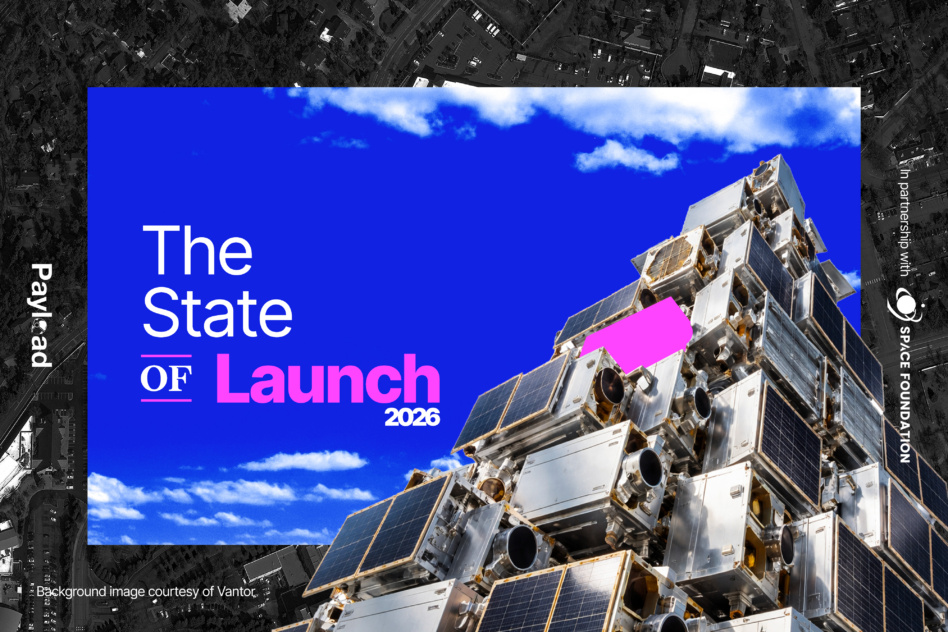
Just this year, the space industry has announced plans for a million-satellite data center constellation, and monthly flights to the Moon. In addition, everyone wants to grow their constellations, from SDA to EO to satcom. And let’s not forget about the impact of Golden Dome, too.
There’s just one problem—everyone is looking for a ride.
“You look at things like Golden Dome. There were a couple of capability gates there where you had to demonstrate capability by deadlines in order to be eligible to continue to compete,” Brian Rogers, Rocket Lab’s VP of launch, told Payload. “The constraints around launch can pick winners and losers there if you don’t have a way to get to space by a deadline.”
Payload spoke with executives from three launch companies: Firefly Aerospace, Rocket Lab, and ULA. (Blue Origin and SpaceX did not reply to a request for comment). Each company rep reiterated that it’s a great time to be in the launch business. With budgets up and ambitious plans in motion, government and commercial customers are clamoring to punch their ticket to orbit.
“There are a lot of critical missions that have to go up, and they have to go up yesterday,” Firefly CEO Jason Kim said of the natsec workload. “There are a lot of systems sitting on the ground, waiting for the large heavies in development to launch. There’s just so much demand for those kinds of systems.”
Spin cycle: It’s easy to wonder if launch companies are just saying that they’re seeing this bottleneck to drive a scarcity mindset, or encourage bookings, with the purpose of padding their wallets.
Except—customers are saying it too.
“We thought we had the launch thing solved, but it’s actually now a bit of a pain in the butt to get manifested on SpaceX. You have to go through launch integrators. They buy up all capacity,” said Patrick Zeitouni, the chief strategy officer at HawkEye 360. “It is something that we do constantly struggle with, still. I thought we’d be done with this by now.”
When Access Matters
With customers scrambling to get their assets into space, those who can launch their own spacecraft are at a unique advantage.
“Space companies of the future will control their own access to space,” Rogers said. “If you don’t control your own access to space, it’s going to be hard to compete with someone who does.”
Rocket Lab is also building a spacecraft business alongside launch. In December, the company won an $816M prime contract to build 18 sats for the SDA’s Tracking Layer. Rocket Lab is also building a maneuverable spacecraft for the military’s VICTUS HAZE tactically response space mission to conduct RPO demos in orbit. In 2025, space systems accounted for two-thirds of the company’s revenue—while launch made up the other third.
Firefly takes a similar approach. Beyond the company’s launch operations, the company also builds lunar landers, and was the first commercial entity to notch a fully successful landing on the lunar surface. It’s also branching into software and on-orbit processing with its November acquisition of SciTec, Inc.
“Obviously we believe in it because we’re doing it,” Kim said of expanding beyond launch. “There’s a future where heavies and super-heavies fill up capacity with their own constellations….That doesn’t leave a lot of capacity for the rest of the world.”
SpaceX is a prime example. The company launched 165 Falcon 9 missions in 2025. Of those, 122—or ~74%—were dedicated Starlink launches.
ULA, however, takes a different approach, launching only when customers buy a flight. The company has no business outside of launch—and no plans to change that, according to Interim CEO John Elbon.
“That’s something that makes ULA unique, and it’s something that we can leverage in the market,” he said. “We have an ability to focus on the missions of our customers, and we’re not distracted by our own missions.”
Traffic jam: Whether you have your own ride to space or not, everyone is contending with one barrier to ramping up launch cadence—congestion at the nation’s ranges. Florida’s space coast supported 109 orbital launches in 2025. Less than 10 years ago, the entity then called the 45th Space Wing (now Space Launch Delta 45) was pushing hard on its “Drive to 48” goal—a 2017 initiative to launch roughly once a week from the Eastern Range.
“Launch rates are increasing across the board, so the ability of the range assets to keep up with that is something that needs to be focused on and managed,” Elbon said. “There’s a lot of work being done in that regard, but it’s certainly a very important thing as we go forward.”
Monopoly Money?
With SpaceX still dominating the global launch market, is the sector facing another monopoly? Execs are split.
Rogers argued that the US space industry is “absolutely” in a “new and different” monopoly, comparing it with a few decades ago when ULA was the only launcher in town. He commended efforts to boost competition, including a provision in the Senate’s NASA Authorization Act that would prevent NASA from buying more than half of its launches from one company.
Others, however, pointed out that SpaceX isn’t the only option for those looking to get to space. Five companies—Rocket Lab, Stoke Space, Blue Origin, SpaceX, and ULA—are eligible to compete for government national security missions. Even commercial companies have options, Elbon said. Amazon Leo is planning to launch its constellation with four launch providers—Airanespace, Blue Origin, SpaceX, and ULA.
Kim also pointed to diversity in the market, noting that small, medium, heavy, and super-heavy rockets are all competing for different missions.

The State of ISAM 2026
It’s becoming increasingly impossible to cover ISAM as a single idea.

The State of EO 2026
Everyone wants their own eyes in space—and the EO industry is benefiting from it.
The State of Satcom 2026
With SpaceX and Amazon storming into the satcom market, traditional players and startups alike are realizing they can’t compete directly with these growing giants—and are pivoting to find creative new ways to play in the crowded market.
Transporter-16 Sends 119 Payloads to Orbit
The latest cargo train to orbit has left the station.
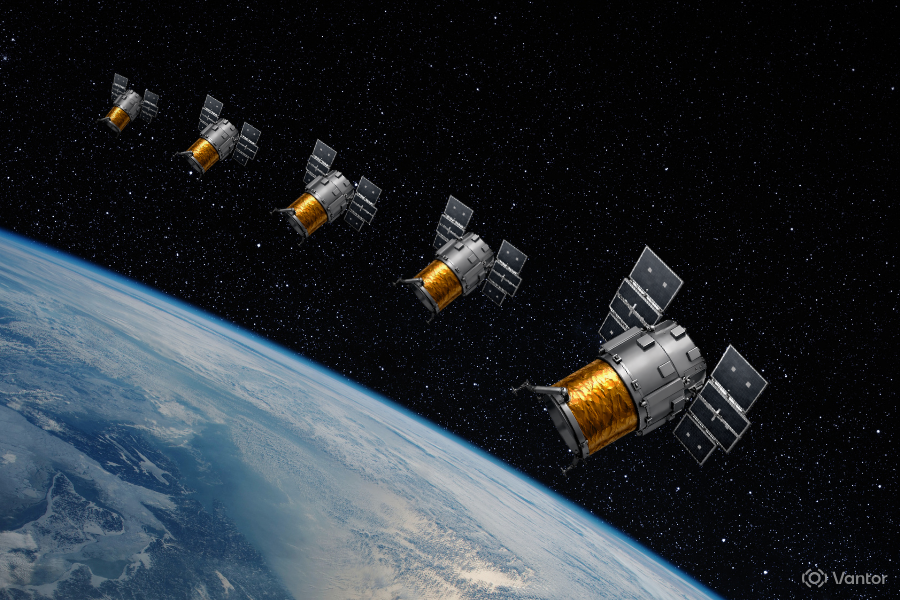
Vantor introduced two new satellite classes today that will aim to improve on the company’s imagery resolution and revisit rate.
Meet the sats: These new offerings will build on the 30-cm class imagery provided by Vantor’s WorldView Legion constellation, which offers revisit rates of up to 15 times per day.
Best of both worlds: EO operators typically offer either super high-res imagery, or fast revisit times. With the addition of these new satellite classes, Vantor is aiming to offer customers both.
Keep reading