


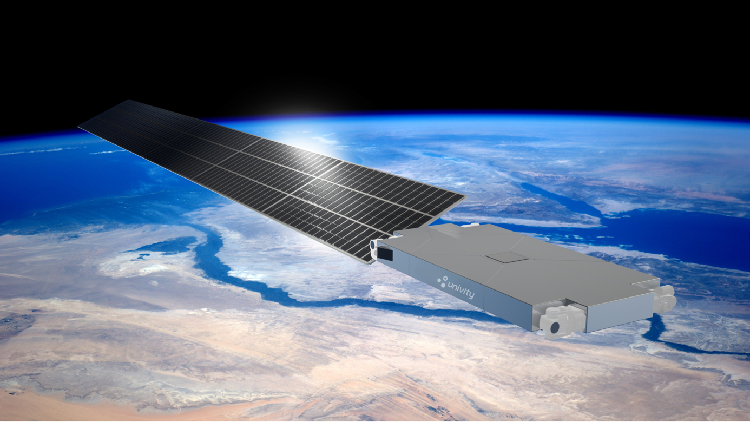
French satcom startup Univity is building a pair of demo sats to be launched to VLEO by the end of 2027—but the requirements are rapidly changing.
The company’s original vision was to deploy a 1,500 sat VLEO constellation to provide high-bandwidth connectivity for telecom providers around the world. It’s now working to offer connections directly to consumer devices as well.
The mission change was driven by growing demand for D2D connectivity from potential customers, according to Univity COO Shola Efunshile. The change also required the company to redesign two core aspects of their sat architecture:
- To reach smartphones or connected vehicles, which have much smaller antennas compared to fixed ground stations, Univity had to increase the amount of power for its satellites to send a signal.
- The company also added another antenna to its satellite design to transmit over frequencies used by cellular devices.
Business as usual: Despite the redesign, much of Univity’s mission remains unchanged. Efunshile shared details with Payload about what we can expect from the rollout:
- Following the demonstration flight in 2027, Univity expects to begin launching its operational VLEO constellation in 2028, with the goal of reaching full capacity by 2031.
- The sats will be launched in batches of 60, meaning the full constellation will require at least 25 flights to reach its 1,500-sat goal.
- The sats are built thin, each about 30-cm in height, to help them withstand orbital drag as they fly at altitudes below 375 km.
- The sats are designed to each last about seven years in orbit, before their demise—a long time for a spacecraft in an area of high atmospheric drag, though Efunshile declined to give details about how the company is keeping its sats up that long.
It’s an aggressive timeline, but Univity officials believe that ample demand for satcom will fuel its buildout. The company therefore plans to presell capacity to fund at least part of its production.
“There’s more demand for data. There’s not been a moment where it’s slowing down,” Efunshile told Payload. “So one of our objectives for this year is to go up a gear in terms of the commercial relationships, talk to more operators, show them the test results…and really engage them in the full constellation.”
To infinity: Univity is setting the stage to make further technological improvements as they come into vogue. To pivot to future needs quickly, Univity plans to integrate the satellites by itself, and develop many of the spacecraft subsystems in-house.
“It means that if we do see a new market opportunity, we’ve got the power and the flexibility to make those modifications, and bring them into the production line. So, we probably wouldn’t switch to 6G overnight, but we do have the possibility to do that,” Efunshile said.
Artemis II Gives Airbus Hope For European Spaceflight
At the heart of Artemis II’s Orion spacecraft is the European Service Module (ESM), built by Airbus Defence and Space in Bremen, Germany, on behalf of ESA.

Czech Radiation Chips on Artemis II Bring ISS Experience
With the sun at solar maximum, HERA serves as an instant warning system if a solar flare emerges.
The State of Satcom 2026
With SpaceX and Amazon storming into the satcom market, traditional players and startups alike are realizing they can’t compete directly with these growing giants—and are pivoting to find creative new ways to play in the crowded market.
Phantom Space Acquires Thermal Management Technologies
Thermal Management Technologies builds advanced satellite thermal components for in-space applications.

The Russians are causing problems again. It was reported this week that Russian spysats may have intercepted what were supposed to be secure comms from European GEO satellites several times during the past three years.
Lucky for Europe, Lithuanian optical comms startup Astrolight is working on a solution to keep space-based comms protected in the years ahead.
The company has three optical comms payloads flying on board customer satellites launching on SpaceX’s next rideshare mission, Transporter-16, according to Astrolight CEO Laurynas Mačiulis. These payloads will serve as demonstration flights for the future of Europe’s laser-enabled, space-to-ground secure communications.
Keep reading