

Part 2 in a series on orbital communications
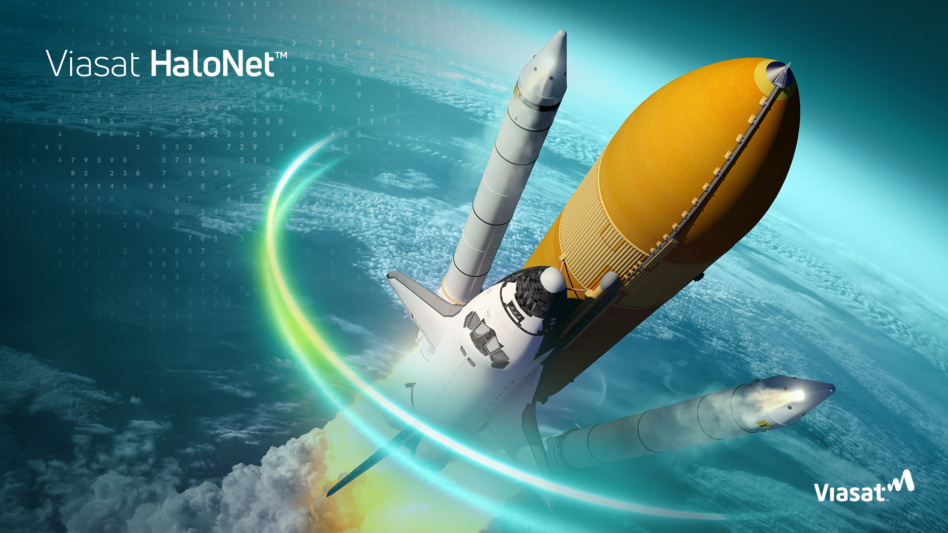
For decades, space launch providers have faced the same persistent challenge: intermittent loss of telemetry data when rockets travel out of range of ground stations. These “blackouts” can last for minutes—leaving long and critical periods when vehicle health, performance, and safety information go dark. Viasat’s HaloNet Launch Telemetry Data Relay Service (DRS)aims to change that, by providing continuous, global coverage from ascent through early orbit.
“Whenever anyone launches a multimillion-dollar rocket or a billion-dollar payload, they need to know the continuous health of that rocket,” said Arnie Christianson, Senior Director, Program Management, Viasat Government, Space and Mission Systems. Launch telemetry to ground controllers provides the equivalent of a car’s dashboard, he explained. “Engine temperature, trajectory, pressure, performance—it’s how you know everything is working as intended.”
Typically, that data could only reach operators while the rocket was within line-of-sight of a ground station. “Over oceans or over the poles, those links drop out,” Christianson said. “With HaloNet, the rocket can communicate through geostationary satellites, so it’s always in contact. There’s no blackout period.”
Filling the Gaps Left by TDRSS
NASA currently uses the Tracking and Data Relay Satellite System (TDRSS) to provide launch support, but the fleet is aging and will be retired over the next decade. “It was groundbreaking in its day,” Christianson said, “but it’s older technology, highly contended, hard to schedule, and expensive. HaloNet uses modern commercial infrastructure to do the same thing more efficiently.”
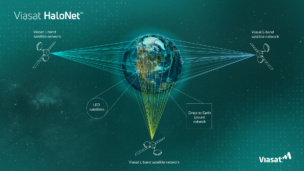
Viasat’s launch telemetry data relay solution leverages its global L-band geostationary network—used for maritime and aviation safety services—to create a transparent data relay. HaloNet enables real-time telemetry continuity, by routing launch data through multiple satellites and redundant ground stations to secure data centers.
“The same network that delivers internet to airplanes, or communications to the Navy, is now supporting launch telemetry,” said Christianson. “It’s proven technology that’s been in use for decades; we’re just applying it in a new way.”
A Dynamic, Scalable Model
Ground-based systems and TDRSS require dedicated antennas and strict scheduling. In contrast, HaloNet uses beam-hopping resource management, which dynamically tracks a launch vehicle’s trajectory and allocates bandwidth as needed. HaloNet can also support several launches simultaneously, eliminating single-use bottlenecks.
Viasat’s “dynamic lease” capability allows bandwidth to follow the vehicle’s path, and to maintain connection through overlapping beams, thus ensuring continuous coverage without dedicating fixed assets.
From a user perspective, the launch vehicle experience remains familiar. “It’s not revolutionary hardware,” said Elias Naffah, Director for Space Systems Strategic Development at Viasat Government, Space and Mission Systems. “The terminals look and operate like the systems launch providers already use. The difference is how we allocate bandwidth and track the vehicle—our internal tools make sure the connection stays live, from pad to orbit.”
Beyond Line-of-Sight
Continuous connectivity is more than a convenience; it can mean mission survival. “In the past, operators had to live with those moments of uncertainty,” Christianson said. “If something looked wrong and you were about to lose signal for 60 seconds, that was a nerve-racking minute. With HaloNet, you’re never out of contact.”
By removing blackout zones, HaloNet allows operators to design optimized trajectories instead of compensating for coverage gaps. That approach can improve payload mass-to-orbit, shorten mission timelines, and reduce risk.
The system also scales easily. “We can support hundreds of launches a year,” Christianson said. “We already service thousands of airplanes and ships—adding rockets to that list is just another category of mobile user.”
Toward a New Standard
In November 2025, Viasat successfully executed the first flight test of its launch telemetry data relay service with Blue Origin’s New Glenn rocket, under NASA’s Communications Services Project. Following this achievement, Viasat is now preparing for a second demonstration of the service with Blue Origin, planned for 2026, as well as collaborations with Mitsubishi Heavy Industries, JAXA, and Skyrora in Europe and Japan.
For now, Viasat sees its service as complementary to ground stations, rather than a full replacement. “We don’t expect to eliminate direct-to-Earth service entirely,” Naffah said. “But by combining ground and relay coverage, you can remove the blackout zones and operate more efficiently.”
As the cadence of global launches accelerates—projected to reach up to 456 launches per year by 2030—Viasat’s HaloNet offers scalable, ready-to-use solutions to keep pace with demand.
“We’re not reinventing the wheel,” Christianson said. “We’re taking what’s already proven, making it more flexible, and opening it up to the entire launch industry. Continuous connectivity shouldn’t be a luxury. It should be the standard.”
Beyond the Rocket: The Digital Infrastructure of the Artemis II Mission
When Artemis II lifts off, the world will see a rocket. What it won’t see is the digital architecture that makes the mission possible. “It [Artemis] may look similar up there on the pad, but it’s completely different from Apollo,” said Karen Fields, vice president and NASA account lead at Booz Allen. “The vehicle is…
Viasat’s HaloNet: The Innovation of Reprogrammable Space Crypto
Spacecraft today operate in an environment defined by two accelerating forces: the explosive growth of satellites in orbit, and the rapid evolution of cyber threats targeting them. As missions become more autonomous, networked, and interdependent, the need for strong, adaptable security has moved from a supporting feature to an operational requirement.
Demonstrators Are No Longer Optional — They’re How Programs Stay on Track
For decades, aerospace and defense programs followed a familiar pattern: define requirements, finalize designs, then validate at the end of the process. That model assumed time was available to manage surprises.
Viasat’s HaloNet: Building the Bridge to a More Connected Orbit
In today’s rapidly proliferating orbital environment, spacecraft are only as capable as their ability to stay connected. Traditional communications architectures—built around scheduled ground passes and line-of-sight links—can’t keep pace with the speed and complexity of modern missions.Viasat’s HaloNet hybrid terminal aims to change that by unifying multiple communications pathways into one adaptive system, designed to keep satellites in constant contact—from launch, through orbit.

ESA ended 2025 with more money than ever, securing record commitments totaling €22B+ from member states at the agency’s ministerial meeting in November. Now, the real work begins.
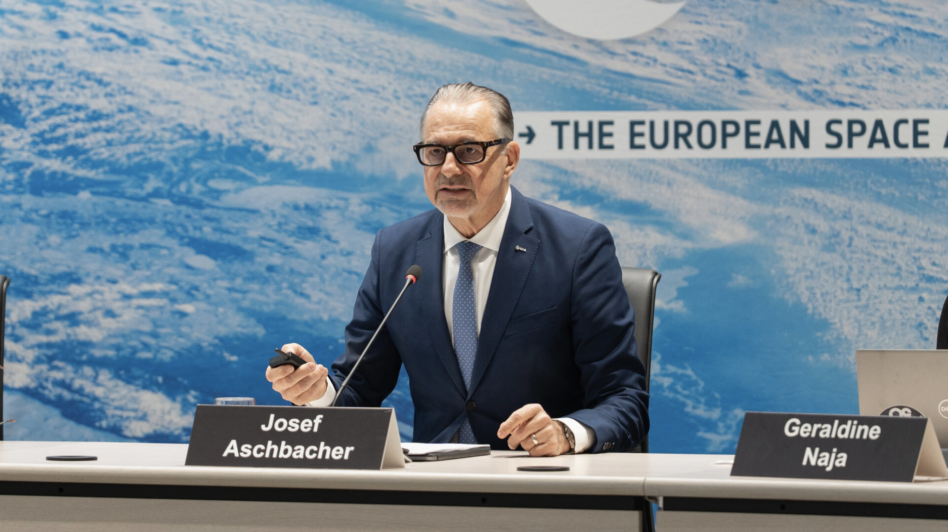
In a press conference at ESA HQ in Paris yesterday, ESA Director General Josef Aschbacher laid out the plan for the year ahead, detailing how the agency plans to allocate its €8.26B budget for 2026.
By the numbers: Sectors earning the largest shares of the year’s budget include:
Keep reading