


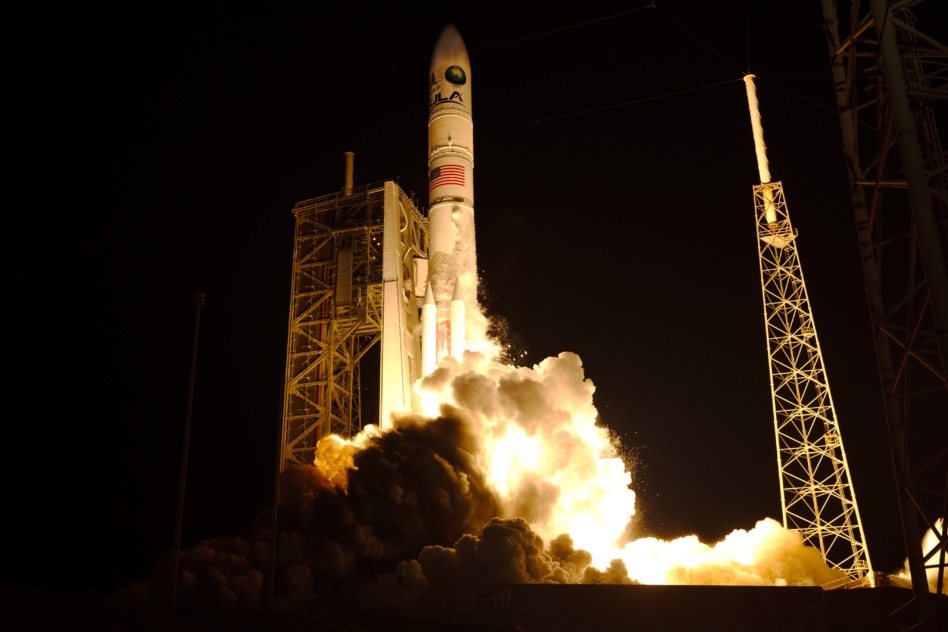
On Thursday, the space community was treated to not one, but two mega launchers blasting off.
The Ariane 64 and Vulcan rockets both got the job done. But issues with Vulcan’s flight will require some review before the rocket welcomes its next national security payload.
Vulcan view: A ULA Vulcan rocket lifted off from Florida at 4:22am, carrying a Space Force spacecraft to geosynchronous orbit—the rocket’s second mission under the National Security Space Launch program. The USSF-87 mission included hardware to improve SSA in GEO, as well as research and training systems aiming to help Space Force Guardians prepare and practice for potential conflict in orbit.
While the rocket did deliver the satellite to its intended orbit, the flight wasn’t without issue. Shortly after launch, Vulcan suffered “a significant performance anomaly” in one of the four solid rocket motors, Gary Wentz, ULA VP of Atlas and Vulcan programs, said in a statement. The issue is clearly visible in this video shared on social media, which appears to show a flame plume coming through the rocket motor.
Wentz said the company will work with the government to review data and collect debris if necessary to figure out what happened—and fix it before the next mission.
Happy first: It was a milestone day for European launch, with the first launch of Arianespace’s Ariane 64 rocket, which launched from French Guiana at 8:45am to bring 32 Amazon Leo sats to orbit. The rocket—a souped-up version of the Ariane 6, with four boosters—received praise and excitement from leaders across the European space community.
“With the powerful roar of four boosters at liftoff, comes more than double the payload mass to orbit, setting Europe back on stage for launching all satellites to all orbits,” ESA Director General Josef Aschbacher wrote on X. “With today’s successful launch, our rocket fleet is now complete. But we will not rest: upgrades are already in progress for future launches.”

HyImpulse Signs Launch Agreement with SaxaVord
The second suborbital flight of HyImpulse’s SR75 is expected to lift off from SaxaVord no earlier than Q3 2026.
Modified Vulcan Expected to Launch This Summer
“There were some changes that we actually had in the works before the anomaly, just to improve margins in the nozzle and solid rocket booster,” Elbon said. “So we’re accelerating those, and focusing on getting those into place sooner.”

FAA Ends Part 450 Transition Period
The FAA announced Tuesday that US launchers had all transitioned to the five-year-old licensing requirements, leaving no one still operating under legacy regulations.
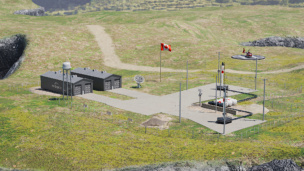
Canadian Launchers and Spaceport Get Funding Boost
Canada will invest in a spaceport and three young rocket systems as part of its push to build up sovereign launch capabilities, officials announced Monday.

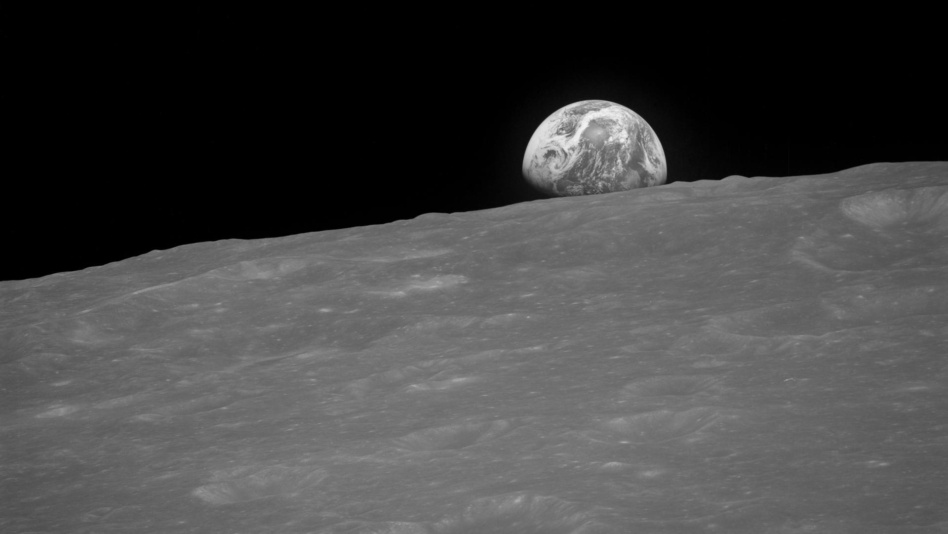
A Latvian nuclear power startup is working on a solution for lunar missions hoping to survive the lunar night—a harsh, cold stretch of darkness lasting 14 Earth days that’s a death sentence for solar powered missions.
Yesterday, Deep Space Energy revealed it secured €930K ($1.1M) to develop a radioisotope power generation system, which could allow Moon missions to last multiple years.
Meet Deep Space Energy: Founded in 2022, Deep Space Energy has been working to build a radioisotope power generation system that’s optimized for spaceflight. The company’s main innovation comes from a dynamic converter and a modified Stirling engine that promises more efficiency than typical radioisotope thermoelectric generators (RTG).
Keep reading