


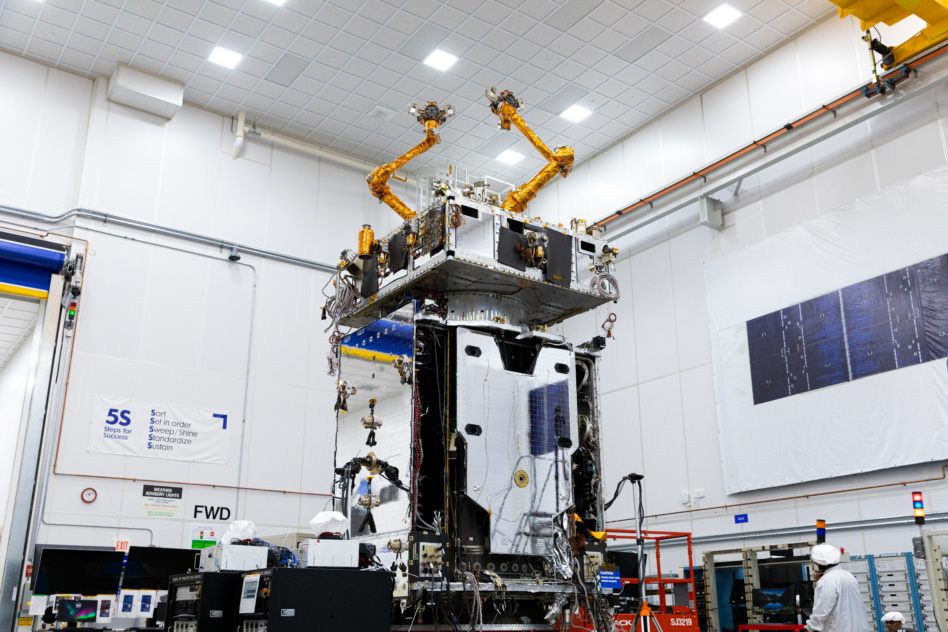
Northrop Grumman’s Mission Robotic Vehicle (MRV) will wear a lot of hats in orbit, from gas station attendant and mechanic to orbital taxi driver and Airbnb host.
Last week, Northrop integrated a pair of robotic arms developed by NRL onto the bus of its MRV, to allow the vehicle to perform in-space services for client satellites zipping around in GEO.
Space AAA: The MRV is expected to launch in 2026, accompanied by three Mission Extension Pods (MEPs) that the MRV will attach to client satellites in GEO. These MEPs are essentially washing-machine sized jetpacks to extend GEO sat lifespans by five or more years.
“Our clients are satellite operators that have one or more satellites where the payload is operating fine; the limiting factor is they’re simply running low on fuel,” Rob Hauge, president of Northrop subsidiary SpaceLogistics, told Payload. “You could build a new satellite, or you could extend what you’ve already got.”
Positive reviews: The MRV builds on technology that Northrop has already demonstrated multiple times on orbit. The company sent two Mission Extension Vehicles (MEVs) to GEO—MEV-1 launched in 2019 and MEV-2 in 2020—where the vehicles extended the lifespans of two Intelsat satellites by docking with them.
In April, MEV-1 successfully undocked from Intelsat 901, and a little more than a month later it rendezvoused with another client satellite in GEO.
GEO TaskRabbit: Northrop’s goal for the MRV, however, is to do a lot more than just arrange extra thrust.
Once the MEPs are attached, the MRV will switch over from gas jockey to full-time mechanic. Using its robotic arms, MRV aims to dock with satellites in GEO and perform up-close inspections with its 20+ onboard cameras and sensors.
The MRV will be able to identify and complete repairs, relocate satellites to different orbits, assemble large structures launched in pieces, and even upgrade satellites by replacing older payloads with newer technology, Hauge said.
Northrop is also launching its MRV with vacant data and power ports to host future payloads, eliminating the need for clients to build their own satellite buses and propulsion systems.
Ultimately, Northrop’s MRV aims to prove that ISAM capabilities are no longer out of reach, but mature and routine.
“If we can do it, then we’re hoping that others are going to follow, because for us—from a business case standpoint—if others enter this market, they help to justify the very same market that we see,” Hauge said.
Exclusive: City Labs Plans Second Nuclear Demo
Following the success of City Labs’ first nuclear-powered betavoltaic demo, City Labs is planning a demo of its radioisotope heating unit.
The Aerospace Corp’s Disksat Gains Commercial Traction
Thinking outside the box is paying off—at least for The Aerospace Corporation, which is starting to gain commercial traction for Disksat, its new box-less satellite configuration.
Exclusive: OrbitAID to Launch RPO Demo in 2027
“Most RPO demonstrations to date have qualified a single piece of the sequence, either far-range inspection or close-approach maneuvering, in isolation,” he said. “OrbitAID’s mission is designed to prove the entire satellite life extension in a single flight.”
Op-ed: The Technologies That Could Define the Future of Space
Daniel Biedermann, a partner at NewSpace Capital, gives his insights on what technologies are driving the future of space tech.

Arkadia Space received data back from its first mission in space proving that its DARK propulsion system—which uses safe-to-handle hydrogen peroxide to generate thrust—can perform as well as, if not better than, toxic hydrazine equivalents.
DARK launched on SpaceX’s Transporter-13 mission in March aboard a D-Orbit ION satellite carrier. Since then, Arkadia has been demonstrating its ability to perform short bursts of thrust—under 100 millinewton-seconds in impulse—which will be critical for customers wanting high-precision maneuvers in space.
Greenhorns: In the five years since its founding, the Spanish propulsion startup has notched some significant wins while developing green propulsion systems.
Keep reading