

Part 1 in a series on orbital communications
As LEO satellite numbers grow into the tens of thousands, maintaining reliable connectivity is a significant challenge for the space industry. Ground coverage gaps, spectrum bottlenecks, and NASA’s planned Tracking and Data Relay Satellite System (TDRSS) retirement create both a communications cliff and an opportunity. Viasat, a global communications company, aims to fill this gap with HaloNet, its holistic space relay network, offering secure multi-band, multi-path connectivity and data transport solutions.
“HaloNet is an end-to-end communications solution for spacecraft and launch vehicles,” said Elias Naffah, Director for Space Systems Strategic Development at Viasat Government, Space and Mission Systems. “It’s designed to provide all the different comms needs that missions have, in a seamless fashion, with a simplified interface.”
What HaloNet Does
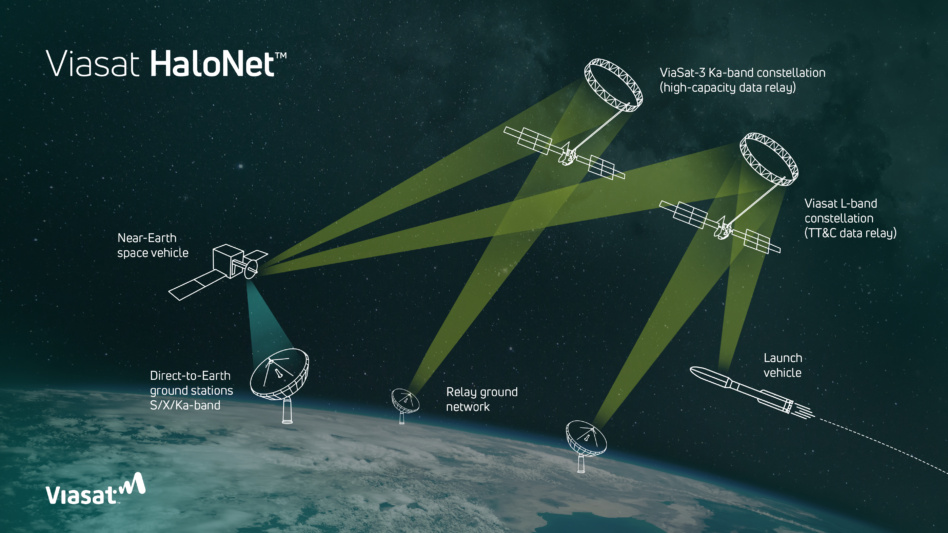
HaloNet combines Viasat’s established Ka-band and L-band relay, as well as direct-to-Earth networks, into a single offering for spacecraft and launch vehicle communications. This hybrid approach enables operators to maintain persistent connectivity throughout the entire mission lifecycle—from launch telemetry, to early orbit operations, to routine spacecraft monitoring.
The value, Naffah said, goes beyond high rate data transfer. “The critical commanding and telemetry—and the assured bandwidth for priority communications—that’s the value to our customers. If you have a spacecraft tumbling in a GPS-starved environment, can you command it and recover it? That’s one scenario for which our low-data-rate L-band solution is ideal.”
Why It’s Vital Now
NASA’s decision not to replenish TDRSS has accelerated the demand for commercial alternatives. “NASA is really looking to get out of the business of infrastructure,” said Naffah, who served a long and distinguished career with NASA prior to joining Viasat. “Industry can do it, and in many regards, industry technology is ahead of NASA.”
HaloNet positions Viasat as a commercial successor to TDRSS. While NASA remains a primary customer, Viasat sees a much broader market in view. Beyond government science and defense missions, potential applications include wildfire monitoring, disaster response, commercial space stations, and proliferated LEO constellations.
Differentiation in a Crowded Field
Unlike competitors who may focus on a single technology—optical links, Ka-band relay, or direct-to-Earth services—HaloNet packages all modalities into one integrated service. “We’re offering it all in one package,” Naffah said. “L-band relay for launch telemetry and spacecraft TT&C, Ka-band relay for high-rate data delivery, direct-to-Earth services, and eventually, free-space optical links. No one else, as far as I’m aware, is offering launch telemetry as part of an integrated service.”
That breadth, backed by Viasat’s heritage in terrestrial and maritime safety communications, gives the program credibility as well as capacity. Twenty-four spacecraft already fly with its L-band service, and upcoming demonstrations with Blue Origin and NASA are set to expand the portfolio.
Toward a Connected Orbital Future
The need for reliable, scalable communications will only grow as LEO traffic swells. Some forecasts suggest 100,000 active satellites by the end of the decade. Naffah says HaloNet will not only keep missions online, but also be a potential enabler of orbital safety. “The L-band capability that today provides safety for maritime and aviation can also be applied to spacecraft,” he said. “There is a need for collision avoidance, and knowing where things are. Technically, we’re capable of doing it.”
For now, Viasat is focused on building the business case—serving government, defense, and established commercial missions first, while keeping an eye on future markets. But the broader vision is clear: a persistent, secure, and flexible communications fabric that will be essential to managing near-Earth space as it becomes ever more crowded.
“HaloNet gives our customers more assurance,” Naffah said. “Assurance that they can command and control their spacecraft at critical moments, assurance that they’ll have the bandwidth when they need it, and assurance that they won’t lose contact when it matters most.”
About This Series
This article is the first in a multi-part series exploring the components of Viasat’s HaloNet portfolio. Future installments will take a closer look at:
- Launch telemetry
- Hybrid terminal solutions
- Space crypto
Together, these articles will show how HaloNet is positioned to provide spacecraft operators with continuous near-Earth communications, for the next decade and beyond.

From Design Reviews to Decision Intelligence: CoLab Rewires Engineering Workflows
In engineering production, hundreds—sometimes thousands—of decisions stand between initial concept and final product. Some decisions are big, and some are small trade-offs, but collectively, they determine whether a program moves forward efficiently—or stalls under the weight of its own complexity. Those stalls often stem from an inefficient process of how design decisions are made and…
Beyond the Rocket: The Digital Infrastructure of the Artemis II Mission
When Artemis II lifts off, the world will see a rocket. What it won’t see is the digital architecture that makes the mission possible. “It [Artemis] may look similar up there on the pad, but it’s completely different from Apollo,” said Karen Fields, vice president and NASA account lead at Booz Allen. “The vehicle is…
Viasat’s HaloNet: The Innovation of Reprogrammable Space Crypto
Spacecraft today operate in an environment defined by two accelerating forces: the explosive growth of satellites in orbit, and the rapid evolution of cyber threats targeting them. As missions become more autonomous, networked, and interdependent, the need for strong, adaptable security has moved from a supporting feature to an operational requirement.

Demonstrators Are No Longer Optional — They’re How Programs Stay on Track
For decades, aerospace and defense programs followed a familiar pattern: define requirements, finalize designs, then validate at the end of the process. That model assumed time was available to manage surprises.

When thinking about operating a satellite in GEO, is it better to rent or buy?
Until now, rental satellites weren’t widely available. A pending deal between Space Leasing International (SLI) and AscendArc stands to open the door for more operators to pay as they go in GEO.
This week, SLI, a subsidiary of the Libra Group conglomerate, signed an initial agreement with AscendArc to purchase two small GEO satellites with a combined value of $200M+. The deal is expected to close in the next three months, and the satellites could fly as early as late 2028.
Keep reading