


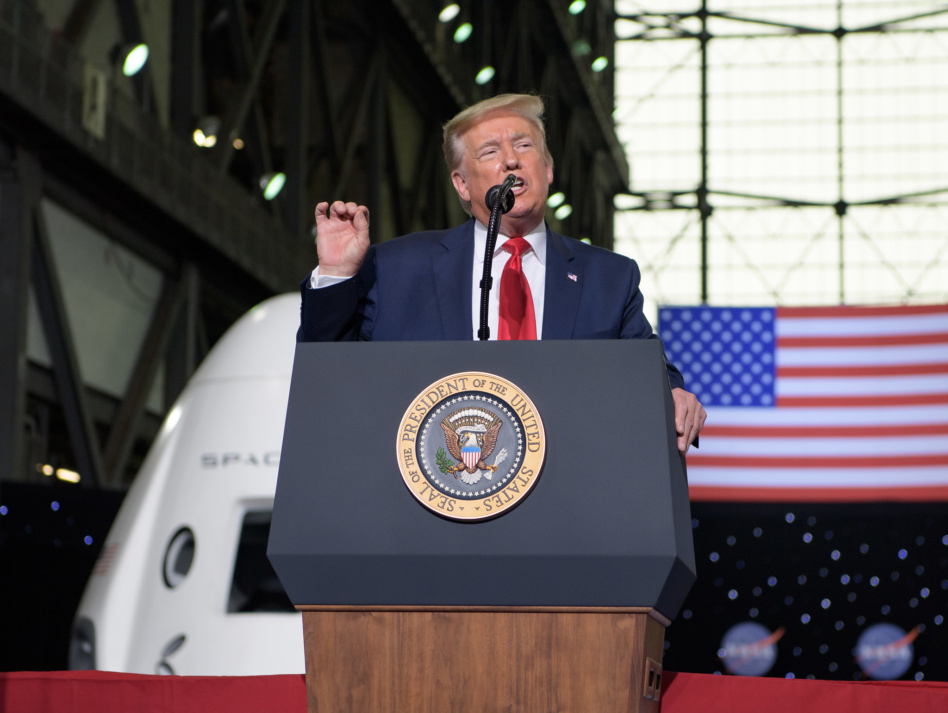
President Donald Trump laid out a clear vision—and timeline—for America’s next steps in space in an executive order signed Thursday afternoon.
The “Ensuring American Space Superiority” executive order says that achievements in space are “a measure of national vision and willpower.”
“The United States must therefore pursue a space policy that will extend the reach of human discovery, secure the nation’s vital economic and security interests, unleash commercial development, and lay the foundation for a new space age,” the order reads.
The order replaces one signed by former President Joe Biden in 2021 that authorized the National Space Council, marking the end of the interagency panel that was never revived in Trump’s second term.
Top priorities: Many points in the EO should come as no surprise—it’s clear, for example, that Trump wants to send Americans to the Moon and build a space-based missile defense constellation.
The document, however, sets concrete dates by which the US will hit certain milestones in civil, national-security, and commercial space, including:
- Putting Americans on the Moon by 2028, and building “initial elements” of a permanent lunar outpost by 2030.
- Demonstrating a prototype for Golden Dome by 2028, and making sure the US can detect threats in space from LEO to cislunar orbits.
- Attracting an additional $50B in investment in US space markets by 2028.
- Building a nuclear reactor to generate power on the lunar surface, which would be ready to launch by 2030.
- Ensuring the private sector has a “pathway” to replace the ISS with a commercial space station in LEO by 2030.
Not so squishy: Attaching numbers and dates to goals gives a sense of urgency—and a hard benchmark against which the administration can be measured for failure and success.
The EO lays out a couple short-term steps to kick off action:
- Drafting a plan by mid-February, to establish a National Initiative for American Space Nuclear Power.
- Delivering a readout to Trump by mid-March with a NASA plan to hit these goals, a review of any space-acquisition projects that are more than 30% behind schedule or 30% over cost (from the acquisition baseline), and a DoD evaluation of gaps in the space and missile defense supply chain.
What’s in a name? Though the document is an executive order, it bears a striking resemblance to the Space Policy Directives that became a hallmark of Trump’s first term. The president signed seven SPDs between 2017 and 2021 that addressed everything from establishing the Space Force, to streamlining regulations for the private space sector.

White House Publishes S&T Strategy for National Security
The Office of Science and Technology Policy released its National Security Science & Technology Strategy.
Xona Clears Final Regulatory Hurdle for PNT Constellation
Xona Space Systems has won FCC approval to broadcast its Pulsar navigation signals from a full satellite constellation, clearing the last regulatory hurdle before the company can scale deployment.
NordSpace Funds NVD Amid Canada’s Export Push
NordSpace Ventures announced an investment in North Vector Dynamics this week, a company building full-spectrum sovereign missile capability.

Intel Authorization Act Proposes Limiting Commercial EO Access
EO data is a privilege, not a right, and the US government wants to control what EO satellite operators can and can’t share with the public.


In a magic trick, making something disappear is only part of the act—bringing it back is what earns the applause. The same is becoming true in the space industry: Launching something to orbit is great and all, but the real wizardry is bringing payloads back in one piece.
For the growing orbital reentry sector, 2025 was a huge year. More than a dozen companies passed crucial milestones in their efforts to build return vehicles. Some emerged from stealth or received their first funding rounds, while others completed their first missions or turned demos into reliable operations.
At the same time, demand for reentry services has grown considerably. Much of that is driven by defense-focused hypersonic research, but the re-entry sector is also ready and willing to fill the vacuum for microgravity research customers when the ISS is retired in 2030.
Keep reading