


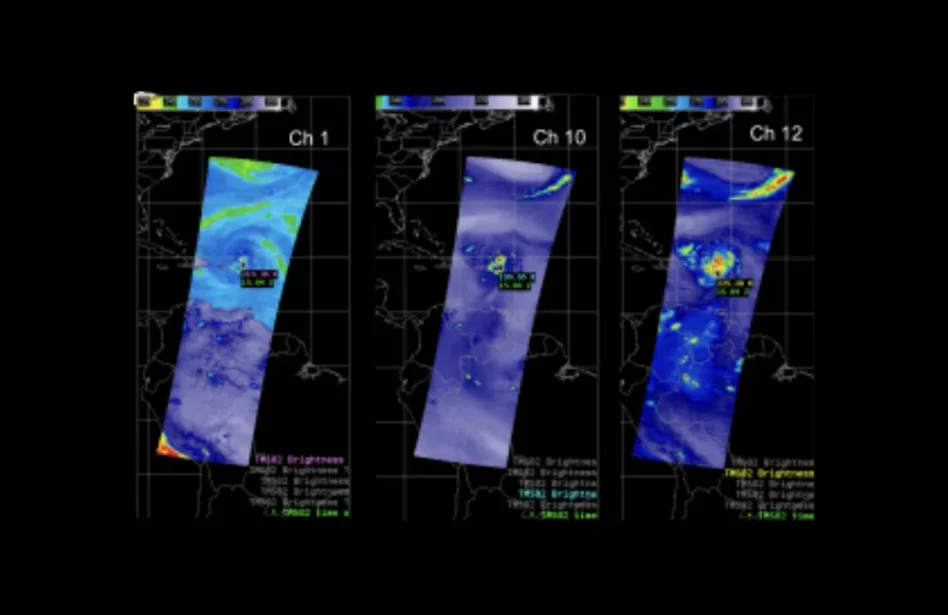
Tomorrow.io’s got its head in the clouds. And the ocean. And everywhere else within the atmosphere, too.
Yesterday, the weather-monitoring company announced a new constellation to track activity across Earth’s atmosphere and oceans. Called DeepSky, the sat network is designed to provide global atmospheric monitoring in real time. That’s a lot of ground to cover.
- The planned constellation would consist of larger satellites than the ones Tomorrow.io has in orbit today, and come equipped with more powerful sensors.
- The company said new types of sensors will also ride on the bigger birds, but didn’t announce what those sensors will be—or how many satellites are planned to be part of the constellation.
- The goal is to complement existing LEO and GEO systems with higher revisit rates and additional sensing capabilities.
- Tomorrow.io calls DeepSky “AI-native,” meaning the constellation will be designed to take advantage of advanced processing and higher data volumes.
“Modern supply chains can no longer rely on static planning or historical averages. True resilience comes from continuously sensing operating conditions and translating that intelligence into network-wide decisions,” Matt Garland, CTO of BNSF Railway (which also heavily uses weather monitoring data for tracking, and is a client of Tomorrow.io), said in a release. “DeepSky represents a meaningful step toward defining a new category of what is possible, as agentic AI becomes a critical part of planning and creating a unified operational picture.”
A step up: DeepSky is the next step from Tomorrow.io’s initial constellation, aptly named Gen1. That first microwave constellation has been collecting weather and ocean data from LEO since May 2023. Gen1 recently achieved a 60-minute revisit rate with the addition of the 10th and 11th satellites in the constellation, according to the company.
The new constellation will take the lessons learned—and government and enterprise customer base—from the first generation of satellites and translate them into more timely, more dense observations of weather and ocean patterns across the globe.

Satlyt Raises $8M Seed to Expand Its Virtual ODC Network
Satlyt was founded in 2024 by Afullo, an alum of SpaceX and Google who spent years trying to convince both companies to invest in in-space edge computing opportunities.
Foundational Raises £8.2M for Satellite Laser Ranging
Foundational emerged from stealth today with Europe’s largest space tech pre-seed round.

Space Insurer Charter Space Raises $5M Seed Round
You can bundle your home and auto insurance with the click of a button, but covering your spacecraft has traditionally been a little trickier.
Exclusive: Hop Aero Raises $11M for Suborbital Point-to-Point Delivery
The suborbital point-to-point logistics company announced $11M in funding today following its participation in the summer Y Combinator batch.


SWISSto12 closed €73M in non-dilutive funding from ESA under the agency’s Advanced Research in Telecommunications Systems (ARTES) program, the Swiss satellite manufacturer announced this week.
Member states who committed the funding at ESA’s ministerial meeting in November include Switzerland, Germany, Austria, Sweden, Norway, and (associate member) Canada.
The new capital—combined with a series of private investments secured in the latter half of 2025—gives the company €100M+ to complete the development of the company’s HummingSat small GEO satellite platform for an inaugural launch scheduled for 2027. The funding also supports SWISSto12’s development of its phased-array antenna tech designed to improve the connection between satellites and ground stations.
Keep reading