


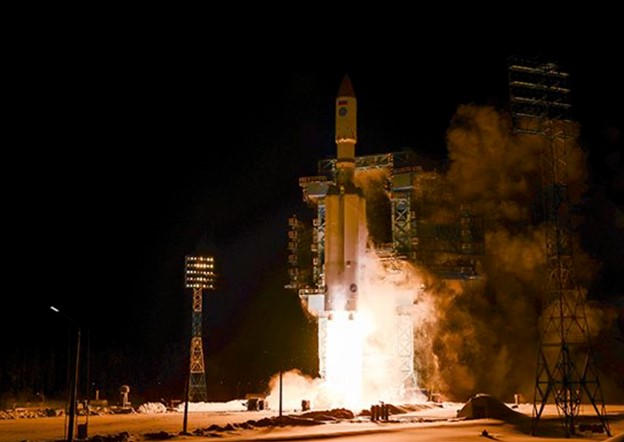
While China is making all the headlines in Space Race 2.0, a DC think tank is cautioning policy makers not to forget about the threat posed by Russia in orbit.
The Atlantic Council published a report looking at Russian capabilities in space—and why existing US policy and resilience is not good enough to protect American space assets.
Context: The paper explores four reasons why Moscow may be more likely to escalate confrontations in space.
- Russian concerns about its own vulnerabilities make Russia more likely to misinterpret US actions in orbit as an attempt to disarm Moscow’s military infrastructure—and for the Russians to react accordingly.
- Moscow could go after America’s space assets, to hurt US access to space for data and intelligence, thereby gaining a terrestrial advantage.
- US resilience in the face of an attack might not be enough to deter Russia from escalating actions in orbit.
- Russia may be more willing to accept self-inflicted damage in orbit, for strategic gains.
The report also game-plans how Russia, the US, American allies, and China would likely react during several conflicts in space, including a nuclear detonation in LEO, an anti-satellite attack that generated debris, and attacks on commercial space assets.
Next steps: The Atlantic Council made 15 recommendations, such as:
- Fielding missile-defense capabilities (cough cough Golden Dome) to stop nuclear or ASAT attacks before they start.
- Improve debris-tracking tech, to better navigate a debris-causing event.
- Build relationships with Indian and Chinese officials as intermediaries to Russia, to avoid escalation or misinterpretation in orbit.
Read more: Dive deeper into the full 88-page report here.

Velos’ Election Day Tracker for Space
Space may not be top of mind when voters head to the ballot box, but Election Day outcomes still have a big impact on US policy and funding above the Kármán line.

Europe’s Space Defenses Fall Just Shy of Weaponization
Europe doesn’t have any weapons in space—but that doesn’t mean the region is comfortable flying around in orbit defenseless.
ArbaLabs Launches AI Verification Demo On South Korea’s Nuri Rocket
“In short, tons of companies are looking at the latest and greatest physical AI deployments,” ArbaLabs CEO Ashley Reeves told Payload. “Nobody is really thinking about putting some checks and balances on what these AI models are doing.”

Colorado Springs, Huntsville Team Up on Golden Dome
“It’s a transformed relationship between Colorado Springs and Huntsville,” Rep. Jeff Crank (R-CO) told Payload. “When I took office, I don’t think it was a bad relationship, but it was one where both communities were kind of looking over their shoulder at the other. That wasn’t good for America, and I don’t think it was good for Colorado Springs or Huntsville either.”


Why build a new satellite, when you can buy one already in orbit?
At least, that was the mentality of officials at HEO, an Australian non-Earth imaging (NEI) startup that announced the purchase of Satellogic’s NewSat-34 yesterday.
The move is a new take on sovereignty. While other national organizations have invested in developing and building new sovereign remote sensing capabilities from scratch, Australia has gained immediate access to sub-meter resolution imagery with the shake of a hand.
Keep reading