


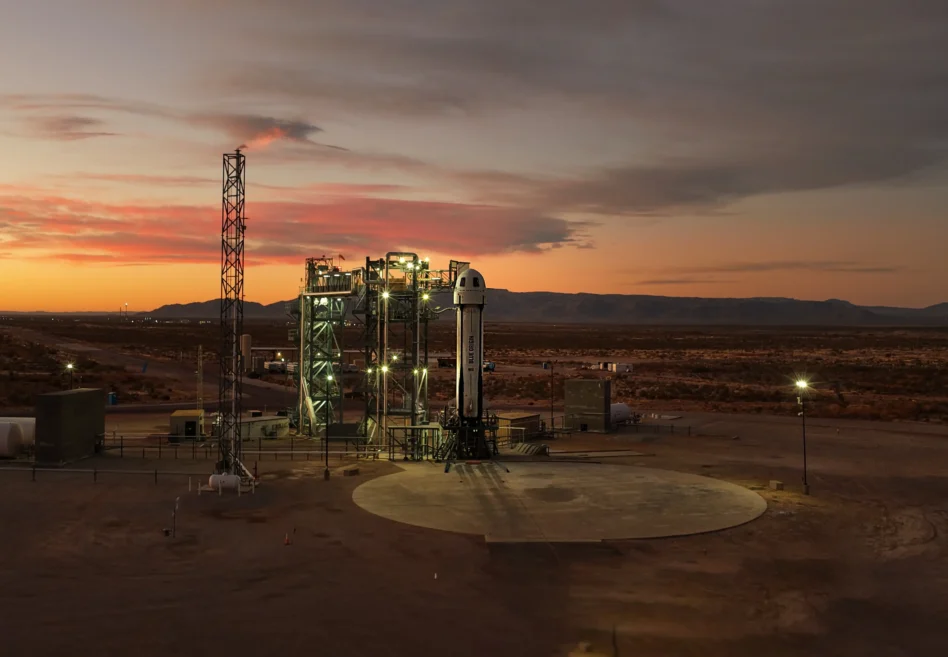
If you were waiting for your chance to spend ten minutes suspended in microgravity at the edge of space aboard one of Blue Origin’s tourist vessels, well, you’re just going to have to wait a little longer.
After 38 launches, including a mix of science payloads and 17 crewed flights, Blue announced Friday that it’s taking a step back from space tourism aboard New Shepard.
- Instead, the company will focus on its lunar program.
- Blue is one of the two companies (along with SpaceX) contracted by NASA to build a vehicle to land humans on the lunar surface no earlier than 2028
- The pause will last at least two years.
The announcement came as a surprise to employees at Blue Origin, who found out via an internal company email on Friday.
“We will redirect our people and resources toward further acceleration of our human lunar capabilities inclusive of New Glenn,” Blue Origin CEO Dave Limp wrote in that email, per Ars. “We have an extraordinary opportunity to be a part of our nation’s goal of returning to the Moon and establishing a permanent, sustained lunar presence.”
The competition heightens: NASA has been yearning for some real competition between its contractors to get to the Moon faster and cheaper, and this move may be just what it needs. Right now, SpaceX is expected to supply the landing vehicle for Artemis III, but there are doubts that the capsule will be ready in time for the agency’s 2028 deadline. If Blue is at its heels and the agency is open to a switch, that adds serious timeline pressure.
For its part, Blue didn’t say much about where exactly it would be putting new resources toward lunar programs beyond increasing New Glenn flight cadence and doubling down on its lunar commitments to NASA.
Out of office: If you’re looking for a space tourism opportunity, SpaceX still has those $55M tickets to visit the ISS. Group trip?
BlackSky Renews HEO Deal, Adds Gen-3 Imagery for Space Domain Awareness
BlackSky Technology inked a seven-figure deal to extend its partnership with Australian non-Earth imaging (NEI) provider HEO for another year.

Nebex Partners with Thrusters Unlimited to Unlock $700M for LATAM Space Ecosystems
The capital will fund EO, telecoms and other strategic capabilities, according to Nebex.

Exclusive: Meridian Space Spins Out from SpinLaunch
“Meridian will carry forward the satcom infrastructure business… SpinLaunch will continue to build on its vision for a lower-cost approach to launch, with further applications in hypersonics to support the Golden Dome program and in the lunar economy,” Meridian Space CEO Massimiliano Ladovaz told Payload.
Rocket Lab CFO Adam Spice Predicts More M&A Deals on the Horizon
Iridium shareholders voted overwhelmingly to approve the company’s acquisition by Rocket Lab. According to Rocket Lab CFO Adam Spice, there’s more M&A on the horizon.


York Space Systems ($YSS) issued shares on the NYSE yesterday in an IPO that netted the satellite manufacturer $629M. The shares began trading at $38, giving York an initial valuation of $4.75B.
The IPO offered a prime opportunity for retail investors looking to ride the wave of US defense spending that’s been buoyed by the Trump administration’s promises of Golden Dome.
Workin’ for the man: In York’s IPO prospectus, the company revealed that the vast majority of its revenue has so far come from government customers. In the first nine months of 2025, for instance, government customers drove $270M in York revenue, compared to just $11M from the commercial sector.
Keep reading