


This week, ESA published its “Document 100” breakdown. This shows funding commitments made by ESA contributing states to each line item on the agency’s €22.07B budget for the next three years.
Member states pledged €902.2M as part of the European Launcher Challenge (ELC) to fund five launch companies’ attempts to set up reliable paths to orbit—Germany’s Isar Aerospace and Rocket Factory Augsburg (RFA), France’s Maiaspace, Spain’s PLD Space and the UK’s’s Orbex.
Double jump: The ELC is a two-step program, with funding tied to specific milestones. Under Component A, ESA will purchase launch services as companies attempt to demonstrate initial capabilities. Then under Component B, ESA will co-fund capacity upgrades.
To remain in the program, launchers must demonstrate their ability to reach orbit no later than 2027, and upgrade their launch capacity (i.e. larger rockets) by 2028. So how much money will each company receive?
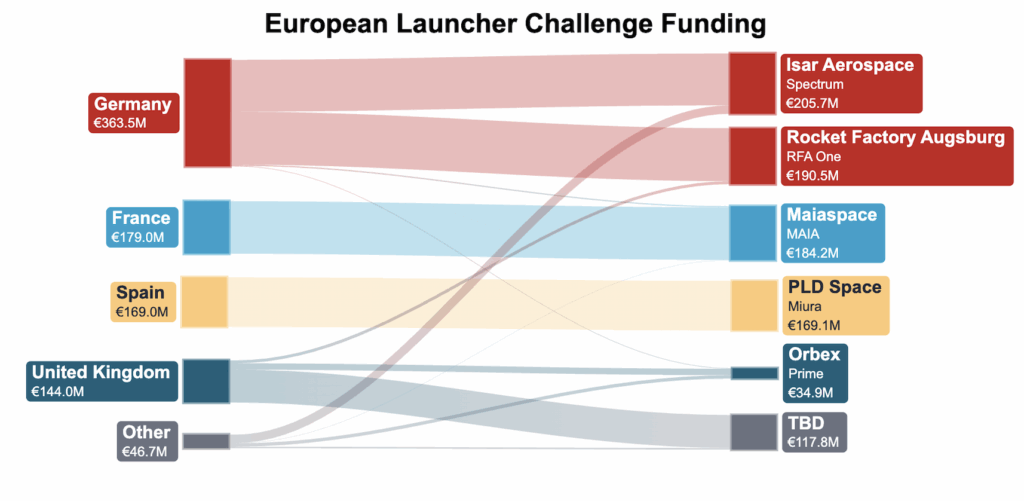
By the numbers: It’s no surprise that Germany contributed the largest sums, as it has two local launchers in the program. Germany pledged €180.5M to RFA’s RFA One rocket, and €176.9M to Isar’s Spectrum. Germany also found room to support international competitors, by committing €4.2M to Maiaspace, €1.8M to Orbex, and €100,000 to PLD Space.
Other nations were less generous, with France and Spain spending all of their funds to back local competitors: €179M to Maiaspace and €169M to PLD Space, respectively.
The UK was even more guarded, and pledged just €21.7M of its total €144M ELC contribution to local launcher Orbex. The UK instead held most funds in an account labeled “to be distributed,” but found room to give €10M towards RFA One, which is expected to launch from the UK’s SaxaVord Spaceport on its next attempt.
This strategy—backing international launchers as a roundabout way to support local launch sites—explains why Norway, which will host flights of Isar’s Spectrum at its Andøya Spaceport, was so eager to contribute. Norway pledged €29.8M to the ELC program, with €25M going to Spectrum, and €4.8M held in reserve.
That’s not all: The ELC program spurred a ton of European-capability investment, but the €902.2M is far from all the funding these companies will receive. As ESA officials pointed out at the agency’s ministerial conference last week, the top-line budget is just part of the equation. Private financiers are expected to co-fund many of the projects in the coming years. In addition, national governments will also, in many cases, purchase spots on initial launches.
PAVE Space Raises $40M for In-Space Propulsion Tech
PAVE’s propulsion systems rely on a storable rocket bipropellant, which aims to make launch operations simpler and more cost-effective, compared with cryogenic fuels.
Inside Austria’s Small But Mighty Space Ecosystem
Austria’s space industry is in the midst of a renaissance, with bigger funding deals and more startup activity.

HyImpulse Signs Launch Agreement with SaxaVord
The second suborbital flight of HyImpulse’s SR75 is expected to lift off from SaxaVord no earlier than Q3 2026.
NanoAvionics Lands Korean National Security Deal
For NanoAvionics, the deal represents the latest win in a strategy of global expansion— which has found an eager and willing partner in the South Korean space industry.

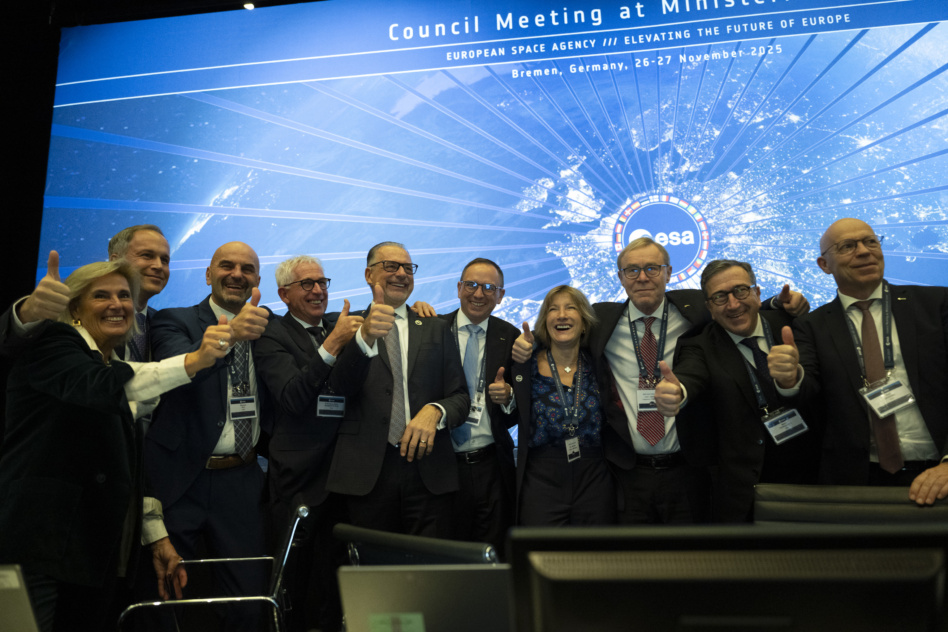
ESA plans to keep subscriptions for a new defense initiative open for the next year, instead of following the typical process of finalizing funding at the close of each three-year ministerial meeting.
ESA’s new, record-breaking budget of €22.07B for the next three years includes funding for its proposed European Resilience from Space (ERS) program—a military-grade system of systems, providing surveillance, communications, navigation, and EO capabilities.
The proposal secured €1.2B of the €1.35B sought. The agency now wants to raise at least a further €250M from European defense ministries.
Keep reading