



ESA plans to keep subscriptions for a new defense initiative open for the next year, instead of following the typical process of finalizing funding at the close of each three-year ministerial meeting.
ESA’s new, record-breaking budget of €22.07B for the next three years includes funding for its proposed European Resilience from Space (ERS) program—a military-grade system of systems, providing surveillance, communications, navigation, and EO capabilities.
The proposal secured €1.2B of the €1.35B sought. The agency now wants to raise at least a further €250M from European defense ministries.
Hired guns: ERS marks a fundamental shift in ESA’s approach to defense. Since its founding in 1975, the agency has pledged a peaceful direction. ESA Director General Josef Aschbacher now points to a “clear defense and security mandate from its member states,” to stimulate funding for ERS.
Such an existential mandate motivates the unique intervention of a one-year extension.
“It’s probably late in the process to now switch budgets from classical defense spending into ESA, so there’s more work to be done in the next months,” Aschbacher told press. “We want to keep it open to collect more money, in addition to what we get today.”
ERS will cover efforts such as its €175M ERS-EO initiative—an electro-optical and radar intelligence, surveillance, and reconnaissance (ISR) satellite constellation supporting the existing Earth Observation Governmental Service (EOGS), expected to launch its first satellite in 2028.
EOGS aims to “harness space data in support of autonomous European decision-making in the area of security and defence,” according to the EU. It aims to align with the defense-focused Readiness Roadmap 2030 plan.
The plan includes the construction of a “European Space Shield,” which—like the American “Golden Dome”—could refer to a number of spaceborne capabilities. The European Space Shield Action Plan describes a series of dual-use space capabilities for EU governments in the fields of PNT, delivered through the Galileo navsats, EOGS, and the secure IRIS² sat constellation beginning in Q2 2026. European Council officials have told Payload that specific details on the space shield architecture are still being discussed. Further EOGS funding will be voted on by the EU Council Dec. 18 and 19.
Battle readiness: Whether ESA can take on a defense project at the scale of ERS is unclear. Keeping subscriptions to ERS open under a one-year extension casts doubts on ESA’s intention to field a pathfinder satellite by 2028.
Experts and analysts have said the politics behind the project are fragile, with suggestions that the agency is stalling for time, as officials work to secure funding for other ambitious projects. ESA has a lot on its plate, including commitments to the Artemis Moon missions, aspirations to support the development of rockets to eventually succeed Arianespace’s Ariane 6, and launching IRIS2 by the 2030s.
Commerce Unveils One-Stop Licensing Proposal For Novel Space Missions
The plan is the latest step in the years-long saga surrounding mission authorization—or which agencies have regulatory authority over novel space missions that don’t fit into the existing framework.
PAVE Space Raises $40M for In-Space Propulsion Tech
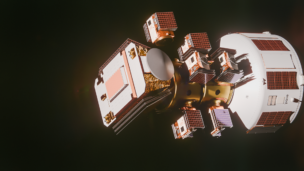
PAVE’s propulsion systems rely on a storable rocket bipropellant, which aims to make launch operations simpler and more cost-effective, compared with cryogenic fuels.

One-On-One With SDA’s GP Sandhoo
It’s been about six months since the SDA launched its first operational tranche of satellites—but troops still aren’t benefiting from the better comms tech because of a series of small issues that forced the agency to take a “strategic pause,” SDA Acting Director Gurpartap “GP” Sandhoo told Payload.

SpaceX v. Amazon Heats Up at the FCC
In a world where regulatory filings can feel dull and dry, this case brings the drama—and the snark. Let’s walk through how these two satcom mega constellations are publicly dueling in a governmental arena.
Part 1 in a series on orbital communications
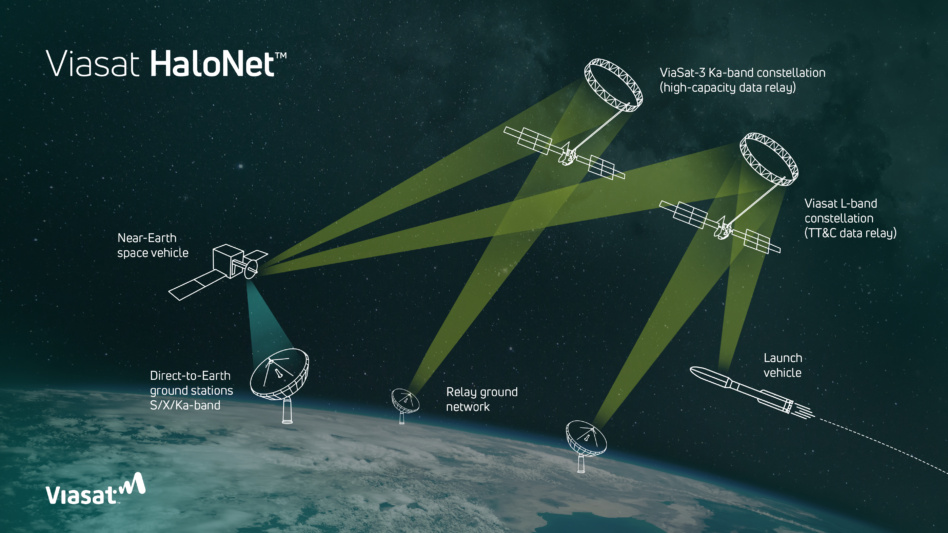
As LEO satellite numbers grow into the tens of thousands, maintaining reliable connectivity is a significant challenge for the space industry. Ground coverage gaps, spectrum bottlenecks, and NASA’s planned Tracking and Data Relay Satellite System (TDRSS) retirement create both a communications cliff and an opportunity. Viasat, a global communications company, aims to fill this gap with HaloNet, its holistic space relay network, offering secure multi-band, multi-path connectivity and data transport solutions.
“HaloNet is an end-to-end communications solution for spacecraft and launch vehicles,” said Elias Naffah, Director for Space Systems Strategic Development at Viasat Government, Space and Mission Systems. “It’s designed to provide all the different comms needs that missions have, in a seamless fashion, with a simplified interface.”
Keep reading