


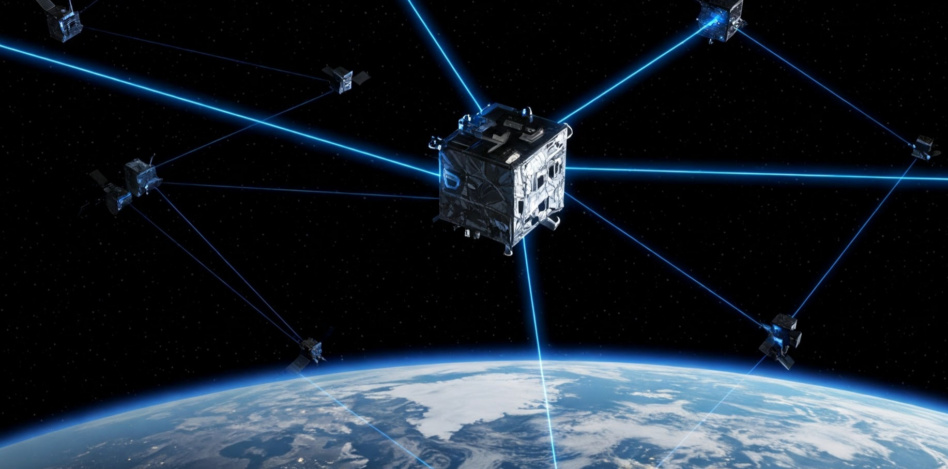
Ravee Optics has closed a $6M seed round to fund the development of its ultra-compact laser communications terminals.
BIG Global Investment JSC led the round, which also included participation from CincyTech Fund VI and JobsOhio Growth Capital Fund.
Why it matters: Satellites are gathering more data than ever, but the phone lines are starting to jam. RF thoroughfares are being pushed past their limit, and a huge share of the data gathered on-orbit never makes it back to Earth.
To solve this problem, many satellite operators have turned to laser-comms tech, which offers greater data throughput. But the hardware remains prohibitively bulky, expensive, and hard to acquire for the vast majority of smallsat operators.
Ravee Optics’ solution is designed to bring laser comms to the masses. The company’s tech is based on meta-optics, and uses silicon wafers—not bulky lenses—to manipulate light. The aim is to create terminals that are lighter, smaller, and easier to manufacture at scale.
“Mynaric Condor is kind of the gold standard for an independently manufactured terminal. It’s approximately 20 kilograms and 25 liters,” Ravee Opticsa’ CTO and cofounder Augustine Urbas told Payload. “Our compact terminal will offer comparable performance in two kilograms and two liters.”
The upgrade would make it possible for laser terminals to fly on smaller sats, but it also represents huge potential savings in launch costs to sats large and small, as compact terminals reduce the overall weight of satellites without sacrificing performance.
The market: The timing couldn’t be better. Ravee Optics’ seed round comes as the demand for laser-comms tech is exploding.
- New defense constellations—like Golden Dome—will require laser-comms capabilities to achieve near-real-time data transfer from orbit.
- The growing pool of in-orbit data center companies have created business plans that rely on laser comms to ferry around petabytes of data.
With smaller, lighter-weight terminals, those capabilities should be easier to achieve, and the business models look a lot more attractive.
“When you look to the future of how many terminals might be needed, it goes from tens of thousands to potentially millions,” Urbas said. “The savings in launch cost and supply chain multiply tremendously when you come up with a technology that can do…competitive data rates, but in a much smaller, lighter and more readily manufacturable system.”
What’s next: Ravee Optics has validated its core tech in the lab, but will spend the next two years completing ground demos and conducting qualification tests. The goal is to fly an in-orbit demonstration in early 2028.
From there, the business model is all about manufacturing at scale, and Ravee’s use of silicon wafers allows the company to tap into the existing silicon wafer manufacturing base before needing to bring manufacturing in-house.
“The manufacturing side of our core technology is already established infrastructure with existing foundries,” Ravee Optics CEO and cofounder Piyush Shah told payload. “Chip manufacturing goes through multiple steps—like 25 steps or more—and for optics manufacturing, it’s the exact same infrastructure, but just one or two steps. That’s it.”
Exclusive: EraDrive Lands $13M DoD Award For Autonomy Module
EraDrive won a $13M DoD award, under which the Space Force will buy an undisclosed number of the company’s Era-Node vision-based autonomy modules.
WarpWare Closes Pre-Seed to Bring Agentic Tools to Flight Software
CO-based WarpWare closed its $1.2M pre-seed round today to expand what it calls an AI-enabled engineering platform for space missions.

RATLOG Wants to Cut ~90% of a Rocket Engine’s Parts
The heavy-lift rocket startup debuted on Y Combinator as part of the Fall 2026 batch.

Seraphim Space Investment Trust Doubled its Value in 2026
Seraphim’s major holdings—ICEYE, ALL.SPACE, D-Orbit, HawkEye 360, and Xona Space Systems, which together represent more than 75% of the firm’s portfolio—all had a great year, and that success has trickled upwards.

We’ve officially closed out the first half of 2026—and investments in the space industry are blasting off.
More than $6.6B has been invested in the space industry in the first half of the year, according to data compiled by our friends at Payload Pro.
Look back: If rounds that used to raise eyebrows now seem commonplace, it’s not your imagination.
Keep reading