


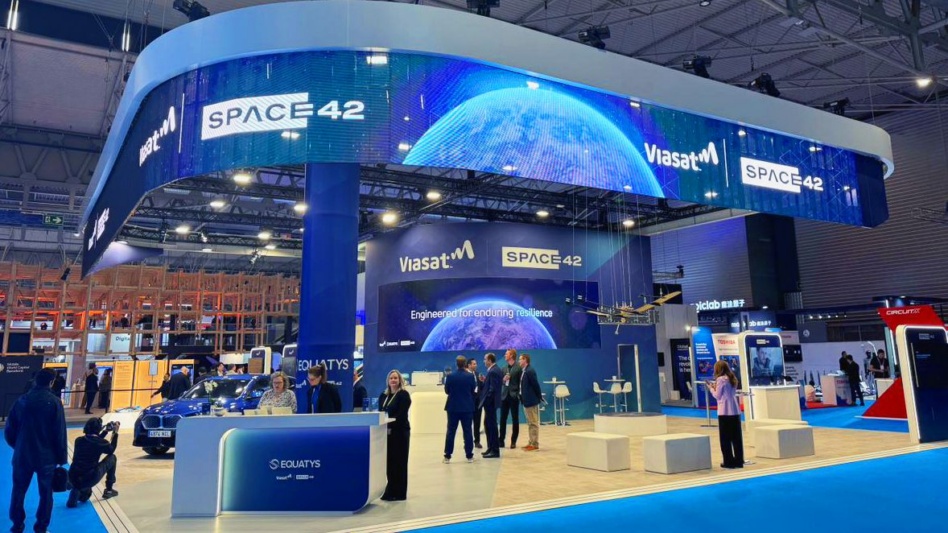
BARCELONA, Spain — Satellite operating giant Viasat ($VSAT) and its UAE-based partner Space42 ($SPACE42) have filings for a constellation of up to 2,800 sats to bring connectivity to billions of people with their Equatys joint venture, announced in September.
The two companies cancelled a media roundtable here at the Mobile World Conference following American strikes in Tehran, which stranded countless execs in Middle East airports due to the ripple effects on global air traffic. However, Viasat CEO Mark Dankberg still shared a rundown with Payload at the conference about the Equatys’ priorities.
- The system is intended to initially operate in harmonized L- and S-band MSS spectrum, with the ability to use over 100 MHz of allocated and coordinated MSS spectrum.
- Its shared multi-tenant infrastructure will be supported by up to 2,800 satellites, operated by both Viasat and Space42, across 60 orbital planes and three altitude layers.
- Equatys has already announced partnerships to explore options with e& UAE (a large Emirati tech group), and PT Telkom Satelit Indonesia (Telkomsat), the national satellite operator.
“Equatys is establishing an industry-first tower company model that can deliver the lowest unit cost of satellite capacity, while preserving each partner’s spectrum rights and sovereign interests. What that means for people all over the world is ubiquitous, affordable, scalable mobility,” Dankberg told Payload. “The idea is that if we share the infrastructure, then the overall costs can go down.”
Stronger together: Viasat has applied this “collaborate to compete” mindset before, both in its landmark 2023 acquisition of Inmarsat, and the company’s founding status with the Mobile Satellite Services Association (MSSA). Founding members of the association include Terrestar Solutions, Ligado Networks, and Omnispace. Space42 also secured a spot on the board after its founding.
“Interoperability and co-ordination is vital across the ecosystem, and that is what we are working on,” Dankberg said. “Through Equatys, each partner can employ its spectrum rights effectively and efficiently using shared system resources. In turn, that will allow us to generate satellite capacity at substantial cost savings, and connect billions of devices.”
Speaking from stages throughout the show, one connectivity CEO after another spoke of regulatory constraints in Europe limiting their ability to compete with the companies of the US and China, with some directly linking that issue to sovereignty concerns.
Eutelsat CEO Jean-François Fallacher explained his company was “in fighting mode” to counter the growing dominance of SpaceX Starlink, China’s Guowang constellation, and the rollout of Amazon Leo.
Deutsche Telekom execs were also concerned. “If we want to keep sovereignty, [and] the wealth in the European constituencies, we have to own these categories—because otherwise our wealth is moving out of the continent,” CEO Timotheus Höttges told attendees.
Bottom line: Europe has been infamous as a regulatory giant, with strong standards for safety, security, and workers rights. Its grandiose targets for homegrown vertically integrated technologies and strong economic growth, however, have led a growing narrative around the need for industrial expedience—even at the cost of rolling back worker protections and steadfast regulatory policy.
The EU Space Act is being drafted with aims to minimize Europe’s fragmented regulatory landscape, though it’s heavily debated if the current iteration would succeed in greasing the wheels of industry.
Update: This article was updated for clarity at 2:00pm ET.
PAVE Space Raises $40M for In-Space Propulsion Tech
PAVE’s propulsion systems rely on a storable rocket bipropellant, which aims to make launch operations simpler and more cost-effective, compared with cryogenic fuels.
Ramon.Space, Ingrasys Aim To Fly Prototype Orbital Data Center In 2027
There’s another entry in the space-data-center race.

Contrivian Launches New Product Bundling Amazon Leo & Starlink
Customers looking for satellite connectivity are often forced to choose between one provider or another. Those days are over.

Inside Austria’s Small But Mighty Space Ecosystem
Austria’s space industry is in the midst of a renaissance, with bigger funding deals and more startup activity.

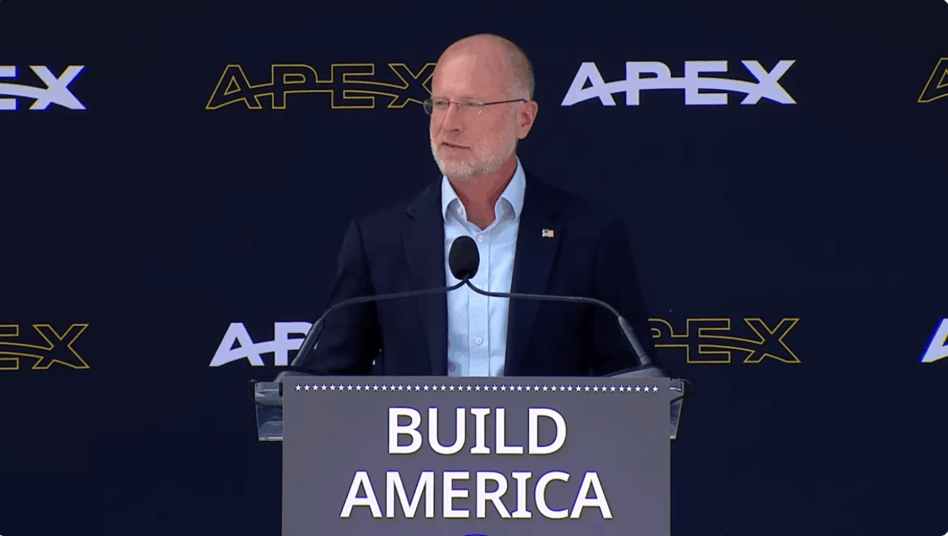
The FCC has a plan to support the space industry sectors that feel more science fiction than fact.
FCC Chair Brendan Carr yesterday announced a proposal to provide spectrum access to “weird space stuff” (his words, not ours.) That includes missions such as orbital labs, in-space repairs, and commercial space stations.
“Whether we’re talking about repairing a satellite in orbit or creating pharmaceutical solutions to our health-care challenges in a space lab, these very real ventures will require very real resources, including secure radio signals for control and basic operations,” Carr said in a statement. “Today’s proposal is the first step toward the spectrum abundance needed to give America’s space activities the predictable spectrum environment they need to thrive.”
Keep reading