


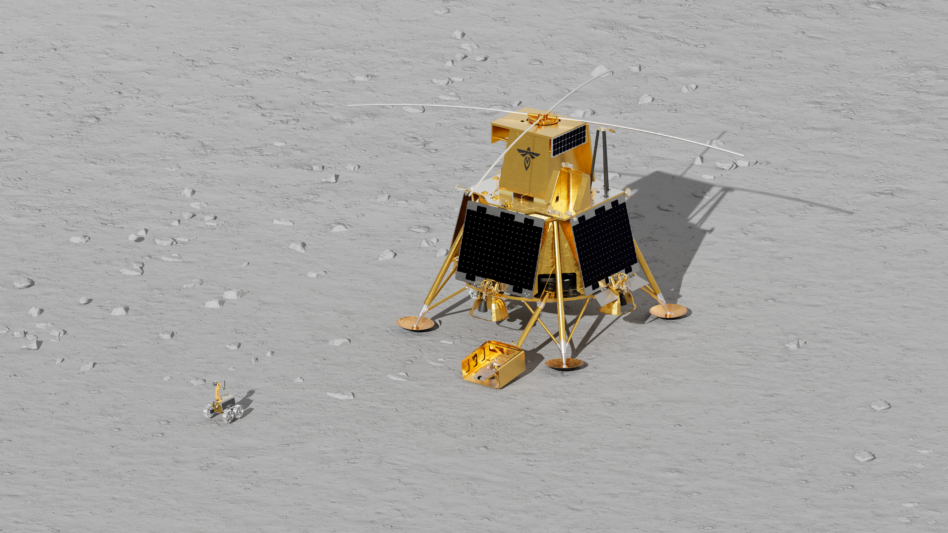
Firefly Aerospace ($FLY) announced yesterday that it acquired Space-ng, which is an AI-powered vision navigation and autonomous guidance systems provider.
While financial details have not been disclosed, Space-ng will be fully integrated into Firefly and Space-ng Cofounder and CEO Ethan Rublee will oversee Firefly’s spacecraft software suite as its newly established chief engineer of software.
“There’s a lot of synergies here,” Firefly CEO Jason Kim told Payload. “Not only can Space-ng’s capabilities help us with landing on the Moon, they can help us with all the other missions that need that kind of real-time navigation and hazard avoidance.”
Charted territory: The two companies are already well-acquainted. Space-ng’s vision-navigation software guided Blue Ghost Mission 1’s lunar descent through autonomous hazard detection and real-time terrain avoidance.
Space-ng also brings high-resolution spacecraft cameras and AI-compute hardware, both of which are critical for upcoming Firefly missions.
- CLPS: Blue Ghost Missions 2, 3, and 4 will require precise autonomous landing on the lunar surface. Space-ng’s vision navigation and hazard avoidance software will guide those touchdowns.
- MoonFall: Firefly’s Elytra OTV will deliver four drones to the lunar south pole for NASA’s MoonFall mission, one of the first missions of NASA’s Moon Base. Space-ng’s optical navigation and AI compute hardware both enable precise positioning where GPS is unreliable.
- Sinequone: Elytra will conduct SDA operations in LEO as part of DIU’s Sinequone Project, where Space-ng’s cameras and AI hardware become the eyes and processing power for tracking objects in orbit.
“This is a very crucial, critical part of the Moon mission,” Kim said. “You’ve got to successfully, repeatedly, reliably land, and that’s what Space-ng’s vision navigation system does for us.”
To build or to buy: The Space-ng deal marks Firefly’s second major software acquisition in the past year, after acquiring AI defense software company SciTec in October 2025.
For Kim, the decision to acquire—instead of continuing to work with Space-ng as a vendor—was a strategic opportunity. Firefly will offer Space-ng’s capabilities to government and commercial customers—creating new revenue streams—while in-house ownership opens the TAM for more diverse mission capabilities.
“One of the things that we’re trying to enhance at the company is we’re vertically integrated,” said Kim. “We build our own rocket engines. We build our own rockets, and our lunar landers, and our spacecraft. Then, we acquired another software company last October. In terms of additional navigation software, we really saw a one-plus-one-equals-four kind of moment.”
Space-ng is unlikely to be Firefly’s last acquisition. Kim noted that Firefly has a “robust M&A pipeline” focused on companies that fit its culture and strategy.

Nebex Partners with Thrusters Unlimited to Unlock $700M for Mexico’s Space Ecosystem
The capital will fund EO, telecoms and other strategic capabilities, according to Nebex.
Exclusive: Meridian Space Spins Out from SpinLaunch
“Meridian will carry forward the satcom infrastructure business… SpinLaunch will continue to build on its vision for a lower-cost approach to launch, with further applications in hypersonics to support the Golden Dome program and in the lunar economy,” Meridian Space CEO Massimiliano Ladovaz told Payload.
Rocket Lab CFO Adam Spice Predicts More M&A Deals on the Horizon
Iridium shareholders voted overwhelmingly to approve the company’s acquisition by Rocket Lab. According to Rocket Lab CFO Adam Spice, there’s more M&A on the horizon.
TRL11 Will Build Imaging Tech for SR-1 Freedom
TRL11 has received a NASA contract to provide imaging systems for the Space Reactor-1 (SR-1) Freedom mission to Mars.

This content is restricted to subscribers
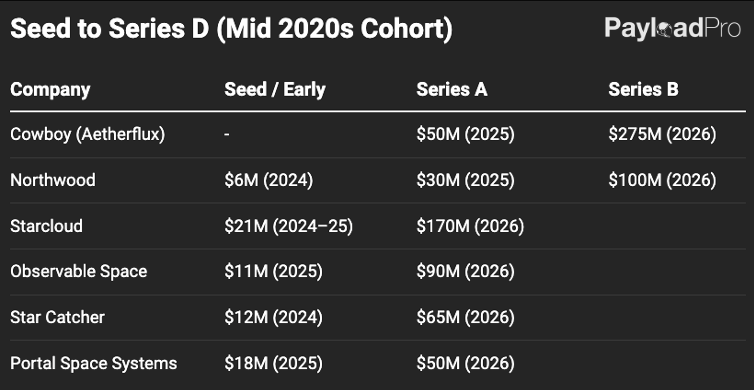
The post A New Crop of Early Stage Space Startups Emerges appeared first on Payload Pro.
Keep reading