


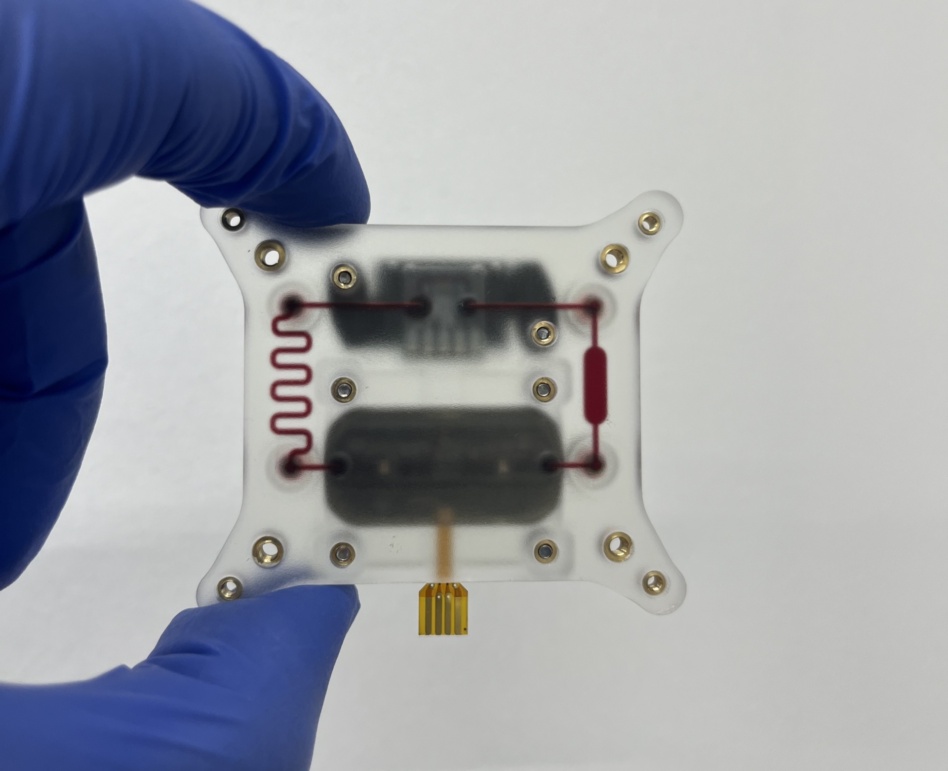
While Europe made strides in standing up its sovereign launch capabilities, it’s long had to rely on the US and Russia to bring things home safely—that is, until now.
ATMOS Space Cargo, the German company leading the charge for reentry services on the continent, launched its first reentry capsule to orbit this week aboard the SpaceX Bandwagon-3 mission.
Four payloads hitched a ride on the Phoenix-1 reentry vehicle: The publicly released ones include a radiation detector from DLR; a micro imaging device from IDDK, a Japanese biotech firm; and a miniature bioreactor from UK-based Frontier Space.
Weird science: Frontier’s first mission is designed to test key components of its lab-in-a-box bioreactor, including its microfluidics chip and its onboard optical imaging system. The mission will also evaluate Frontier’s ability to transport and store microorganisms in microgravity.
The long-term vision is to give astronauts the ability to manufacture the food and medicine they’ll need, instead of packing tons of shelf-stable supplies for long journeys, whether in LEO or deep space.
“Imagine, when you go to the Moon and Mars, you don’t need to carry all the raw materials from Earth because it’s going to be expensive. You can carry a few milligrams of microbes, grow them, and then get your pharmaceutical ingredients,” Aqeel Shamsul, Frontier Space’s CEO, told Payload.
If Frontier’s tech takes off, it could spell the end of freeze-dried astronaut food. Future space travelers could enjoy freshly-printed meals, vitamins, medicine, and biofuel with the help of the lab-in-a-box.
Cost covering: The company is pushing forward on other streams of revenue to keep the lights on while those use cases materialize, including off-Earth R&D for pharmaceutical companies.
Getting in-space manufactured drugs approved for human consumption is uncharted territory, but the company has identified several drugs its bioreactors can help manufacture down the line.
“The challenge that we face in this new industry is not really technology…it’s actually economics,” Shamsul said. “We’ve identified internally several drugs that can really benefit from this innovation. That means that we just need to manufacture, let’s say, one gram of it—and that can already cover its own mission costs, and fixed costs.”
Correction: This story has been updated to correct the spelling of the name of Frontier CEO, Aqeel Shamsul.
Xona Space Systems Raises $170M Series C to Scale Private GPS
Xona has spent the past few years building its ability to transmit PNT signals in LEO that are stronger, more accurate, and more secure than traditional GPS.
Arkadia Space Secures €14.5M to Develop New Biprop Engine
Spanish propulsion startup Arkadia Space just secured a stamp of approval from the European Investment Council.
PAVE Space Raises $40M for In-Space Propulsion Tech
PAVE’s propulsion systems rely on a storable rocket bipropellant, which aims to make launch operations simpler and more cost-effective, compared with cryogenic fuels.

Symphony Space Unveils Adagio Hosted Payload Platform
Symphony Space is building a new model for hosting payloads—one where the satellite remains in orbit and the payloads come and go.


The Trump administration has ordered the Pentagon to speed up its defense acquisition process—but that will require trained staff to quickly get new commercial tech under contract, according to Col. Richard Kniseley, the senior materiel leader of Space Systems Command’s Commercial Space Office.
“The Space Force is the smallest force that we have right now, and heavily reliant on some of our civilian personnel. As much as I love the focus on commercial, I’m going to need people to get this on contract,” he said at Payload’s Polaris After Dark event in DC on Monday night. “These are challenges we’re dealing with right now. I’m sure we will overcome them, but it will hamper us as far as moving the needle.”
His remarks highlight the tension between the EOs coming out of the White House, which call for both a reduction to the workforce and an improved process for buying platforms and services at the Pentagon.
Keep reading