


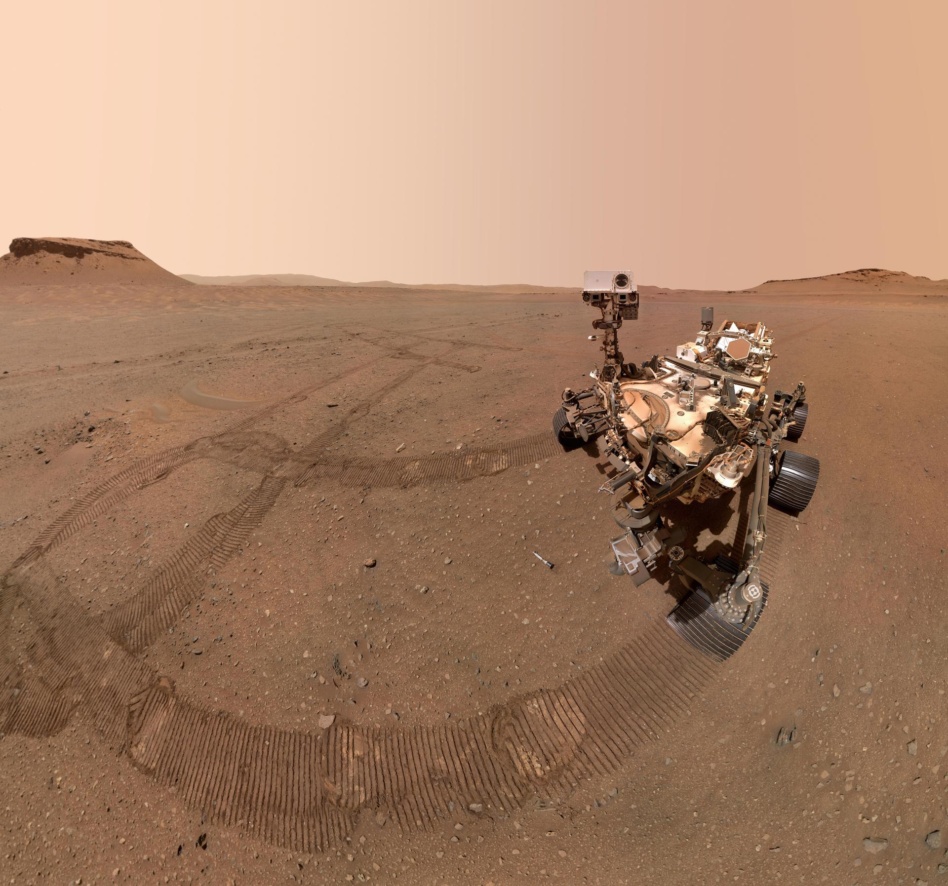
The dozens of tubes of Martian dust collected so far by the Perseverance rover are waiting for a ride that may never come.
The House minibus appropriations bill governing NASA spending in FY2026, which was released this week, doesn’t mince words. “The agreement does not support the existing Mars Sample Return (MSR) program,” lawmakers wrote in an accompanying report explaining why lawmakers structured the bill the way they did.
How we got here: The Perseverance rover landed on Mars in February 2021, gradually collecting at least 33 samples for later pick up and return. It was expected to be the first in a three-part journey to return the samples to Earth.
However, runaway budgets that drove costs up to $11B forced the space agency to press pause on the mission in 2023, despite it being one of the top priorities in the last two planetary decadal surveys.
In 2024, NASA asked industry for cheaper solutions, hoping its reliance on commercial tech for cargo, crew, and beyond could extend to the Red Planet. In January 2025, former NASA chief Bill Nelson laid out two options, both with a $7B+ price tag:
- Using existing tech from JPL to bring the samples to Martian orbit, where they would be picked up by a European-built craft for the ride back to Earth.
- Using a commercial heavy-lift lander to conduct the mission.
However, lawmakers have picked a third option: axing MSR entirely—at least for now.
Hope, is that you? The report is clear that this is the end of MSR in its current form, but not the end for some of the tech that the program was working to develop. The spending bill—which still needs to pass Congress—would appropriate $110M for future Martian hardware, including for radar, landing, entry, and descent. That money could go to in-progress efforts for sample return, which are widely applicable to future exploration of Mars.
Space Race: Martian Drift: If the age of Apollo marked the first space race, and the so-called Space Race 2.0 is the competition to build lasting infrastructure on the lunar surface, it stands to reason that Mars is the third chapter of the global space competition. Though Mars is very different from Earth, Space Race Versions 2 and 3 share one big similarity—China is hot on America’s heels.
Beijing is working on its own plan to bring Martian samples back to Earth, dubbed Tianwen-3. The spacecraft is expected to launch in 2028, and to bring back at least 500 grams of Martian regolith by 2031, Chinese officials announced last year.
“The mission will be a critical step in China’s planetary exploration. We hope to provide the international community with an unprecedented opportunity to understand Mars,” Hou Zengqian, chief scientist of the mission, said in a release.

Jared Isaacman Hits 100 Days In Office With a Bang
NASA Administrator Jared Isaacman has one message: Get in, we’re going to the Moon.
Lawmakers Question NASA’s Shifting Vision for CLDs
NASA Administrator Jared Isaacman proposed a new plan for America’s human presence in LEO that left many lawmakers scratching their heads.
Commerce Unveils One-Stop Licensing Proposal For Novel Space Missions
The plan is the latest step in the years-long saga surrounding mission authorization—or which agencies have regulatory authority over novel space missions that don’t fit into the existing framework.

SpaceX v. Amazon Heats Up at the FCC
In a world where regulatory filings can feel dull and dry, this case brings the drama—and the snark. Let’s walk through how these two satcom mega constellations are publicly dueling in a governmental arena.


Golden Dome’s first fight will be won or lost on its ability to see.
The layer of sensors acts as the eyes of the C4ISR enterprise. Without sensors, the command-and-control architecture has nothing to process, or act upon. Sensors are the first link in the chain—and if that link breaks, everything downstream collapses.
The problem: The threat environment is unforgiving. Hypersonic glide vehicles compress timelines to minutes, drone swarms overwhelm with sheer numbers, advanced decoys muddy targeting pictures, and cyber-spoofed signals erode trust in data feeds. Together, these threats press relentlessly on the sensor layer. That makes the layer of sensors both Golden Dome’s weakest point, and its greatest potential strength.
Keep reading