


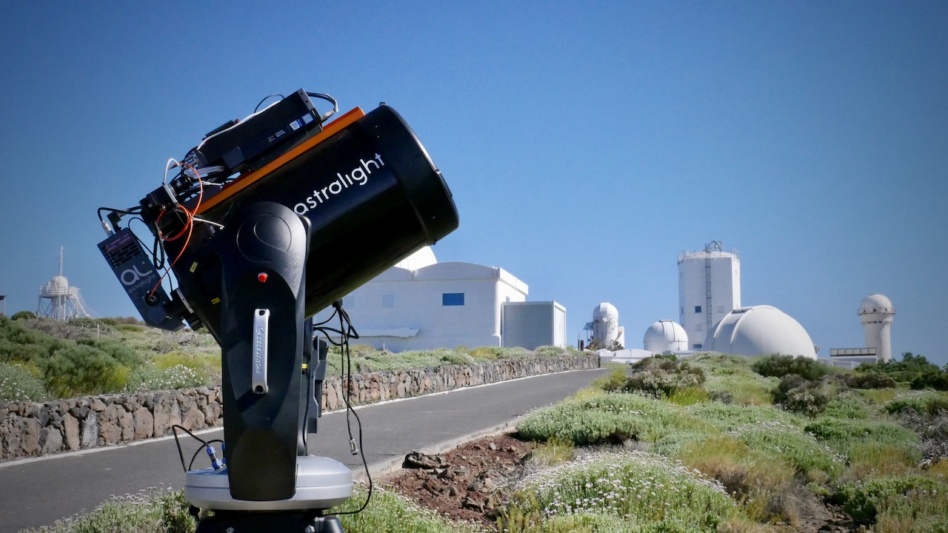
Instances of satellite interference are on the rise. Last week, Maj. Gen. Paul Tedman, head of the UK Space Command, revealed that Russian attempts to jam UK satellites are a weekly occurrence.
In response, European governments are heavily investing in more robust networks, and increased counterspace capabilities. On the commercial front, a sea of startups have begun focusing on optical communications technologies to help usher in an era of secure communications on the continent.
Meet Astrolight: One of these companies, Astrolight from Lithuania, spoke with Payload about its plans and how it hopes to help bring about a more secure European communications network.
“It takes many years for new technologies to be adopted in space,” Astrolight CEO Laurynas Mačiulis told Payload. “In our case, the problem is that you also need communications infrastructure…it doesn’t matter if you put a laser comms terminal on your satellite. It’s really not worth any value if you cannot have a communications infrastructure on the ground.”
If you build it… Astrolight’s plan is to develop multiple optical communications technologies at once, to build a system reliable and robust enough for commercial and government satellite operators, including:
- Optical ground stations;
- Laser terminals for intersatellite links;
- Optical terminals for Navy vessels to perform secure ship-to-ship or ship-to-shore comms.
In May, Astrolight raised a €2.8M seed round to support these projects, and the company has already made significant progress developing its multifaceted network. Astrolight is planning to deploy its first optical ground station in Greenland as early as next year, and expects to demonstrate its first payloads for intersatellite links in 2027, according to Mačiulis.
“We want to build out a global network so that these satellites will not only be able to talk via optical in space, but also space-to-ground because eventually…you’re going to create bottlenecks to the ground, and that needs to be solved as well,” Mačiulis said.
Come one, come all: While the national security space community’s demand for optical comms technology is high, Astrolight’s vision is to create dual-use technology that can easily integrate with military and commercial sats alike. For commercial EO operators, Mačiulis said the value of lasers is clear: Getting around the increasingly strained communications spectrum.
“We would like to build out a minimum viable network…not constrained by the limitations of radio frequency links, in terms of data rates and the spectrum availability,” Mačiulis said. “It’s not only security, but also an interference problem, whereby you have a limited spectrum.”

Inside Finland’s Rapid Rise as a Space Powerhouse
Finland’s space industry has a lot going for it.
NASA Authorization Could Kick Start Space Nuclear Power
The fate of the NASA authorization bill being considered by Congress now could be a make or break moment for the budding space nuclear power sector, according to one company.

SatVu Raises £30M to Accelerate its Constellation
SatVu’s plans for the new capital are twofold: accelerating deployment of its HotSat constellation, and fulfilling demand from across the market.
Kepler Plots European Expansion with NanoAvionics Deal
Kepler Communications and Kongsberg NanoAvionics have teamed up to put on a laser show for Europe.


Stoke Space has raised a whopping $510M Series D to fund development of its Nova rocket.
The round, which brings Stoke’s total fundraising to $990M, will enable the launcher to boost production of Nova, complete its work at Launch Complex 14 at Cape Canaveral Space Force Station, and prepare for its expected high launch cadence.
Meet Nova: Nova is designed to be a fully reusable rocket that’s expected to lift off on its first orbital test flight next year.
Keep reading