


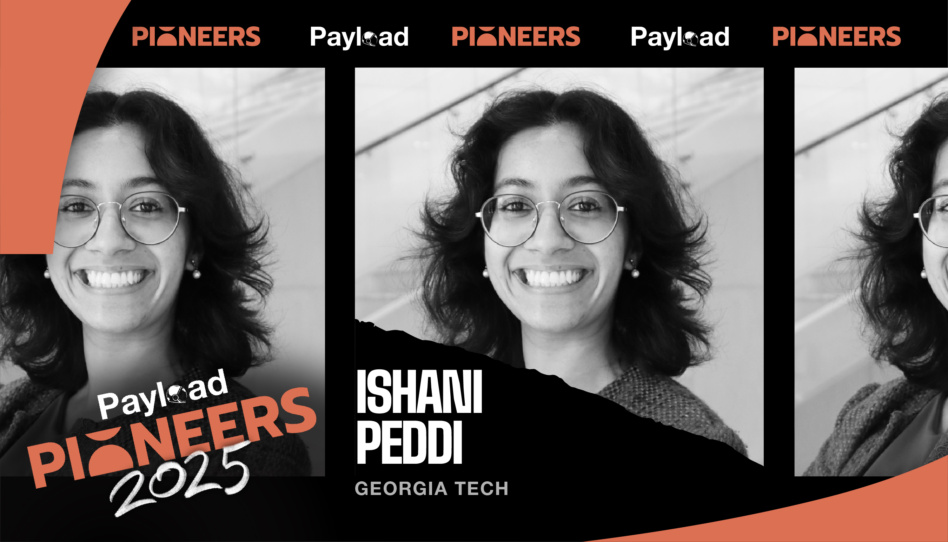
Ishani Peddi knows that money makes the world go around—and that’s especially true when it comes to sustainability in orbit.
The 22-year-old, who is pursuing a master’s degree at the Georgia Institute of Technology, said she believes that tying financial and economic incentives to debris removal is key to moving the conversation from aspiration to action.
“We have the tech, and we have conversations surrounding it, but no one’s making anyone do it. I think adding the financial and economic piece is what will bridge that gap,” said Peddi. “Once you put a number on it and show this is how it’s going to hurt your business, or this is how much it’s going to cost—that’s how we can get the job done.”
From propulsion to policy: Peddi’s journey began as an aerospace engineering major at Georgia Tech, where she focused on climate change and propulsion research. However, her experience in summer 2023 as a Brooke Owens Fellow at Ball Aerospace (now part of BAE Systems, $BAES) led her to explore the intersection between space and government affairs.
After another year of internships and research in space policy, Peddi switched her major, figuring that economics could blend her technical background with her passion for policy.
“I had three years of technical experience under my belt, but I really wanted to learn about how money flows, and how policy works, from a quantitative perspective,” said Peddi.
After graduating this past May, Peddi interned at the Center for Strategic and International Studies through the Matthew Isakowitz Commercial Space Scholarship, where she focused on researching Chinese space manufacturing capabilities.
What’s next: In August, Peddi returned to Georgia Tech to pursue a master’s in international affairs, science, and technology—her next step in building the policy foundation she sees as essential to making a positive impact on the world, and future generations.
“I think implementing policy and…really understanding what matters to people is how you can make real, lasting change.”

Payload Pioneers: Where Are They Now?
Since 2023, the Payload Pioneers program has recognized 90 young stars of the space industry. After three years, we wanted to check in on where some of our 30-under-30s are today.


Thomas Santini, Lodestar Space
As the cofounder of Lodestar Space, Santini is building in-space, bodyguard-like technology to protect and defend UK and Western defense assets in orbit.

Nikita Shetti, Viasat UK
“It’s good to get the big picture of the satellite, both pre-launch and post-launch as well,” Shetti told Payload. “It definitely fixed the jigsaw puzzle.”


A new entity is trying to bridge the language gap between space startup execs and policymakers.
Station DC, a non-profit tech incubator in DC’s Union Market neighborhood, opened its doors last month just before the US government shutdown. Its mission is simple: Connect policymakers and builders in the same room to shape the future of American technology competitiveness, especially in the space industry.
Challenges in DC: “Policymakers on the Hill, and space startups, from Chantilly, Colorado, Alabama, and elsewhere speak in different languages”, said Zachary Kirstein, head of growth at Northwood Space. Kirstein added that his company has struggled to fully communicate ground infrastructure to Congressional staffers in 10-15 minute Hill meetings.
Keep reading