


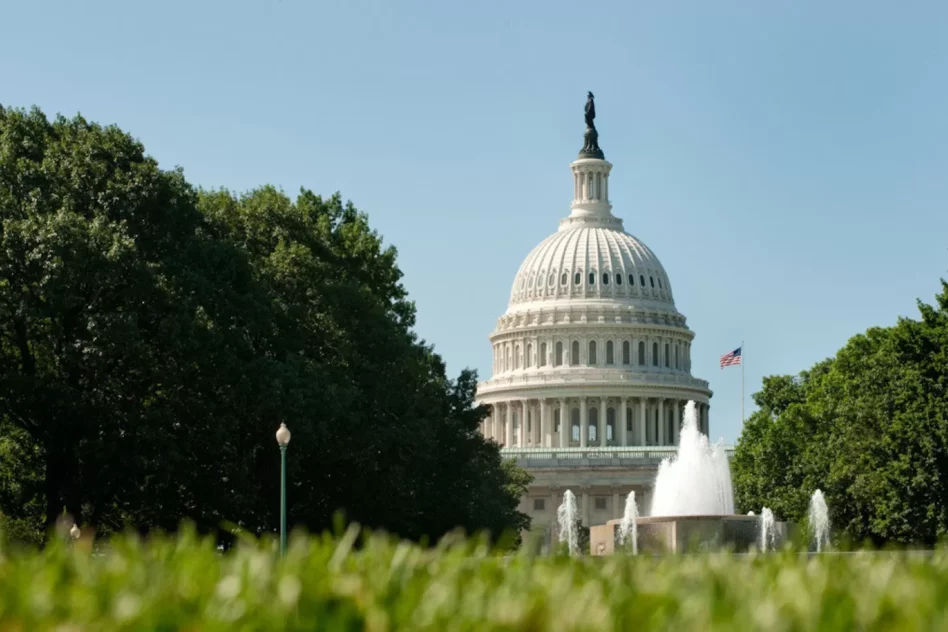
Congress is considering the NDAA this week, and—as always—lawmakers will try to use the annual defense authorization bill as a vehicle for their priorities, given the NDAA is one of the only must-pass pieces of legislation.
House lawmakers submitted 1,100+ amendments to the NDAA. The rules committee met yesterday to decide which ones will be considered on the floor this week. Here’s what’s in, and what’s out.
Up for debate: The House will consider the following space-related amendments, each getting 10 minutes of debate on the floor:
- An order for defense officials to consider whether commercial or state-run spaceports could be added to DoD’s launch infrastructure.
- A proposal that would require US Space Command to use satellites to track fentanyl trafficking, in partnership with the Department of Homeland Security and the Drug Enforcement Administration.
- A call for a report on activities in the upper atmosphere and near-space environment, including intel missions by other nations.
Left out: Several proposed amendments, however, didn’t make the cut to be debated on the floor, including:
- An amendment from four Virginia Democrats to prevent the Space Shuttle Discovery—now based at the Smithsonian National Air and Space Museum branch nearby DC—from being transferred to Texas.
- The addition of the ORBITS Act, which directs the government to clean up debris in space. The bill has unanimously passed the Senate multiple times.
- A proposal calling for an independent study concerning which national security space missions should fall under the Space Force.
- An amendment to review the plan to modernize GPS.
- A statement of support for cooperation between the US and Israel in orbit, on civil and national security priorities.
- The establishment of a program under which the Space Force’s chief of space operations can award $2.5B in direct loans, to support companies using GEO sats for collecting continuous Earth imagery.
- An amendment that would direct NASA to stand up a research center for cislunar and interplanetary missions.
White House Requests $18.8B FY27 Budget for NASA
The budget proposal includes the same top line as the administration’s fiscal 2026 request, and would make similar cuts to NASA’s science and STEM missions.

Insurance is Commercial Space Nuclear’s Biggest Headache
Lots of challenges face commercial space nuclear missions—but experts at an industry seminar on Thursday only called one a “show stopper”—insurance.
Top Space Lawmaker on Moon Base, Artemis Plans
“What I have heard from colleagues is they’re really rallying behind the idea of going to the Moon,” he told Payload. “Once we establish a base there…that might be the best place to launch to Mars.”

Jared Isaacman Hits 100 Days In Office With a Bang
NASA Administrator Jared Isaacman has one message: Get in, we’re going to the Moon.


British space-based infrared mapping startup SatVu has partnered with Japan industrial company IHI Corporation to develop a high-res thermal infrared satellite constellation.
The two companies are expected to sign an MOU at the DSEI UK defense conference in London on Wednesday. The goal is to “define requirements” for a sovereign constellation that would enhance Japan’s national security and “explore optimal business structures for building and operating the constellation in Japan,” the companies said in a statement.
“It’s an early but vital step—making sure the capability is designed in a way that delivers maximum value to Japan, while also strengthening UK–Japan cooperation in space,” SatVu CEO Anthony Baker told Payload.
Keep reading