


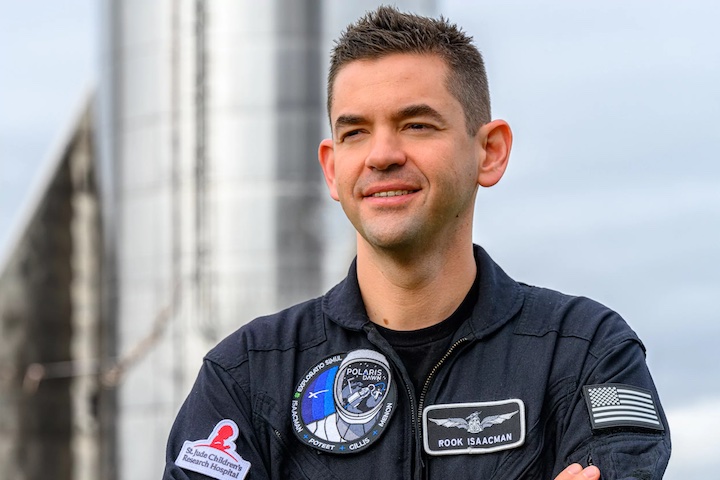
NASA is starting off the year hot, with a positive budget proposal—as well as a permanent administrator at the helm, after nearly a year of interim leadership.
Budget bonanza: On Monday, the House Appropriations Committee released a “minibus” bill that includes $24.4B for the space agency in fiscal 2026. While it’s a slight decrease from the $24.9B NASA got the two prior fiscal years, the bill contains a substantial increase over the $18.8B proposed by the Trump administration.
Within the allocation, the bill would appropriate $7.3B to NASA’s science missions—a clear rebuke of the White House’s proposal to gut the space agency’s science portfolio. That’s nearly double the $3.9B request from the Trump administration, and nearly flat with the fiscal 2025 enacted budget.
What’s next: It’s important to note that these numbers are not law…at least not yet. Both chambers of Congress still need to pass the bill before the continuing resolution runs out on Jan. 30, to avoid another government shutdown.
New hire: Meanwhile, Jared Isaacman is hitting the ground running after being sworn in as NASA chief on Dec. 18.
- The billionaire-turned-SpaceX astronaut announced a plan on Monday to modernize the space agency’s infrastructure, starting with the demolition of two test structures at Marshall Space Flight Center in Huntsville, AL beginning on Saturday. The removal of aging infrastructure is intended to make way for new tech, Isaacman said in a statement.
- Isaacman has also found himself playing referee between states over who gets to keep Space Shuttle Discovery. If budget restrictions and worries about damage to the vehicle do not allow the spacecraft to relocate from the Smithsonian outside DC to Houston, Isaacman offered an enticing consolation prize to Texas—a capsule that will make a trip around the Moon on a future Artemis mission, as soon as with the Artemis II crewed mission that lifts off this year.
Of course, Isaacman has a lot more than demolition and parochial battles on his plate. The NASA chief’s top priorities will be overseeing the US return to the Moon, the agency’s relationship with the commercial sector, and the long-term push to send humans to Mars.
Commercial Space Law Takes Center Stage at DC Moot Court
Future space lawyers will gather in DC this month to debate how far federal jurisdiction extends in regulating commercial megaconstellations.
Senate Tees Up NASA Reauthorization, Deputy Hearings
The Senate Commerce, Science, and Transportation Committee is gearing up for a busy week.
Bill Spotlight: Methane Monitoring Science Act
Two lawmakers introduced a bill that would task NASA to improve the nation’s ability to detect cow farts—and all other forms of methane leaks.

Rep. Mike Haridopolos On Cutting Red Tape, Passing NASA Bill
“We don’t have the budgetary ability to do everything and now—unlike 10 years ago—there is a business case to be made.”

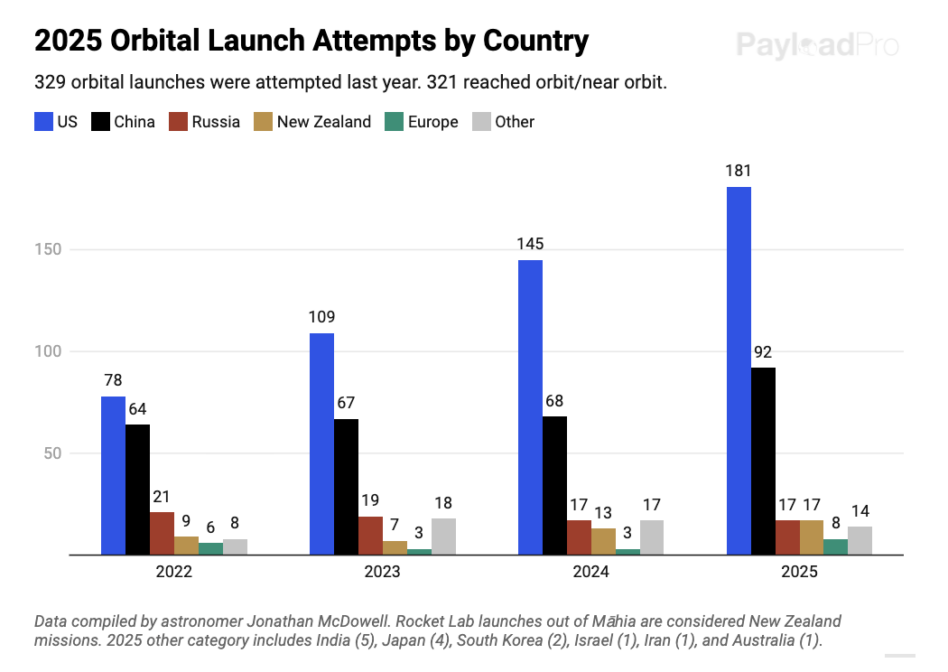
2025 was yet another banner year for launch. Around the world, rockets attempted to lift off 329 times—with 321 of these attempts reaching orbit or near orbit—according to data compiled by astronomer Jonathan McDowell.
US (SpaceX): The data follows similar trends in years past where SpaceX accounted for the vast majority of US launches. The company also blew past the number of attempts made by entire nations—including nearly doubling the number from China in the same time period.
Over the course of the year, US launchers attempted to reach orbit 181 times, and hit (or very nearly missed) the mark in 179 of those attempts. US launch providers included:
Keep reading