


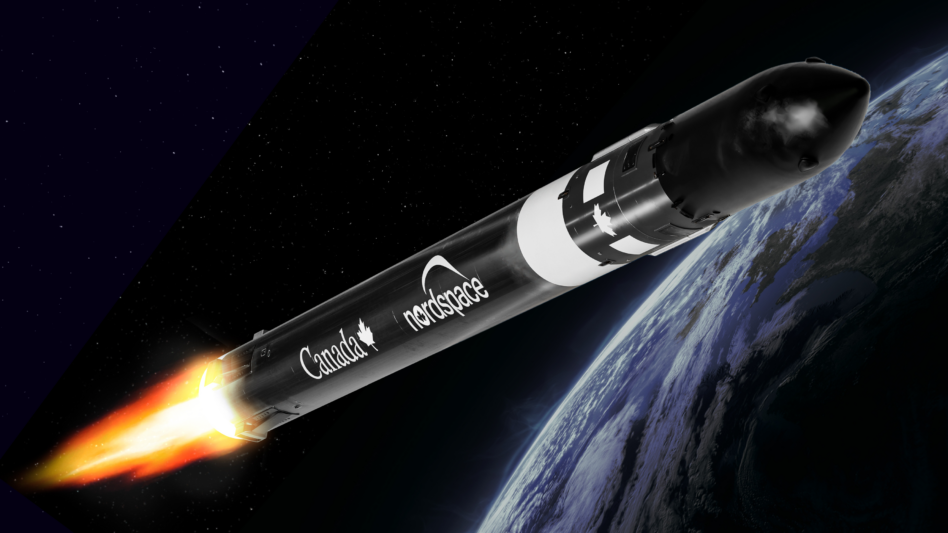
The Canadian space program is growing at a hypersonic pace.
NordSpace, the Ontario-based space tech startup, is establishing the Supersonic and Hypersonic Applications Research Platform (SHARP), which aims to grow the country’s hypersonic capabilities with three new products.
- SHARP Arrow: A fixed-wing, rocket-powered, uncrewed aircraft built for research, reconnaissance, and intercept missions, capable of launching from and landing on a standard airport runway.
- SHARP Sabre: A modified version of the company’s suborbital Taiga rocket, which held a successful rocket engine test in January, updated to reach hypersonic speeds with larger payloads on board.
- M2S-HyRock: A 3D-printed, multi-fuel, multi-purpose liquid regeneratively cooled rocket engine, built to provide the industry with a storable rocket engine.
“There’s been a lot more interest in national sovereignty and understanding what our own capabilities are here, so that we’re more resilient at home, but also, in NordSpace’s opinion, more capable allies to partners like the United States,” Rahul Goel, NordSpace’s CEO, told Payload.
North, strong, and free: The announcement comes at an uncertain moment in Canadian foreign and defense policy. President Donald Trump has spent his first two months in office calling the nation America’s 51st state and pushing publicly to annex the country, while climate change has opened up the Arctic region to more commercial and military traffic.
The result is that Canada is increasingly focused on building up its sovereign defense capabilities to monitor and defend its northern front.
In February, Canada announced a new defense policy, which committed the country to invest 2% of its GDP into national security by 2032. Canadian defense spending is expected to grow by C$73B ($51.1B) over 20 years, including a C$8.1B ($5.67B) increase in the next five years alone.
SHARP will help Canada develop and test next-generation hypersonic tech, build out its fleet of monitoring aircraft, improve its responsive launch capabilities, and get better at detecting rocket and missile launches from above.
“[It’s] really important to get eyes in the sky as quickly as possible, especially in our Arctic, which is almost entirely undefended relative to other parts of the nation. So, a key element of all our hardware, especially these two vehicles, is that they’re being optimized for extreme cold weather environments like the Arctic,” Goel said.
What’s next: NordSpace is building Canada’s first commercial spaceport—Spaceport Canada—which is expected to be operational for the company’s first test launch of its Taiga suborbital rocket this year. At the same time, NordSpace is working on a larger orbital vehicle, named Tundra, which it hopes to demonstrate with a flight test in 2027.
Spaceport Canada will have two launch pads, one each for suborbital and orbital launches. While the company plans to use the spaceport for its own rocket tests and flights, it’s also hopeful that it will attract foreign launchers to the great white north.
“We’re very excited and steadfast in our approach and desire to work closely with the United States. This moment will pass, but I can say it’s a good opportunity for us as Canadians to take off the training wheels a little bit and be more capable allies,” Goel said.
Transporter-16 Sends 119 Payloads to Orbit
The latest cargo train to orbit has left the station.
With Artemis Changes, Europe is Left Holding the Bag
ESA and European space primes were developing many of the key components of the planned lunar orbiting station.
One-On-One With SDA’s GP Sandhoo
It’s been about six months since the SDA launched its first operational tranche of satellites—but troops still aren’t benefiting from the better comms tech because of a series of small issues that forced the agency to take a “strategic pause,” SDA Acting Director Gurpartap “GP” Sandhoo told Payload.
Ramon.Space, Ingrasys Aim To Fly Prototype Orbital Data Center In 2027
There’s another entry in the space-data-center race.


Firefly’s successful Moon landing has caught the interest of space startups looking to build their businesses on the lunar surface, CEO Jason Kim said Tuesday.
“People have business models and revenues they need to generate,” Kim said, adding that he’s been getting “a lot of inquiries” from potential commercial customers after Blue Ghost’s flight. “They can depend on Firefly to take a pragmatic approach and stick the landing and get multiple days of surface operations.”
Blue Ghost’s first flight was funded by NASA’s Commercial Lunar Payload Services, or CLPS, program, but companies are already talking about heading to the Moon for everything from lunar mining to building power grids. Those industries could allow Firefly to ramp up its mission cadence to multiple lunar flights every year, Kim predicted.
Keep reading