


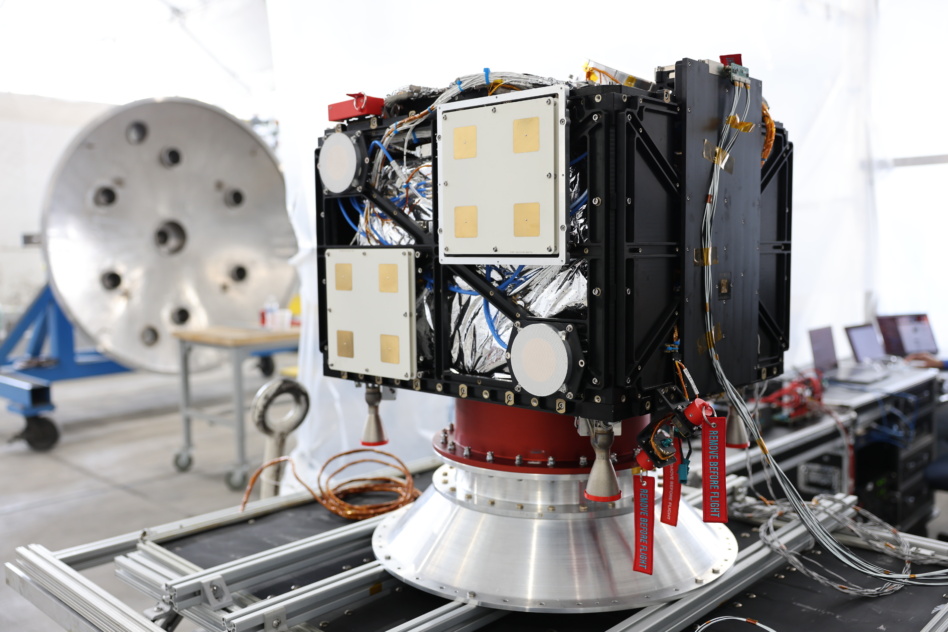
NASA said it intends to launch monthly uncrewed missions to the Moon starting next year. That’s good news for more than just Moon-focused companies.
The space agency established the Commercial Lunar Payload Services (CLPS) program to invest in private rides to the Moon, and to help spark a lunar economy. But regular commercial flights to deep space, subsidized by NASA, have helped other companies tackle ambitious missions at a lower price point.
Asteroid hunting: Astroforge CEO Matt Gialich said his business case to mine asteroids wouldn’t be possible without CLPS.
- The company’s first deep-space mission cost $3.5M—which doesn’t allow Astroforge to purchase a dedicated ride, especially when most commercial launch opportunities today focus between LEO and GEO.
- Astroforge’s spacecraft also can’t hitch a ride with NASA missions—regulations prevent commercial payloads from riding on government launches. That leaves CLPS as the only cost-effective option for the startup.
Business case: Gialich said a Falcon 9 translunar injection mission would cost in the range of $80M.
- It makes no sense, he said, to use such an expensive rocket to fly spacecraft that only cost a couple million dollars each.
- Buying the whole rocket would give AstroForge more space than it needed. In that case, Gialich said the company would likely build to fit the space—and end up with a much more expensive, much larger spacecraft catching a very expensive flight.
“What this actually means is that the CapEx required for me to go see if this is possible just exploded by, probably, an order of two of magnitude,” Gialich told Payload. “With that $80M spaceship and an $80M rocket purchase, I’m at $160M before I even try it.”
Destination unknown: However, a rideshare comes with unique challenges. Not being the prime customer means Astroforge is at the whim of someone else’s launch date, and mission profile. The company has therefore built a unique system to game-plan every potential asteroid destination, enabling it to quickly pivot if launch slips a day.
“We have to be target-agnostic,” Gialich said. “The way scientists win NASA missions is they say, ‘Hey, we found this really cool asteroid…We want to plan a mission.’ We do it the other way around. We think there are quite a bit of asteroids that meet our criteria.”
Catch a ride: Astrobotic was supposed to fly the VIPER spacecraft on its CLPS mission. But when the mission’s initial iteration was canceled, NASA’s loss became someone else’s gain.
“We got 60 responses for folks who wanted to fly,” Astrobotic CEO John Thornton told Payload. “Without NASA largely driving these missions, I don’t think we’re at the point where commercial could fund its own mission.”
Astrolab’s FLIP lunar rover got the open space, buying the opportunity to earn flight heritage for some of its systems ahead of NASA’s lunar terrain vehicle award. The company also has OIP Sensor Systems’ LandCam-X camera flying on that mission, on behalf of ESA—evidence that CLPS is also good for helping international space agencies have a Moon program without the upfront cost, Thornton said.
Supply and demand: Intuitive Machines CTO Tim Crain said the company is having to turn away people looking to hitch a ride to the Moon, proving the need for both more frequent flights and for larger landers.
“18 months before launch, we have [a] flurry of payloads that want on, but we’re out of space,” he said. “We’ve probably turned away over half a mission’s worth of payloads, because our timing and their timing didn’t quite line up.”
What’s next: Once the landers are through development, Thornton predicted the cost of lunar missions will come down, opening new business opportunities on the commercial (but NASA-backed) flights.
“It’s as simple as having people pay $50 to drive a rover on the Moon…or real time streaming cameras,” he said. “People like bird cameras on Earth. I could see them watching the Moon base.”
BlackSky Renews HEO Deal, Adds Gen-3 Imagery for Space Domain Awareness
BlackSky Technology inked a seven-figure deal to extend its partnership with Australian non-Earth imaging (NEI) provider HEO for another year.
Nebex Partners with Thrusters Unlimited to Unlock $700M for LATAM Space Ecosystems
The capital will fund EO, telecoms and other strategic capabilities, according to Nebex.
Exclusive: Meridian Space Spins Out from SpinLaunch
“Meridian will carry forward the satcom infrastructure business… SpinLaunch will continue to build on its vision for a lower-cost approach to launch, with further applications in hypersonics to support the Golden Dome program and in the lunar economy,” Meridian Space CEO Massimiliano Ladovaz told Payload.
Rocket Lab CFO Adam Spice Predicts More M&A Deals on the Horizon
Iridium shareholders voted overwhelmingly to approve the company’s acquisition by Rocket Lab. According to Rocket Lab CFO Adam Spice, there’s more M&A on the horizon.


This content is restricted to subscribers
The post The Terrestrial Bottlenecks Pushing Compute to Space appeared first on Payload Pro.
Keep reading