



Seraphim Space today announced the first meeting of its new global space futures advisory council, to assist with steering investment priorities as space becomes commercially relevant and politically significant.
Seraphim tracked $12.4B in global space investment in 2025—a dozen times more than in 2015. But the shift goes beyond the numbers—global perception of space is changing as the domain becomes more critical for national security and commercial infrastructure, officials wrote.
What this means: Seraphim will work with the council to “inform our long-term strategy as the sector becomes increasingly commercial, multipolar, and geopolitically consequential,” Rob Desborough, Seraphim general partner and council member, said in a statement.
The council will look at the most complex challenges plaguing the industry—from sustainability, to regulatory hurdles, to national security, to working across national borders, Candace Johnson, council chair and cofounder of SES, said in the same statement.
Big questions: Board members will wrestle with political and philosophical questions, including:
- “The next 10 years of space and SpaceTech investment” (tackled during the first meeting, at Space Symposium);
- What’s next for the fast-growing space industry in terms of regulation, cooperation, and sustainability;
- Space infrastructure’s role in “national security and energy resilience”;
- Using sat data for comms, AI, and climate monitoring;
- Creating a “multipolar space economy.”
From ISS to SES: The initial six members of the council—which is expected to grow to 10 members—were appointed to two year terms.
Seeing double: Seraphim wasn’t the only one launching a new advisory council during the symposium. On Wednesday, the Space Information Sharing and Analysis Center (Space ISAC) also established the Space Governance Working Group (SGWG), which will consider policy and legal challenges facing the industry.

Congress Seeks Answers On Starlink Disruptions in Ukraine
“The United States government has a fundamental obligation to protect American personnel serving overseas,” the senators wrote. “The possibility that American personnel were endangered by preventable disruptions, inadequate coordination, or decisions made by their own government demands immediate scrutiny and accountability.”
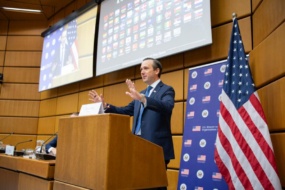
State Department Taps Trio for $5M Space Diplomacy Push
At last week’s second annual US Space Forum, the US Mission to the International Organizations in Vienna launched Project Constellation, a $5M effort to build international space partnerships.
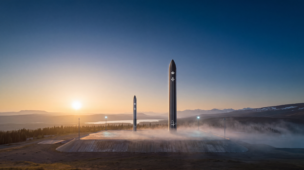
Reaction Dynamics Targets 2031 for Borealis Medium-Lift Launch
In the contest to build up commercial launch capabilities in Canada, Quebec-based startup Reaction Dynamics has entered a new weight class.
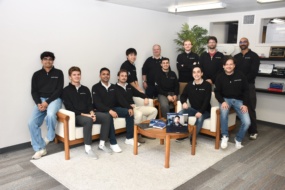
Exclusive: EraDrive Lands $13M DoD Award For Autonomy Module
EraDrive won a $13M DoD award, under which the Space Force will buy an undisclosed number of the company’s Era-Node vision-based autonomy modules.

Global X is betting investors want more space joy in their portfolios.
The thematic fund provider today announced the Global X Space Tech ETF, a passively managed fund trading under the symbol $ORBX.
The goal is to track companies that earn more than half of their revenue from space tech—everything from transportation, to space software, to satellite-enabled data services. New entrants will be brought in up to four times a year.
Keep reading