


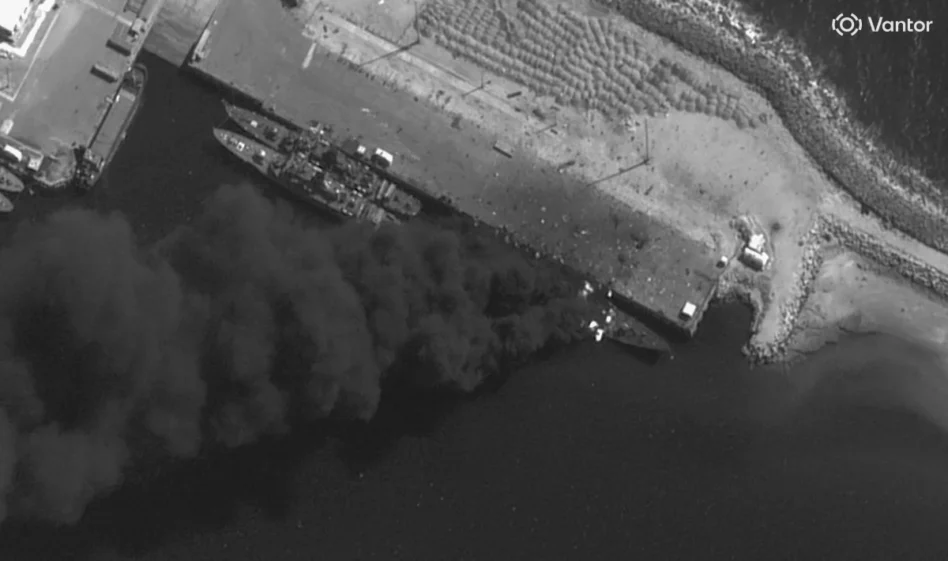
Military space capabilities played a critical role in the early stages of Operation Epic Fury, according to the Pentagon’s top general.
Chairman of the Joint Chiefs Gen. Dan Caine said Monday that US Space Command used “non-kinetic effects” to disrupt Iran’s infrastructure in space, hindering their ability to operate in the first hours of the conflict, which began on Feb. 28.
“The first movers were USCYBERCOM and USSPACECOM,” Caine said at a press conference. “Coordinated space and cyber operations effectively disrupted communications and sensor networks across the area of responsibility, leaving the adversary without the ability to see, coordinate, or respond effectively.”
The bottom line: The remarks prove that space is no longer a nice-to-have capability in conflict, as everything from comms to intel collection to navigation can be disabled if adversaries target space assets. While this isn’t the first military conflict to extend to (or begin) in space, it is a real-world demonstration showing why maintaining eyes in orbit during conflict is critical to military success.
Birds eye: While Iran may have been blinded in orbit, commercial space assets are giving the public a view of the conflict from the ultimate high ground. Imagery from companies, including Vantor and Planet Labs, has shown the result of the US and Israeli strikes.
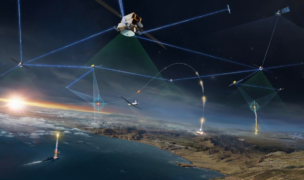
One-On-One With SDA’s GP Sandhoo
It’s been about six months since the SDA launched its first operational tranche of satellites—but troops still aren’t benefiting from the better comms tech because of a series of small issues that forced the agency to take a “strategic pause,” SDA Acting Director Gurpartap “GP” Sandhoo told Payload.
Leonardo’s Missile-Defense Demo in Ukraine Aims To Be a Blueprint for Other Nations
Leonardo is positioning itself to become a mass distributor of space-enabled missile defense shields.

A Recap of Payload’s Space Stage
Two days. Nine panels. Two dozen speakers—and that’s just the space content.

Q&A With Laurent Jaffart, ESA’s Director of Resilience, Navigation and Connectivity
Jaffart is leading the charge to build up ESA’s defensive posture. Payload chatted with him to hear his plans for the new role.


Starpath Space launched a new line of space solar panels today—called Starlight Air—which claim to be far lighter than anything else on the market.
The panels are just 73g per square meter, and are priced around $15 per watt.
“Starlight Air enables satellite designs that are virtually unbounded by the constraints of power,” Starpath CEO Saurav Shroff told Payload. “The approach behind designing it was: Let’s design right up against the limit of physics, so that we know that the product we’ve made is definitely the best possible product,”
Keep reading