


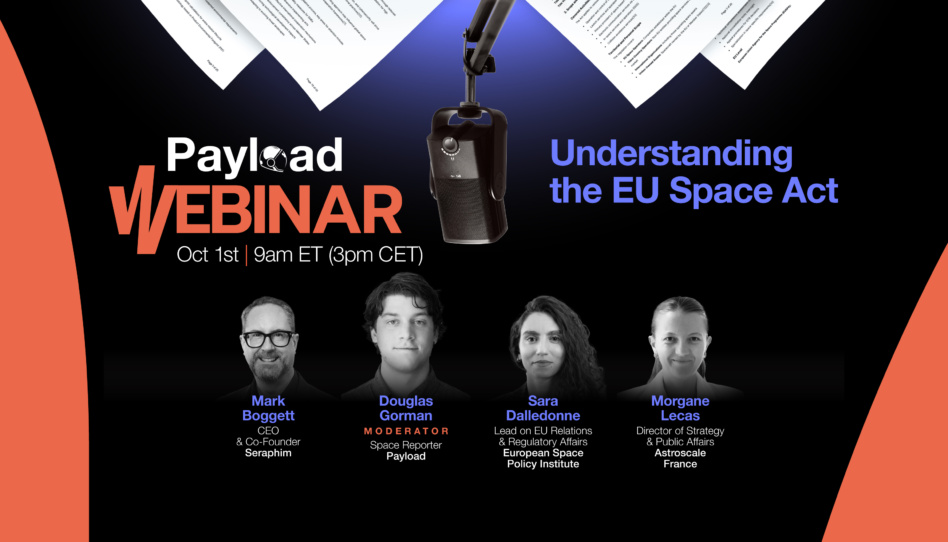
ICYMI: This week, Payload Europe hosted its first ever webinar—all about the EU Space Act.
We were joined by Sara Dalledonne, lead on EU relations and regulatory affairs for the European Space Policy Institute; Mark Boggett, cofounder and CEO of the UK VC fund Seraphim; and Morgane Lecas, director of strategy and public affairs for Astroscale France.
Initially billed as a webinar to help listeners understand the draft regulation, the event instead turned up a lot of great questions still being debated about what the act could mean for the future of the EU and global space industry.
Where it stands: The first draft of the EU Space Act was released by the European Commission in June. Its explicit aim was to reduce the administrative burdens on space businesses operating in the EU, but as the webinar progressed it became clear that—in its current form—the act could have the opposite effect.
The act will spend the next few months in its public review and drafting process, and even after it reaches its final form, it could take years to fully implement. The panelists on our webinar shared many of the concerns they’ve been hearing in the European market about the current version of the act.
Not like this: Altogether the panelists shared the view that while regulation is welcomed, the act runs the risk of slowing industry growth through over-regulation, and unclear regulatory borders.
“I have canvassed some of our 150 portfolio companies to really try and get opinions,” said Boggett. “[And] the feedback is almost uniformly negative, I’m afraid to report… Most of the concerns really relate to compliance overload and additional costs that are going to be incurred as overhead in aligning with this.”
In the draft EU Space Act, there are regulations imposing additional fees on space businesses, including satellite constellation operators and launch companies. These fees add additional cost, placing a heavier burden on newer companies in particular, Boggett said.
Rules for thee: The act has also created a lot of uncertainty concerning its interaction with existing laws impacting space companies in Europe and internationally, according to Dalledonne.
“This type of heavy burden could also potentially drive to some type of forum shopping,” Dalledonne said. “Operators will start looking into establishing themselves and seek[ing] authorization…in other countries less stringent or more favorable.”
Dalledonne explained that in the EU, 13 countries have regulations covering the space industry. Whether the EU Space Act will supersede these laws, or create additional regulatory barriers for companies in those nations, is not well understood by space lawyers, and should be better defined before the act becomes law.
Ultimately, the pros and cons of the EU Space Act lie in the same fact: It’s an incredibly robust document. The panelists on our webinar applauded the effort, but maintained that shooting for a smaller target could be the better path forward. European space businesses will benefit from clearly defined rules of the road, but officials worried that regulating every aspect of the budding industry could effectively stymie the rate of growth.

Jared Isaacman Hits 100 Days In Office With a Bang
NASA Administrator Jared Isaacman has one message: Get in, we’re going to the Moon.
With Artemis Changes, Europe is Left Holding the Bag
ESA and European space primes were developing many of the key components of the planned lunar orbiting station.
Arkadia Space Secures €14.5M to Develop New Biprop Engine
Spanish propulsion startup Arkadia Space just secured a stamp of approval from the European Investment Council.
PAVE Space Raises $40M for In-Space Propulsion Tech
PAVE’s propulsion systems rely on a storable rocket bipropellant, which aims to make launch operations simpler and more cost-effective, compared with cryogenic fuels.
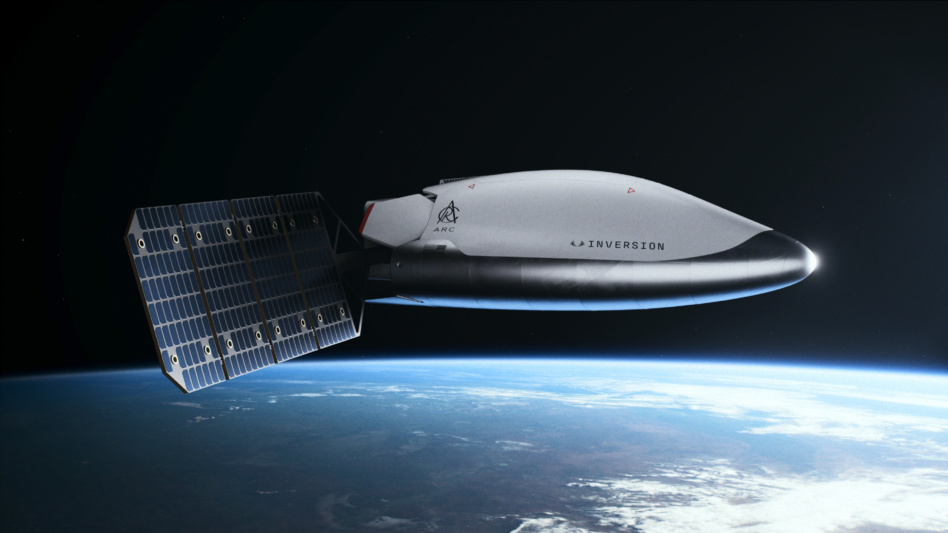
The quickest delivery service isn’t coming via drone from an Amazon fulfilment center—it’s coming from space.
Inversion Space, the California reentry startup, unveiled its flagship vehicle—called Arc—yesterday in preparation for the spacecraft’s first orbital flight next year.
Arc is intended to improve upon its predecessor, Ray, the company’s subscale demo vehicle that flew in January on SpaceX’s Transporter-12 launch. Ray demonstrated a bunch of key tech on that mission, but failed to reenter the atmosphere as planned after suffering a short circuit in a component “preventing our deorbit engine from igniting,” the company previously wrote in a mission update.
Keep reading