


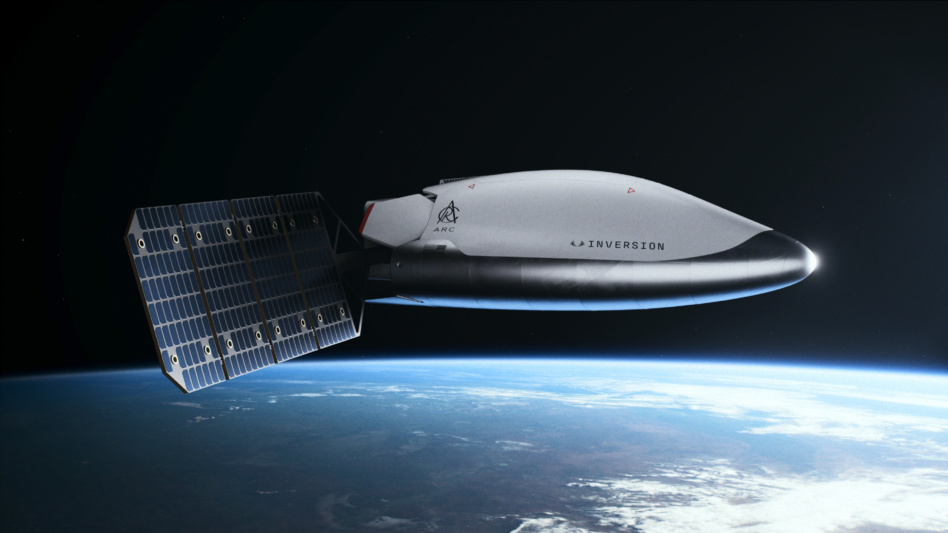
The quickest delivery service isn’t coming via drone from an Amazon fulfilment center—it’s coming from space.
Inversion Space, the California reentry startup, unveiled its flagship vehicle—called Arc—yesterday in preparation for the spacecraft’s first orbital flight next year.
Arc is intended to improve upon its predecessor, Ray, the company’s subscale demo vehicle that flew in January on SpaceX’s Transporter-12 launch. Ray demonstrated a bunch of key tech on that mission, but failed to reenter the atmosphere as planned after suffering a short circuit in a component “preventing our deorbit engine from igniting,” the company previously wrote in a mission update.
Measuring cubits: Compared to Ray, and the increasing pool of reentry vehicles being developed by startups around the world, Arc is unique in its design and capabilities.
“It’s not a space capsule, it’s not a space plane, it is in between—a lifting body reentry vehicle,” Inversion CEO Justin Fiaschetti told Payload.
Arc is built to hold and store about 500 lbs of payload in orbit for up to five years. It’s fully reusable and built to withstand speeds over Mach 20. Equipped with control flaps, ACS thrusters, a deorbit engine, and an autonomously maneuverable parachute, it can cover a total reentry range of over 1,000 km and land on a target within 50 feet.
These characteristics make the space craft an ideal fit for hypersonic testing payloads, as well as for defense missions, company officials say.
Anytime, anyplace: Inversion’s vision is to deploy constellations of Arcs in-orbit to ensure that allied militaries can access critical cargo at a moment’s notice—even in denied environments. The goal is to create multiple global delivery networks that can reach anywhere on the planet in under an hour.
“The long-term vision for the company is that space becomes a new mode of transportation,” Fiaschetti said. “We’re fully focused on defense right now…When we think about what we’re going to be carrying, it’s that high-value, high time-sensitivity, cargo or effect that lets a mission happen.”
What’s next: The first Arc is scheduled to fly to space next year, with individual missions set to continue after, Fiaschetti said. Longer term, Inversion is aiming to build hundreds of Arcs per year—something that will be needed for an operational constellation, which is expected to be up and running by 2028.

Fortastra Raises $30M Series A to Fund its Next Security Spacecraft
The US military has weapons in space, and—with the orbital arsenal expanding—security is becoming a top priority.
Exclusive: Xona Ramps Up Production Ahead of Pulsar Launch
With FCC approval in hand and six sats ready for the pad, Xona is turning to its next challenge: building the next 250.
ArbaLabs Launches AI Verification Demo On South Korea’s Nuri Rocket
“In short, tons of companies are looking at the latest and greatest physical AI deployments,” ArbaLabs CEO Ashley Reeves told Payload. “Nobody is really thinking about putting some checks and balances on what these AI models are doing.”
HawkEye 360 Turns its RF-Sensors to Orbital Targets
The DoD wants to better understand what’s going on in orbit. HawkEye 360 ($HAWK) has the inside scoop.

The UK wants to build a vibrant sovereign space industry, but it knows it can’t do it alone.
This week, the UK Space Agency (UKSA) announced it will invest a total of £6.5M ($8.8M) to support 23 partnerships between UK and international space organizations as part of the second round of awards from the space agency’s International Bilateral Fund (IBF). It includes partnerships with organizations in Australia, Canada, France, Germany, India, Japan, Lithuania, and the US.
Telegraphing wins: Two UK startups—Lodestar and Lúnasa—received two awards each, showing that defense and in-space satellite servicing capabilities are at the forefront of the UK’s long-term vision for its space sector.
Keep reading